第6章学習
6.2 Classical Conditioning6.2 古典的条件づけ
Learning Objectives学習目標
By the end of this section, you will be able to:
この節を学び終えると、次のことができるようになる。
- Explain how classical conditioning occurs古典的条件づけがどのように起こるかを説明する
- Summarize the processes of acquisition, extinction, spontaneous recovery, generalization, and discrimination獲得、消去、自発的回復、般化、弁別の過程を要約する
Does the name Ivan Pavlov ring a bell? Even if you are new to the study of psychology, chances are that you have heard of Pavlov and his famous dogs.
英語のヒント
イワン・パヴロフという名前にピンとくるだろうか。心理学を学びはじめたばかりの人でも、パヴロフと彼の有名な犬たちの話は、おそらく耳にしたことがあるだろう。
Pavlov (1849–1936), a Russian scientist, performed extensive research on dogs and is best known for his experiments in classical conditioning (Figure 6.3). As we discussed briefly in the previous section, classical conditioning is a process by which we learn to associate stimuli and, consequently, to anticipate events.
英語のヒント
ロシアの科学者パヴロフ(1849〜1936)は、犬を使って幅広い研究を行い、古典的条件づけの実験で最もよく知られている(図6.3)。前の節で簡単に述べたように、古典的条件づけとは、私たちが刺激どうしを結びつけることを学び、その結果として出来事を予期するようになる過程である。
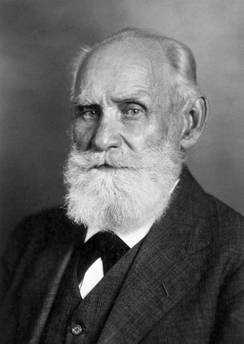
Figure 6.3図 6.3
Ivan Pavlov’s research on the digestive system of dogs unexpectedly led to his discovery of the learning process now known as classical conditioning.
犬の消化器系についてのイワン・パヴロフの研究は、思いがけず、現在では古典的条件づけとして知られる学習過程の発見につながった。
Pavlov came to his conclusions about how learning occurs completely by accident. Pavlov was a physiologist, not a psychologist. Physiologists study the life processes of organisms, from the molecular level to the level of cells, organ systems, and entire organisms. Pavlov’s area of interest was the digestive system (Hunt, 2007). In his studies with dogs, Pavlov measured the amount of saliva produced in response to various foods. Over time, Pavlov (1927) observed that the dogs began to salivate not only at the taste of food, but also at the sight of food, at the sight of an empty food bowl, and even at the sound of the laboratory assistants' footsteps. Salivating to food in the mouth is reflexive, so no learning is involved. However, dogs don’t naturally salivate at the sight of an empty bowl or the sound of footsteps.
英語のヒント
学習がどのように起こるのかについてのパヴロフの結論は、まったくの偶然から得られたものだった。パヴロフは心理学者ではなく、生理学者だった。生理学者は、分子のレベルから、細胞、器官系、生物個体全体のレベルまで、生物の生命過程を研究する。パヴロフの関心領域は消化器系だった(Hunt, 2007)。犬を使った研究で、パヴロフは、さまざまな食物に反応して分泌される唾液の量を測定した。やがてパヴロフ(1927)は、犬が食物の味だけでなく、食物を見たとき、空の餌入れを見たとき、さらには実験助手の足音を聞いたときにも唾液を分泌しはじめることを観察した。口の中の食物に対して唾液を分泌するのは反射であり、学習はかかわっていない。しかし、犬は本来、空の餌入れを見ても足音を聞いても唾液を分泌しない。
These unusual responses intrigued Pavlov, and he wondered what accounted for what he called the dogs' “psychic secretions” (Pavlov, 1927). To explore this phenomenon in an objective manner, Pavlov designed a series of carefully controlled experiments to see which stimuli would cause the dogs to salivate. He was able to train the dogs to salivate in response to stimuli that clearly had nothing to do with food, such as the sound of a bell, a light, and a touch on the leg. Through his experiments, Pavlov realized that an organism has two types of responses to its environment: (1) unconditioned (unlearned) responses, or reflexes, and (2) conditioned (learned) responses.
英語のヒント
こうした普通ではない反応に興味を引かれたパヴロフは、自ら犬の「精神的分泌」と呼んだものが何によって生じるのかを考えた(Pavlov, 1927)。この現象を客観的な方法で探究するために、パヴロフは、どの刺激が犬に唾液を分泌させるのかを調べる、注意深く統制された一連の実験を計画した。パヴロフは、ベルの音、光、脚に触れることなど、明らかに食物とは何の関係もない刺激に反応して唾液を分泌するように、犬を訓練できた。一連の実験を通して、パヴロフは、生物が環境に対して示す反応には二つの種類があることに気づいた。(1)無条件の(学習されていない)反応、すなわち反射と、(2)条件づけられた(学習された)反応である。
In Pavlov’s experiments, the dogs salivated each time meat powder was presented to them. The meat powder in this situation was an unconditioned stimulus (UCS): a stimulus that elicits a reflexive response in an organism. The dogs’ salivation was an unconditioned response (UCR): a natural (unlearned) reaction to a given stimulus. Before conditioning, think of the dogs’ stimulus and response like this:
英語のヒント
パヴロフの実験では、犬は肉粉を提示されるたびに唾液を分泌した。この状況での肉粉は無条件刺激(UCS)、すなわち生物に反射的な反応を引き起こす刺激だった。犬の唾液分泌は無条件反応(UCR)、すなわちある刺激に対する自然な(学習されていない)反応だった。条件づけの前の、犬にとっての刺激と反応は、次のように考えるとよい。
(6.1)
In classical conditioning, a neutral stimulus is presented immediately before an unconditioned stimulus. Pavlov would sound a tone (like ringing a bell) and then give the dogs the meat powder (Figure 6.4). The tone was the neutral stimulus (NS), which is a stimulus that does not naturally elicit a response. Prior to conditioning, the dogs did not salivate when they just heard the tone because the tone had no association for the dogs.
英語のヒント
古典的条件づけでは、中性刺激が無条件刺激の直前に提示される。パヴロフは、(ベルを鳴らすように)音を鳴らしてから、犬に肉粉を与えるということを繰り返した(図6.4)。この音が中性刺激(NS)であり、中性刺激とは、本来は反応を引き起こさない刺激である。条件づけの前には、犬は音を聞いただけでは唾液を分泌しなかった。その音は、犬にとって何とも結びついていなかったからである。
(6.2)
When Pavlov paired the tone with the meat powder over and over again, the previously neutral stimulus (the tone) also began to elicit salivation from the dogs. Thus, the neutral stimulus became the conditioned stimulus (CS), which is a stimulus that elicits a response after repeatedly being paired with an unconditioned stimulus. Eventually, the dogs began to salivate to the tone alone, just as they previously had salivated at the sound of the assistants’ footsteps. The behavior caused by the conditioned stimulus is called the conditioned response (CR). In the case of Pavlov’s dogs, they had learned to associate the tone (CS) with being fed, and they began to salivate (CR) in anticipation of food.
英語のヒント
パヴロフが音と肉粉を何度も繰り返し対にすると、以前は中性だった刺激(音)も、犬の唾液分泌を引き起こすようになった。こうして中性刺激は条件刺激(CS)になった。条件刺激とは、無条件刺激と繰り返し対にされた後に反応を引き起こす刺激である。やがて犬は、以前に助手の足音を聞いて唾液を分泌していたのと同じように、音だけに対して唾液を分泌しはじめた。条件刺激によって引き起こされる行動を、条件反応(CR)という。パヴロフの犬の場合、犬は音(CS)を餌を与えられることと結びつけるように学習しており、食物を予期して唾液を分泌しはじめた(CR)のである。
(6.3)
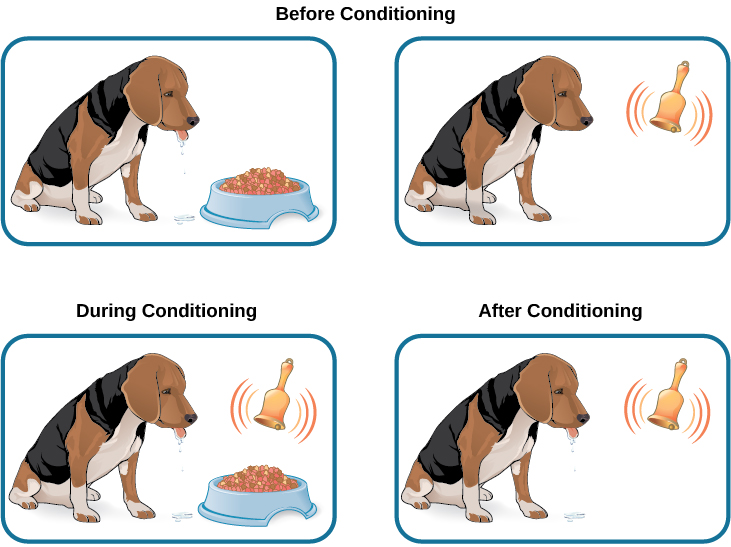


Figure 6.4図 6.4
Before conditioning, an unconditioned stimulus (food) produces an unconditioned response (salivation), and a neutral stimulus (bell) does not produce a response. During conditioning, the unconditioned stimulus (food) is presented repeatedly just after the presentation of the neutral stimulus (bell). After conditioning, the neutral stimulus alone produces a conditioned response (salivation), thus becoming a conditioned stimulus.
条件づけの前には、無条件刺激(食物)は無条件反応(唾液分泌)を引き起こし、中性刺激(ベル)は反応を引き起こさない。条件づけの間には、中性刺激(ベル)を提示した直後に、無条件刺激(食物)が繰り返し提示される。条件づけの後には、中性刺激だけで条件反応(唾液分泌)が引き起こされるようになり、こうして中性刺激は条件刺激になる。