第6章学習
Cognition and Latent Learning認知と潜在学習
Strict behaviorists like Watson and Skinner focused exclusively on studying behavior rather than cognition (such as thoughts and expectations). In fact, Skinner was such a staunch believer that cognition didn't matter that his ideas were considered radical behaviorism. Skinner considered the mind a "black box"—something completely unknowable—and, therefore, something not to be studied. However, another behaviorist, Edward C. Tolman, had a different opinion. Tolman’s experiments with rats demonstrated that organisms can learn even if they do not receive immediate reinforcement (Tolman & Honzik, 1930; Tolman, Ritchie, & Kalish, 1946). This finding was in conflict with the prevailing idea at the time that reinforcement must be immediate in order for learning to occur, thus suggesting a cognitive aspect to learning.
英語のヒント
ワトソンやスキナーのような厳格な行動主義者は、認知(思考や期待など)ではなく、行動を研究することだけに焦点を当てた。実際、スキナーは認知など重要ではないと固く信じていたので、その考えは徹底的行動主義とみなされた。スキナーは心を「ブラックボックス」、すなわちまったく知りえないもの、したがって研究すべきでないものとみなした。しかし、別の行動主義者であるエドワード・C・トールマンは、異なる意見を持っていた。トールマンのネズミを使った実験は、生物は即座に強化を受けなくても学習できることを示した(Tolman & Honzik, 1930; Tolman, Ritchie, & Kalish, 1946)。この発見は、学習が起こるためには強化が即座でなければならないという当時広く受け入れられていた考えと食い違っており、それによって学習には認知的な側面があることを示唆していた。
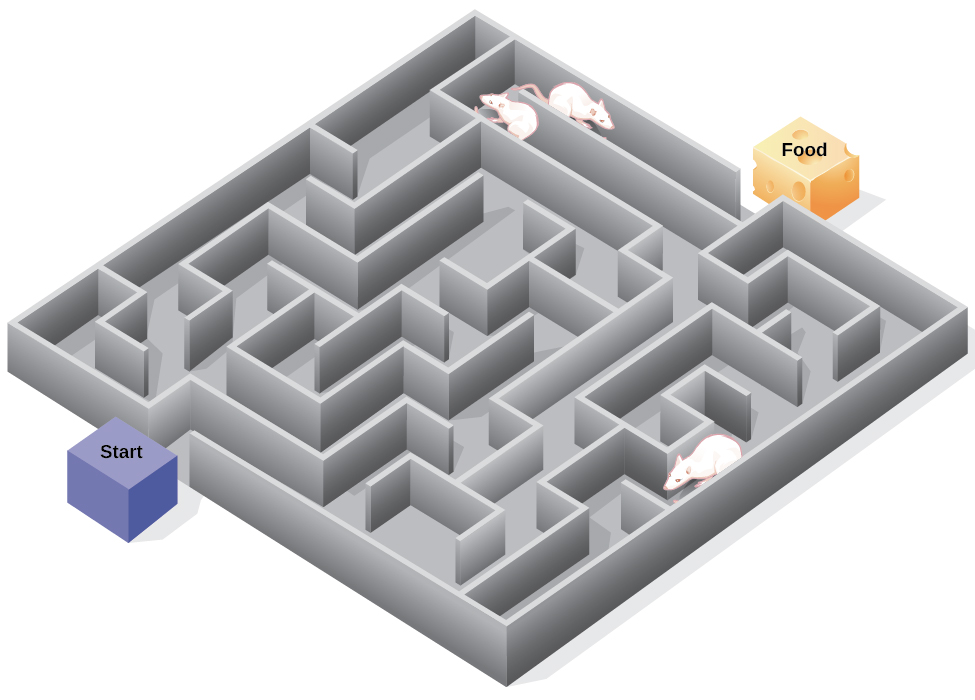
In the experiments, Tolman placed hungry rats in a maze with no reward for finding their way through it. He also studied a comparison group that was rewarded with food at the end of the maze. As the unreinforced rats explored the maze, they developed a cognitive map: a mental picture of the layout of the maze (Figure 6.15). After 10 sessions in the maze without reinforcement, food was placed in a goal box at the end of the maze. As soon as the rats became aware of the food, they were able to find their way through the maze quickly, just as quickly as the comparison group, which had been rewarded with food all along. This is known as latent learning: learning that occurs but is not observable in behavior until there is a reason to demonstrate it.
英語のヒント
これらの実験でトールマンは、空腹のネズミを迷路に入れたが、迷路を通り抜けても報酬は与えなかった。また、迷路の終点で餌の報酬を与えられる比較群も調べた。強化を受けないネズミは、迷路を探索するうちに認知地図、すなわち迷路の配置についての心的なイメージを形成した(図6.15)。強化のない迷路での試行を10回行った後、迷路の終点にあるゴール箱に餌が置かれた。ネズミは餌に気づくとすぐに、迷路を素早く通り抜けられるようになった。その速さは、最初からずっと餌の報酬を与えられていた比較群とちょうど同じだった。これは潜在学習として知られている。潜在学習とは、起こってはいるが、それを示す理由が生じるまでは行動に現れない学習である。
OpenStax, Rice University; Psychology 2e. (credit: modification of work by "FutUndBeidl"/Flickr) · CC BY 4.0 · Source出典

Figure 6.15図 6.15
Psychologist Edward Tolman found that rats use cognitive maps to navigate through a maze. Have you ever worked your way through various levels on a video game? You learned when to turn left or right, move up or down. In that case you were relying on a cognitive map, just like the rats in a maze. (credit: modification of work by "FutUndBeidl"/Flickr)
心理学者エドワード・トールマンは、ネズミが認知地図を使って迷路を進むことを見いだした。テレビゲームで、さまざまなステージを進んでいったことはあるだろうか。あなたは、どこで右や左に曲がり、どこで上や下へ移動すればよいかを学んだ。その場合、あなたは迷路の中のネズミとまったく同じように、認知地図に頼っていたのである。(出典:"FutUndBeidl"/Flickrの作品を改変)
Latent learning also occurs in humans. Children may learn by watching the actions of their parents but only demonstrate it at a later date, when the learned material is needed. For example, suppose that Ravi’s dad drives him to school every day. In this way, Ravi learns the route from his house to his school, but he’s never driven there himself, so he has not had a chance to demonstrate that he’s learned the way. One morning Ravi’s dad has to leave early for a meeting, so he can’t drive Ravi to school. Instead, Ravi follows the same route on his bike that his dad would have taken in the car. This demonstrates latent learning. Ravi had learned the route to school, but had no need to demonstrate this knowledge earlier.
英語のヒント
潜在学習は人間にも起こる。子どもは親の行動を見て学習しても、それを示すのは、学習した内容が必要になった後日になってからかもしれない。たとえば、ラヴィの父親が毎日ラヴィを車で学校へ送っているとしよう。こうしてラヴィは家から学校までの道順を覚えるが、自分でそこまで運転したことは一度もないので、道を覚えたことを示す機会はなかった。ある朝、ラヴィの父親は会議のために早く出かけなければならず、ラヴィを学校まで送っていけない。そこでラヴィは、父親が車で通ったであろう同じ道順を、自転車でたどる。これは潜在学習を示している。ラヴィは学校までの道順を学習していたが、それまでその知識を示す必要がなかったのである。