第15章心理的障害
Bipolar Disorder双極性障害
A person with bipolar disorder (commonly known as manic depression) often experiences mood states that vacillate between depression and mania; that is, the person’s mood is said to alternate from one emotional extreme to the other (in contrast to unipolar, which indicates a persistently sad mood).
英語のヒント
双極性障害(一般には躁うつ病として知られる)のある人は、抑うつと躁状態のあいだを揺れ動く気分状態をしばしば経験する。つまり、その人の気分は、感情の一方の極からもう一方の極へと交互に移り変わるとされる(これに対して単極性は、持続的に悲しい気分を示す)。
To be diagnosed with bipolar disorder, a person must have experienced a manic episode at least once in their life; although major depressive episodes are common in bipolar disorder, they are not required for a diagnosis (APA, 2013). According to the DSM-5, a manic episode is characterized as a “distinct period of abnormally and persistently elevated, expansive, or irritable mood and abnormally and persistently increased activity or energy lasting at least one week,” that lasts most of the time each day (APA, 2013, p. 124). During a manic episode, some experience a mood that is almost euphoric and become excessively talkative, sometimes spontaneously starting conversations with strangers; others become excessively irritable and complain or make hostile comments. The person may talk loudly and rapidly, exhibiting flight of ideas, abruptly switching from one topic to another. These individuals are easily distracted, which can make a conversation very difficult. They may exhibit grandiosity, in which they experience inflated but unjustified self-esteem and self-confidence. For example, they might quit a job in order to “strike it rich” in the stock market, despite lacking the knowledge, experience, and capital for such an endeavor. They may take on several tasks at the same time (e.g., several time-consuming projects at work) and yet show little, if any, need for sleep; some may go for days without sleep. Patients may also recklessly engage in pleasurable activities that could have harmful consequences, including spending sprees, reckless driving, making foolish investments, excessive gambling, or engaging in sexual encounters with strangers (APA, 2013).
英語のヒント
双極性障害と診断されるには、生涯に少なくとも一度、躁病エピソードを経験していなければならない。大うつ病エピソードは双極性障害によく見られるが、診断に必須ではない(APA, 2013)。DSM-5によれば、躁病エピソードとは、「異常かつ持続的に高揚した、開放的な、または易怒的な気分と、異常かつ持続的に亢進した活動または活力とが、少なくとも1週間続く、はっきりと区別される期間」であり、それが毎日ほとんどの時間続くものとされる(APA, 2013, p. 124)。躁病エピソードのあいだ、多幸感に近い気分を経験して過度に多弁になり、ときには見知らぬ人に自分から話しかけたりする人もいれば、過度に怒りっぽくなって、不平を言ったり敵意のある発言をしたりする人もいる。本人は大声で早口にしゃべり、観念奔逸を示して、ある話題から別の話題へと唐突に切り替えることがある。こうした人々は注意がそれやすく、そのため会話がとても難しくなることがある。誇大性を示すこともあり、その場合、根拠のない、膨れ上がった自尊心と自信を抱く。たとえば、株式市場で「一山当てる」ために仕事を辞めてしまうかもしれない。そのような企てに必要な知識も経験も資本もないにもかかわらず、である。同時にいくつもの仕事(たとえば、職場で時間のかかるプロジェクトをいくつも)を引き受けながら、睡眠の必要は、あるとしてもごくわずかしか示さないこともある。何日も眠らずに過ごす人もいる。患者はまた、有害な結果を招きかねない快楽的な活動に無謀にのめり込むことがある。散財、無謀な運転、愚かな投資、過度のギャンブル、見知らぬ人との性的な関係などである(APA, 2013)。
During a manic episode, individuals usually feel as though they are not ill and do not need treatment. However, the reckless behaviors that often accompany these episodes—which can be antisocial, illegal, or physically threatening to others—may require involuntary hospitalization (APA, 2013). Some patients with bipolar disorder will experience a rapid-cycling subtype, which is characterized by at least four manic episodes (or some combination of at least four manic and major depressive episodes) within one year.
英語のヒント
躁病エピソードのあいだ、本人はたいてい、自分は病気ではなく治療も必要ないかのように感じている。しかし、こうしたエピソードにしばしば伴う無謀な行動は、反社会的なもの、違法なもの、あるいは他者を身体的に脅かすものでもありえ、非自発的な入院を要することがある(APA, 2013)。双極性障害の患者の中には、急速交代型という下位型を経験する人もいる。これは、1年以内に少なくとも4回の躁病エピソード(または、躁病エピソードと大うつ病エピソードを合わせて少なくとも4回)があることを特徴とする。
Risk Factors for Bipolar Disorder双極性障害の危険因子
Bipolar disorder is considerably less frequent than major depressive disorder. In the United States, 1 out of every 167 people meets the criteria for bipolar disorder each year, and 1 out of 100 meet the criteria within their lifetime (Merikangas et al., 2011). The rates are higher in men than in women, and about half of those with this disorder report onset before the age of 25 (Merikangas et al., 2011). Around 90% of those with bipolar disorder have a comorbid disorder, most often an anxiety disorder or a substance abuse problem. Unfortunately, close to half of the people suffering from bipolar disorder do not receive treatment (Merikangas & Tohen, 2011). Suicide rates are extremely high among those with bipolar disorder: around 36% of individuals with this disorder attempt suicide at least once in their lifetime (Novick, Swartz, & Frank, 2010), and between 15%–19% die by suicide (Newman, 2004).
英語のヒント
双極性障害は、大うつ病性障害よりもかなりまれである。アメリカでは、毎年167人に1人が双極性障害の基準を満たし、生涯のうちでは100人に1人が基準を満たす(Merikangas et al., 2011)。有病率は女性より男性で高く、この障害のある人の約半数が、25歳になる前に発症したと報告している(Merikangas et al., 2011)。双極性障害のある人の約90%は併存障害を抱えており、最も多いのは不安障害か物質乱用の問題である。残念なことに、双極性障害に苦しむ人の半数近くは治療を受けていない(Merikangas & Tohen, 2011)。双極性障害のある人の自殺率はきわめて高い。この障害のある人の約36%が生涯に少なくとも一度は自殺を試み(Novick, Swartz, & Frank, 2010)、15〜19%が自殺によって亡くなる(Newman, 2004)。
The Biological Basis of Mood and Bipolar Disorders気分障害と双極性障害の生物学的基盤
Mood disorders have been shown to have a strong genetic and biological basis. Relatives of those with major depressive disorder have double the risk of developing major depressive disorder, whereas relatives of patients with bipolar disorder have over nine times the risk (Merikangas et al., 2011). The rate of concordance for major depressive disorder is higher among identical twins than fraternal twins (50% vs. 38%, respectively), as is that of bipolar disorder (67% vs. 16%, respectively), suggesting that genetic factors play a stronger role in bipolar disorder than in major depressive disorder (Merikangas et al. 2011).
英語のヒント
気分障害には、強い遺伝的・生物学的基盤があることが示されている。大うつ病性障害のある人の血縁者は、大うつ病性障害を発症するリスクが2倍であるのに対し、双極性障害の患者の血縁者のリスクは9倍を超える(Merikangas et al., 2011)。大うつ病性障害の一致率は、一卵性双生児のほうが二卵性双生児より高く(それぞれ50%と38%)、双極性障害の一致率も同様である(それぞれ67%と16%)。このことは、遺伝的要因が、大うつ病性障害よりも双極性障害で大きな役割を果たしていることを示唆している(Merikangas et al. 2011)。
People with mood disorders often have imbalances in certain neurotransmitters, particularly norepinephrine and serotonin (Thase, 2009). These neurotransmitters are important regulators of the bodily functions that are disrupted in mood disorders, including appetite, sex drive, sleep, arousal, and mood. Medications that are used to treat major depressive disorder typically boost serotonin and norepinephrine activity, whereas lithium—used in the treatment of bipolar disorder—blocks norepinephrine activity at the synapses (Figure 15.16).
英語のヒント
気分障害のある人には、特定の神経伝達物質、とくにノルエピネフリンとセロトニンの不均衡が見られることが多い(Thase, 2009)。これらの神経伝達物質は、食欲、性欲、睡眠、覚醒、気分など、気分障害で乱される身体機能の重要な調節役である。大うつ病性障害の治療に用いられる薬は、一般にセロトニンとノルエピネフリンの活動を高めるのに対し、双極性障害の治療に用いられるリチウムは、シナプスでのノルエピネフリンの活動を妨げる(図15.16)。
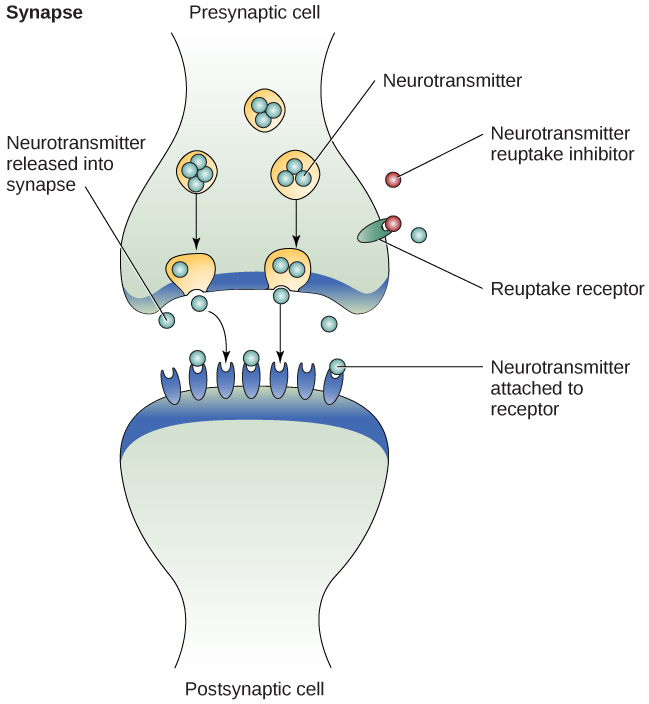
Figure 15.16図 15.16
Many medications designed to treat mood disorders work by altering neurotransmitter activity in the neural synapse.
気分障害の治療のために作られた薬の多くは、神経のシナプスにおける神経伝達物質の活動を変えることによって作用する。
Depression is linked to abnormal activity in several regions of the brain (Fitzgerald, Laird, Maller, & Daskalakis, 2008) including those important in assessing the emotional significance of stimuli and experiencing emotions (amygdala), and in regulating and controlling emotions (like the prefrontal cortex, or PFC) (LeMoult, Castonguay, Joormann, & McAleavey, 2013). People with depression show elevated amygdala activity (Drevets, Bogers, & Raichle, 2002), especially when presented with negative emotional stimuli, such as photos of sad faces (Figure 15.17) (Surguladze et al., 2005). Interestingly, heightened amygdala activation to negative emotional stimuli among depressed persons occurs even when stimuli are presented outside of conscious awareness (Victor, Furey, Fromm, Öhman, & Drevets, 2010), and it persists even after the negative emotional stimuli are no longer present (Siegle, Thompson, Carter, Steinhauer, & Thase, 2007). Additionally, depressed individuals exhibit less activation in the prefrontal, particularly on the left side (Davidson, Pizzagalli, & Nitschke, 2009). Because the PFC can dampen amygdala activation, thereby enabling one to suppress negative emotions (Phan et al., 2005), decreased activation in certain regions of the PFC may inhibit its ability to override negative emotions that might then lead to more negative mood states (Davidson et al., 2009). These findings suggest that people with depression are more prone to react to emotionally negative stimuli, yet have greater difficulty controlling these reactions.
英語のヒント
うつ病は、脳のいくつかの領域の異常な活動と関連している(Fitzgerald, Laird, Maller, & Daskalakis, 2008)。その中には、刺激の感情的な意味を評価し、感情を経験するうえで重要な領域(扁桃体)や、感情を調節し制御するうえで重要な領域(前頭前野、すなわちPFCなど)が含まれる(LeMoult, Castonguay, Joormann, & McAleavey, 2013)。うつ病の人は扁桃体の活動の高まりを示し(Drevets, Bogers, & Raichle, 2002)、とくに悲しい顔の写真のような否定的な感情刺激を提示されたときにそれが顕著である(図15.17)(Surguladze et al., 2005)。興味深いことに、抑うつ状態の人に見られる、否定的な感情刺激に対する扁桃体の活性化の高まりは、刺激が意識的な自覚の外で提示されたときにさえ生じ(Victor, Furey, Fromm, Öhman, & Drevets, 2010)、否定的な感情刺激がもはや存在しなくなった後にも続く(Siegle, Thompson, Carter, Steinhauer, & Thase, 2007)。さらに、抑うつ状態の人は前頭前野、とくにその左側の活性化が低い(Davidson, Pizzagalli, & Nitschke, 2009)。前頭前野は扁桃体の活性化を弱めることができ、それによって人は否定的な感情を抑えられる(Phan et al., 2005)。そのため、前頭前野の特定の領域の活性化が低下していると、否定的な感情を抑え込む前頭前野の能力が妨げられるのかもしれない。そうした否定的な感情は、その後、さらに否定的な気分状態につながるかもしれない(Davidson et al., 2009)。これらの知見は、うつ病の人は感情的に否定的な刺激に反応する傾向が強いのに、その反応を制御することにはより大きな困難を抱えていることを示唆している。



Figure 15.17図 15.17
People with depression react to negative emotional stimuli, such as sad faces, with greater amygdala activation than do non-depressed individuals. (credit: Ian Munroe)
うつ病の人は、悲しい顔のような否定的な感情刺激に対して、抑うつ状態でない人よりも大きな扁桃体の活性化で反応する。(出典:Ian Munroe)
Since the 1950s, researchers have noted that depressed individuals have abnormal levels of cortisol, a stress hormone released into the blood by the neuroendocrine system during times of stress (Mackin & Young, 2004). When cortisol is released, the body initiates a fight-or-flight response in reaction to a threat or danger. Many people with depression show elevated cortisol levels (Holsboer & Ising, 2010), especially those reporting a history of early life trauma such as the loss of a parent or abuse during childhood (Baes, Tofoli, Martins, & Juruena, 2012). Such findings raise the question of whether high cortisol levels are a cause or a consequence of depression. High levels of cortisol are a risk factor for future depression (Halligan, Herbert, Goodyer, & Murray, 2007), and cortisol activates activity in the amygdala while deactivating activity in the PFC (McEwen, 2005)—both brain disturbances are connected to depression. Thus, high cortisol levels may have a causal effect on depression, as well as on its brain function abnormalities (van Praag, 2005). Also, because stress results in increased cortisol release (Michaud, Matheson, Kelly, Anisman, 2008), it is equally reasonable to assume that stress may precipitate depression.
英語のヒント
1950年代以来、研究者たちは、抑うつ状態の人のコルチゾールの濃度が異常であることに注目してきた。コルチゾールはストレスホルモンであり、ストレスのかかった時期に神経内分泌系によって血中に放出される(Mackin & Young, 2004)。コルチゾールが放出されると、身体は脅威や危険に反応して闘争・逃走反応を開始する。うつ病の人の多くはコルチゾールの濃度が高く(Holsboer & Ising, 2010)、とくに、親を失うことや子ども時代の虐待のような、人生の早い時期のトラウマの経歴を報告する人ではそれが顕著である(Baes, Tofoli, Martins, & Juruena, 2012)。こうした知見は、コルチゾールの高い濃度がうつ病の原因なのか、それとも結果なのかという疑問を投げかける。コルチゾールの高い濃度は将来のうつ病の危険因子であり(Halligan, Herbert, Goodyer, & Murray, 2007)、またコルチゾールは扁桃体の活動を活性化する一方で、前頭前野の活動を低下させる(McEwen, 2005)。この二つの脳の乱れは、どちらもうつ病と結びついている。したがって、コルチゾールの高い濃度は、うつ病そのものに対しても、うつ病に伴う脳機能の異常に対しても、因果的な影響を持っているのかもしれない(van Praag, 2005)。また、ストレスはコルチゾールの放出の増加をもたらすので(Michaud, Matheson, Kelly, Anisman, 2008)、ストレスがうつ病を引き起こすかもしれないと想定するのも、同じく妥当である。