第15章心理的障害
15.2 Diagnosing and Classifying Psychological Disorders15.2 心理的障害の診断と分類
Learning Objectives学習目標
By the end of this section, you will be able to:
この節を学び終えると、次のことができるようになる。
- Explain why classification systems are necessary in the study of psychopathology精神病理学の研究において分類体系が必要な理由を説明する
- Describe the basic features of the Diagnostic and Statistical Manual of Mental Disorders, Fifth Edition (DSM-5)『精神疾患の診断・統計マニュアル第5版』(DSM-5)の基本的な特徴を説明する
- Discuss changes in the DSM over time, including criticisms of the current edition現行版への批判も含め、DSMが時代とともにどのように変わってきたかを論じる
- Identify which disorders are generally the most common一般に最もよく見られるのはどの障害かを特定する
A first step in the study of psychological disorders is carefully and systematically discerning significant signs and symptoms. How do mental health professionals ascertain whether or not a person’s inner states and behaviors truly represent a psychological disorder? Arriving at a proper diagnosis—that is, appropriately identifying and labeling a set of defined symptoms—is absolutely crucial. This process enables professionals to use a common language with others in the field and aids in communication about the disorder with the patient, colleagues and the public. A proper diagnosis is an essential element to guide proper and successful treatment. For these reasons, classification systems that organize psychological disorders systematically are necessary.
英語のヒント
心理的障害を研究する第一歩は、重要な徴候と症状を注意深く、体系的に見きわめることである。精神保健の専門家は、ある人の内的な状態や行動が本当に心理的障害に当たるのかどうかを、どのようにして確かめるのだろうか。適切な診断に至ること、すなわち定義された一連の症状を適切に特定し、名前を付けることは、決定的に重要である。この過程によって、専門家は同じ分野のほかの人々と共通の言葉を使えるようになり、また、患者や同僚、一般の人々とその障害について意思疎通しやすくなる。適切な診断は、適切で効果のある治療の道しるべとして欠かせない要素である。こうした理由から、心理的障害を体系的に整理する分類体系が必要となる。
The Diagnostic and Statistical Manual of Mental Disorders (DSM)『精神疾患の診断・統計マニュアル』(DSM)
Although a number of classification systems have been developed over time, the one that is used by most mental health professionals in the United States is the Diagnostic and Statistical Manual of Mental Disorders (DSM-5), published by the American Psychiatric Association (2013). (Note that the American Psychiatric Association differs from the American Psychological Association; both are abbreviated APA.) The first edition of the DSM, published in 1952, classified psychological disorders according to a format developed by the U.S. Army during World War II (Clegg, 2012). In the years since, the DSM has undergone numerous revisions and editions. The most recent edition, published in 2013, is the DSM-5 (APA, 2013). The DSM-5 includes many categories of disorders (e.g., anxiety disorders, depressive disorders, and dissociative disorders). Each disorder is described in detail, including an overview of the disorder (diagnostic features), specific symptoms required for diagnosis (diagnostic criteria), prevalence information (what percent of the population is thought to be afflicted with the disorder), and risk factors associated with the disorder. Figure 15.4 shows lifetime prevalence rates—the percentage of people in a population who develop a disorder in their lifetime—of various psychological disorders among U.S. adults. These data were based on a national sample of 9,282 U.S. residents (National Comorbidity Survey, 2007).
英語のヒント
これまでに数多くの分類体系がつくられてきたが、アメリカの精神保健の専門家の大半が用いているのは、アメリカ精神医学会(2013)が刊行した『精神疾患の診断・統計マニュアル』(DSM-5)である。(なお、アメリカ精神医学会はアメリカ心理学会とは別の組織である。どちらも略称はAPAである。)1952年に刊行されたDSMの初版は、第二次世界大戦中にアメリカ陸軍が開発した形式に従って心理的障害を分類していた(Clegg, 2012)。それ以来、DSMは何度も改訂され、版を重ねてきた。最新版は2013年に刊行されたDSM-5である(APA, 2013)。DSM-5には、障害の多くのカテゴリー(たとえば不安障害、抑うつ障害、解離性障害)が含まれている。それぞれの障害は詳しく記述されており、そこには障害の概要(診断的特徴)、診断に必要な具体的な症状(診断基準)、有病率の情報(人口の何%がその障害にかかっていると考えられるか)、その障害と関連する危険因子が含まれる。図15.4は、アメリカの成人におけるさまざまな心理的障害の生涯有病率を示している。生涯有病率とは、ある集団の中で、生涯のうちにある障害を発症する人の割合である。このデータは、アメリカ在住の9,282人から成る全国規模の標本に基づいている(National Comorbidity Survey, 2007)。
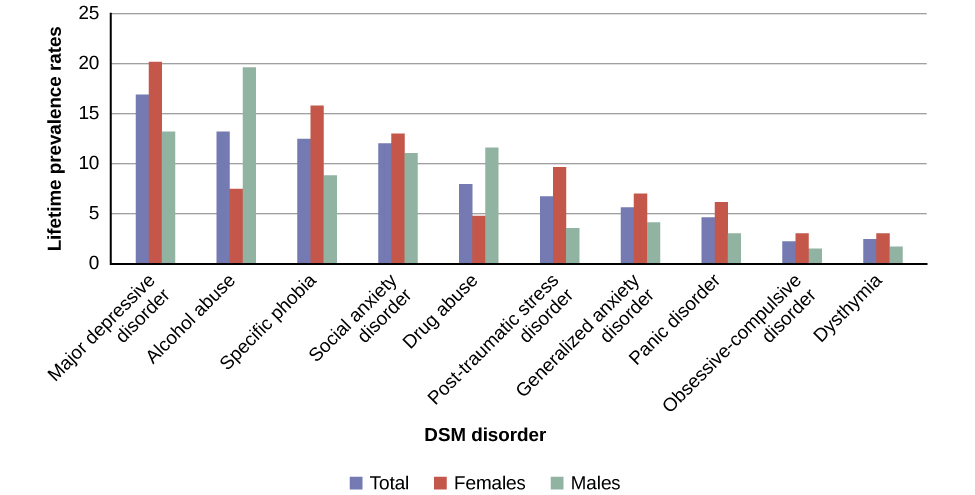
Figure 15.4図 15.4
The graph shows the breakdown of psychological disorders, comparing the percentage prevalence among adult males and adult females in the United States. Because the data is from 2007, the categories shown here are from the DSM-IV, which has been supplanted by the DSM-5. Most categories remain the same; however, alcohol abuse now falls under a broader Alcohol Use Disorder category.
このグラフは心理的障害の内訳を示し、アメリカの成人男性と成人女性の有病率(%)を比べている。データが2007年のものであるため、ここに示したカテゴリーは、その後DSM-5に取って代わられたDSM-IVのものである。ほとんどのカテゴリーは変わっていないが、アルコール乱用は現在、より広い「アルコール使用障害」のカテゴリーに含まれている。
The DSM-5 also provides information about comorbidity; the co-occurrence of two disorders. For example, the DSM-5 mentions that 41% of people with obsessive-compulsive disorder (OCD) also meet the diagnostic criteria for major depressive disorder (Figure 15.5). Problematic substance use is highly comorbid with other mental illnesses; 6 out of 10 people who have a substance use disorder also suffer from another form of mental illness (National Institute on Drug Abuse [NIDA], 2007).
英語のヒント
DSM-5は、併存、すなわち二つの障害が同時に起こることについての情報も示している。たとえばDSM-5は、強迫性障害(OCD)のある人の41%が、大うつ病性障害の診断基準も満たしていると述べている(図15.5)。問題のある物質使用は、ほかの精神疾患と併存する率が高い。物質使用障害のある人の10人に6人は、別の形の精神疾患にも苦しんでいる(National Institute on Drug Abuse [NIDA], 2007)。
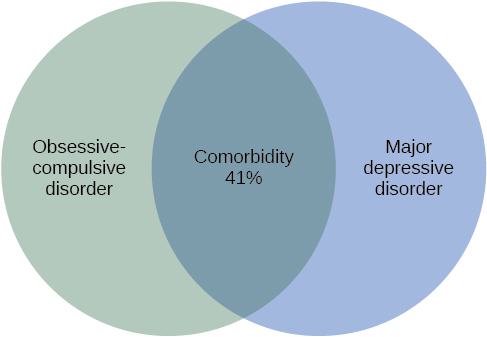


Figure 15.5図 15.5
Obsessive-compulsive disorder and major depressive disorder frequently occur in the same person.
強迫性障害と大うつ病性障害は、同じ人に同時に起こることが多い。
The DSM has changed considerably in the half-century since it was originally published. The first two editions of the DSM, for example, listed homosexuality as a disorder; however, in 1973, the APA voted to remove it from the manual (Silverstein, 2009). While the DSM-III did not list homosexuality as a disorder, it introduced a new diagnosis, ego-dystonic homosexuality, which emphasized same-sex arousal that the patient viewed as interfering with desired heterosexual relationships and causing distress for the individual. This new diagnosis was considered by many as a compromise to appease those who viewed homosexuality as a mental illness. Other professionals questioned how appropriate it was to have a separate diagnosis that described the content of an individual's distress. In 1986, the diagnosis was removed from the DSM-III-R (Herek, 2012). Additionally, beginning with the DSM-III in 1980, mental disorders have been described in much greater detail, and the number of diagnosable conditions has grown steadily, as has the size of the manual itself. DSM-I included 106 diagnoses and was 130 total pages, whereas DSM-III included more than 2 times as many diagnoses (265) and was nearly seven times its size (886 total pages) (Mayes & Horowitz, 2005). Although DSM-5 is longer than DSM-IV, the volume includes only 237 disorders, a decrease from the 297 disorders that were listed in DSM-IV. The latest edition, DSM-5, includes revisions in the organization and naming of categories and in the diagnostic criteria for various disorders (Regier, Kuhl, & Kupfer, 2012), while emphasizing careful consideration of the importance of gender and cultural difference in the expression of various symptoms (Fisher, 2010).
英語のヒント
DSMは、最初に刊行されてからの半世紀のあいだに大きく変わってきた。たとえば、DSMの最初の二つの版は同性愛を障害として挙げていたが、1973年にAPAは投票によって、同性愛をマニュアルから削除することを決めた(Silverstein, 2009)。DSM-IIIは同性愛を障害として挙げなかったものの、新しい診断として自我異和的同性愛を導入した。この診断が重視したのは、望んでいる異性愛の関係を妨げ、自分に苦痛をもたらしていると患者自身がみなしている、同性への性的興奮だった。この新しい診断は、同性愛を精神疾患とみなす人々をなだめるための妥協だと、多くの人に考えられた。ほかの専門家たちは、個人の苦痛の内容を記述する別個の診断を設けることがどれほど適切なのか、疑問を呈した。1986年、この診断はDSM-III-Rから削除された(Herek, 2012)。さらに、1980年のDSM-III以降、精神障害ははるかに詳しく記述されるようになり、診断可能な状態の数は着実に増えてきた。マニュアル自体の大きさも同じように増えてきた。DSM-Iには106の診断が収められ、全体で130ページだったのに対し、DSM-IIIには2倍を超える数の診断(265)が収められ、大きさは7倍近く(全886ページ)になった(Mayes & Horowitz, 2005)。DSM-5はDSM-IVより長いが、収められている障害は237にとどまり、DSM-IVに挙げられていた297から減っている。最新版のDSM-5には、カテゴリーの構成と名称、さまざまな障害の診断基準についての改訂が含まれており(Regier, Kuhl, & Kupfer, 2012)、同時に、さまざまな症状の現れ方における性別や文化の違いの重要性を注意深く考慮することを重視している(Fisher, 2010)。
Some believe that establishing new diagnoses might overpathologize the human condition by turning common human problems into mental illnesses (The Associated Press, 2013). Indeed, the finding that nearly half of all Americans will meet the criteria for a DSM disorder at some point in their life (Kessler et al., 2005) likely fuels much of this skepticism. The DSM-5 is also criticized on the grounds that its diagnostic criteria have been loosened, thereby threatening to “turn our current diagnostic inflation into diagnostic hyperinflation” (Frances, 2012, para. 22). For example, DSM-IV specified that the symptoms of major depressive disorder must not be attributable to normal bereavement (loss of a loved one). The DSM-5, however, has removed this bereavement exclusion, essentially meaning that grief and sadness after a loved one’s death can constitute major depressive disorder.
英語のヒント
新しい診断を設けることは、人間によくある問題を精神疾患に変えてしまうことで、人間のありようを過剰に病理化するかもしれない、と考える人もいる(The Associated Press, 2013)。実際、アメリカ人のほぼ半数が人生のどこかの時点でDSMの障害の基準を満たすことになるという知見(Kessler et al., 2005)が、こうした懐疑の多くをあおっているのだろう。DSM-5は、診断基準が緩められたという理由でも批判されている。基準の緩和によって、「われわれの現在の診断のインフレを、診断のハイパーインフレに変えてしまう」おそれがあるというのである(Frances, 2012, para. 22)。たとえばDSM-IVは、大うつ病性障害の症状が、通常の死別(愛する人を失うこと)に起因するものであってはならないと定めていた。しかしDSM-5は、この死別の除外規定を削除した。これは実質的に、愛する人の死後の悲嘆や悲しみが大うつ病性障害に該当しうることを意味する。