第15章心理的障害
Panic Disorderパニック障害
Imagine that you are out one day with your friends and—suddenly and inexplicably—you begin sweating and trembling, your heart starts pounding, you have trouble breathing, and you start to feel dizzy and nauseous. This episode lasts for 10 minutes and is terrifying because you start to think that you are going to die. When you visit your doctor the following morning and describe what happened, she tells you that you have experienced a panic attack (Figure 15.9). If you experience another one of these episodes two weeks later and worry for a month or more that similar episodes will occur in the future, it is likely that you have developed panic disorder.
英語のヒント
ある日、友人と出かけていると、突然、わけも分からないまま、汗が出て体が震えはじめ、心臓がどきどきしだし、呼吸が苦しくなり、めまいと吐き気がしてくる、と想像してみよう。この出来事は10分間続き、自分は死ぬのだと考えはじめるので、ひどく恐ろしい。翌朝、医者に行って何があったかを説明すると、医者は、あなたが経験したのはパニック発作だと告げる(図15.9)。2週間後にまた同じような出来事を経験し、似たような出来事がこの先も起こるのではないかと1か月以上心配しつづけるなら、パニック障害を発症している可能性が高い。
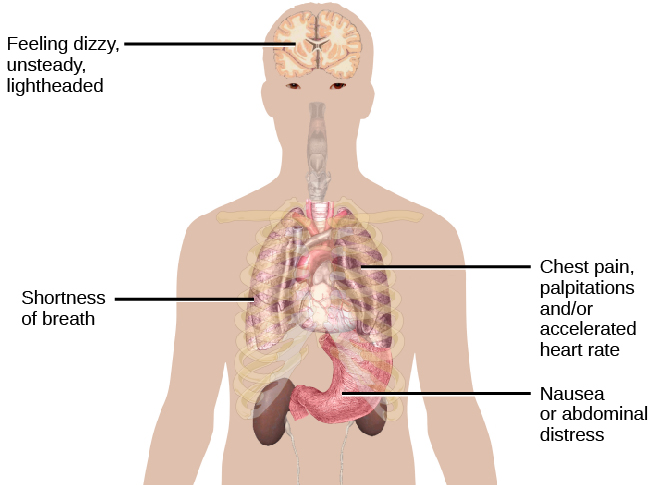

Figure 15.9図 15.9
Some of the physical manifestations of a panic attack are shown. People may also experience sweating, trembling, feelings of faintness, or a fear of losing control, among other symptoms.
パニック発作の身体的な現れのいくつかを示す。このほかにも、発汗、震え、気が遠くなる感じ、自分を制御できなくなることへの恐怖などの症状を経験することがある。
People with panic disorder experience recurrent (more than one) and unexpected panic attacks, along with at least one month of persistent concern about additional panic attacks, worry over the consequences of the attacks, or self-defeating changes in behavior related to the attacks (e.g., avoidance of exercise or unfamiliar situations) (APA, 2013). As is the case with other anxiety disorders, the panic attacks cannot result from the physiological effects of drugs and other substances, a medical condition, or another mental disorder. A panic attack is defined as a period of extreme fear or discomfort that develops abruptly and reaches a peak within 10 minutes. Its symptoms include accelerated heart rate, sweating, trembling, choking sensations, hot flashes or chills, dizziness or lightheadedness, fears of losing control or going crazy, and fears of dying (APA, 2013). Sometimes panic attacks are expected, occurring in response to specific environmental triggers (such as being in a tunnel); other times, these episodes are unexpected and emerge randomly (such as when relaxing). According to the DSM-5, the person must experience unexpected panic attacks to qualify for a diagnosis of panic disorder.
英語のヒント
パニック障害のある人は、繰り返し起こる(2回以上の)予期しないパニック発作を経験する。それに加えて、少なくとも1か月にわたって、さらなるパニック発作についての持続的な懸念、発作がもたらす結果についての心配、または発作に関連した自滅的な行動の変化(運動や見慣れない状況を避けるなど)が見られる(APA, 2013)。ほかの不安障害の場合と同じく、そのパニック発作は、薬物やその他の物質の生理学的作用、医学的疾患、あるいは別の精神障害によるものであってはならない。パニック発作は、突然生じて10分以内にピークに達する、極度の恐怖や不快感の期間と定義される。その症状には、心拍数の増加、発汗、震え、窒息感、ほてりや寒気、めまいやふらつき、制御を失うことや気が変になることへの恐怖、死ぬことへの恐怖が含まれる(APA, 2013)。パニック発作は予期されたものであることもあり、その場合は特定の環境のきっかけ(トンネルの中にいることなど)に反応して起こる。またあるときには、予期されずに、何の脈絡もなく現れる(くつろいでいるときなど)。DSM-5によれば、パニック障害と診断されるためには、予期しないパニック発作を経験していなければならない。
Experiencing a panic attack is often terrifying. Rather than recognizing the symptoms of a panic attack merely as signs of intense anxiety, individuals with panic disorder often misinterpret them as a sign that something is intensely wrong internally (thinking, for example, that the pounding heart represents an impending heart attack). Panic attacks can occasionally precipitate trips to the emergency room because several symptoms of panic attacks are, in fact, similar to those associated with heart problems (e.g., palpitations, racing pulse, and a pounding sensation in the chest) (Root, 2000). Unsurprisingly, those with panic disorder fear future attacks and may become preoccupied with modifying their behavior in an effort to avoid future panic attacks. For this reason, panic disorder is often characterized as fear of fear (Goldstein & Chambless, 1978).
英語のヒント
パニック発作を経験するのは、しばしばひどく恐ろしいことである。パニック障害のある人は、パニック発作の症状を単に強い不安の兆候として認識するのではなく、体の内部で何かがひどくおかしくなっている兆候だと誤って解釈することが多い(たとえば、心臓がどきどきしているのは心臓発作が迫っている表れだと考える)。パニック発作の症状のいくつかは、実際に心臓の問題に伴う症状(動悸、脈が速くなること、胸がどきどきする感覚など)と似ているため、パニック発作がきっかけで救急外来に駆け込むことがときにはある(Root, 2000)。当然のことながら、パニック障害のある人は将来の発作を恐れ、今後のパニック発作を避けようとして、自分の行動を変えることで頭がいっぱいになることがある。そのため、パニック障害はしばしば「恐怖への恐怖」と特徴づけられる(Goldstein & Chambless, 1978)。
Panic attacks themselves are not mental disorders. Indeed, around 23% of Americans experience isolated panic attacks in their lives without meeting the criteria for panic disorder (Kessler et al., 2006), indicating that panic attacks are fairly common. Panic disorder is, of course, much less common, afflicting 4.7% of Americans during their lifetime (Kessler et al., 2005). Many people with panic disorder develop agoraphobia, which is marked by fear and avoidance of situations in which escape might be difficult or help might not be available if one were to develop symptoms of a panic attack. People with panic disorder often experience a comorbid disorder, such as other anxiety disorders or major depressive disorder (APA, 2013).
英語のヒント
パニック発作そのものは精神障害ではない。実際、アメリカ人のおよそ23%が、パニック障害の診断基準を満たすことなく、生涯のうちに単発のパニック発作を経験しており(Kessler et al., 2006)、パニック発作がかなりありふれたものであることがうかがえる。もちろん、パニック障害ははるかに少なく、生涯のうちにこの障害に苦しむアメリカ人は4.7%である(Kessler et al., 2005)。パニック障害のある人の多くは広場恐怖症を発症する。広場恐怖症は、仮にパニック発作の症状が出た場合に、逃げ出すのが難しいかもしれない、あるいは助けが得られないかもしれない状況に対する恐怖と回避を特徴とする。パニック障害のある人は、ほかの不安障害や大うつ病性障害などの併存障害を経験することが多い(APA, 2013)。
Researchers are not entirely sure what causes panic disorder. Children are at a higher risk of developing panic disorder if their parents have the disorder (Biederman et al., 2001), and family and twins studies indicate that the heritability of panic disorder is around 43% (Hettema, Neale, & Kendler, 2001). The exact genes and gene functions involved in this disorder, however, are not well-understood (APA, 2013). Neurobiological theories of panic disorder suggest that a region of the brain called the locus coeruleus may play a role in this disorder. Located in the brainstem, the locus coeruleus is the brain’s major source of norepinephrine, a neurotransmitter that triggers the body’s fight-or-flight response. Activation of the locus coeruleus is associated with anxiety and fear, and research with nonhuman primates has shown that stimulating the locus coeruleus either electrically or through drugs produces panic-like symptoms (Charney et al., 1990). Such findings have led to the theory that panic disorder may be caused by abnormal norepinephrine activity in the locus coeruleus (Bremner, Krystal, Southwick, & Charney, 1996).
英語のヒント
パニック障害の原因が何なのか、研究者たちにも完全には分かっていない。親がパニック障害を持っている場合、子どもがこの障害を発症するリスクは高くなる(Biederman et al., 2001)。また、家族研究と双生児研究は、パニック障害の遺伝率がおよそ43%であることを示している(Hettema, Neale, & Kendler, 2001)。しかし、この障害にかかわる正確な遺伝子や遺伝子の機能は、よく分かっていない(APA, 2013)。パニック障害の神経生物学的理論は、青斑核と呼ばれる脳の領域がこの障害に何らかの役割を果たしているかもしれないと示唆している。青斑核は脳幹にあり、脳におけるノルエピネフリンの主要な供給源である。ノルエピネフリンは、体の闘争・逃走反応を引き起こす神経伝達物質である。青斑核の活性化は不安や恐怖と関連しており、人間以外の霊長類を対象にした研究では、電気や薬物によって青斑核を刺激すると、パニックに似た症状が生じることが示されている(Charney et al., 1990)。こうした知見から、パニック障害は青斑核におけるノルエピネフリンの異常な活動によって引き起こされるのかもしれない、という理論が生まれた(Bremner, Krystal, Southwick, & Charney, 1996)。
Conditioning theories of panic disorder propose that panic attacks are classical conditioning responses to subtle bodily sensations resembling those normally occurring when one is anxious or frightened (Bouton, Mineka, & Barlow, 2001). For example, consider a child who has asthma. An acute asthma attack produces sensations, such as shortness of breath, coughing, and chest tightness, that typically elicit fear and anxiety. Later, when the child experiences subtle symptoms that resemble the frightening symptoms of earlier asthma attacks (such as shortness of breath after climbing stairs), they may become anxious, fearful, and then experience a panic attack. In this situation, the subtle symptoms would represent a conditioned stimulus, and the panic attack would be a conditioned response. The finding that panic disorder is nearly three times as frequent among people with asthma as it is among people without asthma (Weiser, 2007) supports the possibility that panic disorder has the potential to develop through classical conditioning.
英語のヒント
パニック障害の条件づけ理論は、パニック発作とは、人が不安やおびえを感じているときにふつう生じる感覚に似た、かすかな身体感覚に対する古典的条件づけの反応だと提唱している(Bouton, Mineka, & Barlow, 2001)。たとえば、喘息のある子どもを考えてみよう。喘息の急性発作は、息切れ、せき、胸の締めつけといった感覚を生じさせ、それらはたいてい恐怖と不安を引き起こす。のちにその子どもが、以前の喘息発作の恐ろしい症状に似たかすかな症状(階段を上ったあとの息切れなど)を経験すると、不安になり、怖くなり、そしてパニック発作を経験するかもしれない。この場合、かすかな症状は条件刺激に当たり、パニック発作は条件反応に当たるだろう。パニック障害が、喘息のない人よりも喘息のある人でほぼ3倍多く見られるという知見(Weiser, 2007)は、パニック障害が古典的条件づけを通して発達しうるという可能性を支持している。
Cognitive factors may play an integral part in panic disorder. Generally, cognitive theories (Clark, 1996) argue that those with panic disorder are prone to interpret ordinary bodily sensations catastrophically, and these fearful interpretations set the stage for panic attacks. For example, a person might detect bodily changes that are routinely triggered by innocuous events such as getting up from a seated position (dizziness), exercising (increased heart rate, shortness of breath), or drinking a large cup of coffee (increased heart rate, trembling). The individual interprets these subtle bodily changes catastrophically (“Maybe I’m having a heart attack!”). Such interpretations create fear and anxiety, which trigger additional physical symptoms; subsequently, the person experiences a panic attack. Support of this contention rests with findings that people with more severe catastrophic thoughts about sensations have more frequent and severe panic attacks, and among those with panic disorder, reducing catastrophic cognitions about their sensations is as effective as medication in reducing panic attacks (Good & Hinton, 2009).
英語のヒント
認知的要因は、パニック障害において欠かせない役割を果たしているかもしれない。一般に認知理論(Clark, 1996)は、パニック障害のある人はふだんの身体感覚を破局的に解釈する傾向があり、こうした恐怖に満ちた解釈がパニック発作のお膳立てをする、と論じる。たとえば、座った姿勢から立ち上がる(めまい)、運動する(心拍数の増加、息切れ)、大きなカップでコーヒーを飲む(心拍数の増加、震え)といった、何でもない出来事によって日常的に引き起こされる身体の変化に、人が気づくことがあるだろう。その人は、こうしたかすかな身体の変化を破局的に解釈する(「もしかしたら心臓発作を起こしているのかもしれない!」)。そうした解釈は恐怖と不安を生み、それがさらなる身体症状を引き起こす。そして、その人はパニック発作を経験する。この主張の裏づけは、次のような知見にある。身体感覚についてより深刻な破局的思考を持つ人は、パニック発作がより頻繁で重い。また、パニック障害のある人では、自分の身体感覚についての破局的な認知を減らすことが、パニック発作を減らすうえで薬物療法と同じくらい効果的である(Good & Hinton, 2009)。