第15章心理的障害
A Diathesis-Stress Model and Major Depressive Disorders素因ストレスモデルと大うつ病性障害
Indeed, it has long been believed that stressful life events can trigger depression, and research has consistently supported this conclusion (Mazure, 1998). Stressful life events include significant losses, such as death of a loved one, divorce or separation, and serious health and money problems; life events such as these often precede the onset of depressive episodes (Brown & Harris, 1989). In particular, exit events—instances in which an important person departs (e.g., a death, divorce or separation, or a family member leaving home)—often occur prior to an episode (Paykel, 2003). Exit events are especially likely to trigger depression if these happenings occur in a way that humiliates or devalues the individual. For example, people who experience the breakup of a relationship initiated by the other person develop major depressive disorder at a rate more than 2 times that of people who experience the death of a loved one (Kendler, Hettema, Butera, Gardner, & Prescott, 2003).
英語のヒント
実際、ストレスの多いライフイベントがうつ病の引き金になりうると古くから信じられており、研究も一貫してこの結論を支持してきた(Mazure, 1998)。ストレスの多いライフイベントには、愛する人の死、離婚や別居、深刻な健康問題やお金の問題といった大きな喪失が含まれる。こうしたライフイベントは、しばしば抑うつエピソードの発症に先立って起こる(Brown & Harris, 1989)。とくに、退出イベント、すなわち重要な人物が去っていく出来事(たとえば、死、離婚や別居、家族の一人が家を出ること)は、エピソードの前に起こることが多い(Paykel, 2003)。退出イベントは、本人に屈辱を与えたり、本人の価値をおとしめたりするような形で起こった場合に、とりわけうつ病の引き金になる可能性が高い。たとえば、相手の側から別れを切り出されて関係の破局を経験した人は、愛する人の死を経験した人の2倍を超える率で大うつ病性障害を発症する(Kendler, Hettema, Butera, Gardner, & Prescott, 2003)。
Likewise, individuals who are exposed to traumatic stress during childhood—such as separation from a parent, family turmoil, and maltreatment (physical or sexual abuse)—are at a heightened risk of developing depression at any point in their lives (Kessler, 1997). A recent review of 16 studies involving over 23,000 subjects concluded that those who experience childhood maltreatment are more than 2 times as likely to develop recurring and persistent depression (Nanni, Uher, & Danese, 2012).
英語のヒント
同様に、子ども時代に、親との別離、家庭内の混乱、不適切な養育(身体的虐待や性的虐待)といったトラウマとなるストレスにさらされた人は、人生のどの時点においても、うつ病を発症するリスクが高い(Kessler, 1997)。23,000人を超える対象者を含む16件の研究を検討した最近のレビューは、子ども時代に不適切な養育を経験した人は、繰り返し起こり持続するうつ病を発症する可能性が2倍を超えると結論づけた(Nanni, Uher, & Danese, 2012)。
Of course, not everyone who experiences stressful life events or childhood adversities succumbs to depression—indeed, most do not. Clearly, a diathesis-stress interpretation of major depressive disorder, in which certain predispositions or vulnerability factors influence one’s reaction to stress, would seem logical. If so, what might such predispositions be? A study by Caspi and others (2003) suggests that an alteration in a specific gene that regulates serotonin (the 5-HTTLPR gene) might be one culprit. These investigators found that people who experienced several stressful life events were significantly more likely to experience episodes of major depression if they carried one or two short versions of this gene than if they carried two long versions. Those who carried one or two short versions of the 5-HTTLPR gene were unlikely to experience an episode, however, if they had experienced few or no stressful life events. Numerous studies have replicated these findings, including studies of people who experienced maltreatment during childhood (Goodman & Brand, 2009). In a recent investigation conducted in the United Kingdom (Brown & Harris, 2013), researchers found that childhood maltreatment before age 9 elevated the risk of chronic adult depression (a depression episode lasting for at least 12 months) among those individuals having one (LS) or two (SS) short versions of the 5-HTTLPR gene (Figure 15.18). Childhood maltreatment did not increase the risk for chronic depression for those who have two long (LL) versions of this gene. Thus, genetic vulnerability may be one mechanism through which stress potentially leads to depression.
英語のヒント
もちろん、ストレスの多いライフイベントや子ども時代の逆境を経験した人が、誰でもうつ病に屈するわけではない。実際、大半の人はそうならない。明らかに、大うつ病性障害についての素因ストレスの解釈、すなわち特定の素因や脆弱性の要因がストレスへの反応に影響するという解釈は、理にかなっているように思われる。そうだとすれば、そうした素因とは何なのだろうか。カスピら(2003)の研究は、セロトニンを調節する特定の遺伝子(5-HTTLPR遺伝子)の変異が、原因の一つかもしれないことを示唆している。この研究者たちは、ストレスの多いライフイベントをいくつも経験した人は、この遺伝子の短い型を一つか二つ持っている場合には、長い型を二つ持っている場合よりも、大うつ病のエピソードを経験する可能性が有意に高いことを見いだした。しかし、5-HTTLPR遺伝子の短い型を一つか二つ持っている人でも、ストレスの多いライフイベントをほとんど、あるいはまったく経験していなければ、エピソードを経験する可能性は低かった。数多くの研究が追試によってこれらの知見を再現しており、その中には子ども時代に不適切な養育を受けた人々の研究も含まれる(Goodman & Brand, 2009)。イギリスで行われた最近の調査(Brown & Harris, 2013)では、9歳より前の子ども時代の不適切な養育が、5-HTTLPR遺伝子の短い型を一つ(LS)または二つ(SS)持つ人々において、成人期の慢性うつ病(少なくとも12か月続く抑うつエピソード)のリスクを高めていたことが見いだされた(図15.18)。この遺伝子の長い型を二つ(LL)持つ人々では、子ども時代の不適切な養育は慢性うつ病のリスクを高めなかった。したがって、遺伝的な脆弱性は、ストレスがうつ病につながりうる仕組みの一つなのかもしれない。
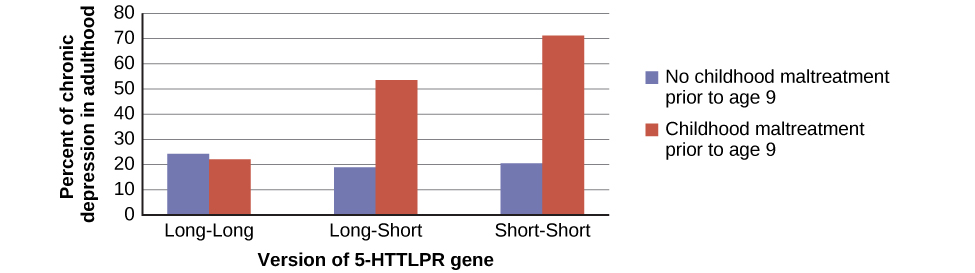

Figure 15.18図 15.18
A study on gene-environment interaction in people experiencing chronic depression in adulthood suggests a much higher incidence in individuals with a short version of the gene in combination with childhood maltreatment (Brown & Harris, 2013).
成人期に慢性うつ病を経験している人々における遺伝子と環境の相互作用についての研究は、遺伝子の短い型と子ども時代の不適切な養育とが組み合わさった人で、発生率がはるかに高いことを示唆している(Brown & Harris, 2013)。
Cognitive Theories of Depressionうつ病の認知理論
Cognitive theories of depression take the view that depression is triggered by negative thoughts, interpretations, self-evaluations, and expectations (Joormann, 2009). These diathesis-stress models propose that depression is triggered by a “cognitive vulnerability” (negative and maladaptive thinking) and by precipitating stressful life events (Gotlib & Joormann, 2010). Perhaps the most well-known cognitive theory of depression was developed in the 1960s by psychiatrist Aaron Beck, based on clinical observations and supported by research (Beck, 2008). Beck theorized that depression-prone people possess depressive schemas, or mental predispositions to think about most things in a negative way (Beck, 1976). Depressive schemas contain themes of loss, failure, rejection, worthlessness, and inadequacy, and may develop early in childhood in response to adverse experiences, then remain dormant until they are activated by stressful or negative life events. Depressive schemas prompt dysfunctional and pessimistic thoughts about the self, the world, and the future. Beck believed that this dysfunctional style of thinking is maintained by cognitive biases, or errors in how we process information about ourselves, which lead us to focus on negative aspects of experiences, interpret things negatively, and block positive memories (Beck, 2008). A person whose depressive schema consists of a theme of rejection might be overly attentive to social cues of rejection (more likely to notice another’s frown), and they might interpret this cue as a sign of rejection and automatically remember past incidents of rejection. Longitudinal studies have supported Beck’s theory, in showing that a preexisting tendency to engage in this negative, self-defeating style of thinking—when combined with life stress—over time predicts the onset of depression (Dozois & Beck, 2008). Cognitive therapies for depression, aimed at changing a depressed person’s negative thinking, were developed as an expansion of this theory (Beck, 1976).
英語のヒント
うつ病の認知理論は、うつ病は否定的な思考、解釈、自己評価、予期によって引き起こされるという見方をとる(Joormann, 2009)。こうした素因ストレスモデルは、うつ病は「認知的脆弱性」(否定的で不適応的な考え方)と、きっかけとなるストレスの多いライフイベントによって引き起こされる、と提唱する(Gotlib & Joormann, 2010)。うつ病の認知理論として最もよく知られているのは、おそらく精神科医アーロン・ベックが1960年代に構築した理論だろう。この理論は臨床観察に基づき、研究によって支持されている(Beck, 2008)。ベックは、うつ病になりやすい人は抑うつスキーマ、すなわち、ほとんどの物事を否定的に考える心的な素因を持っている、という理論を立てた(Beck, 1976)。抑うつスキーマには、喪失、失敗、拒絶、無価値、不十分さといったテーマが含まれている。抑うつスキーマは、子ども時代の早い時期に逆境的な経験への反応として形成されることがあり、その後、ストレスの多いライフイベントや否定的なライフイベントによって活性化されるまで、休眠状態のままでいる。抑うつスキーマは、自己、世界、未来についての非機能的で悲観的な思考を促す。ベックは、この非機能的な考え方は、認知バイアス、すなわち自分自身についての情報の処理の仕方の誤りによって維持されていると考えた。認知バイアスによって、私たちは経験の否定的な側面に注目し、物事を否定的に解釈し、肯定的な記憶を締め出すようになる(Beck, 2008)。抑うつスキーマが拒絶というテーマから成り立っている人は、拒絶を示す社会的な手がかりに過度に注意を向け(他人のしかめ面に気づく可能性が高く)、その手がかりを拒絶のしるしと解釈して、過去に拒絶された出来事を自動的に思い出すかもしれない。縦断的研究は、この否定的で自滅的な考え方をもともとする傾向が、生活上のストレスと結びつくと、時間の経過とともにうつ病の発症を予測することを示し、ベックの理論を支持してきた(Dozois & Beck, 2008)。うつ病の人の否定的な思考を変えることを目的としたうつ病の認知療法は、この理論を発展させる形で開発された(Beck, 1976)。
Another cognitive theory of depression, hopelessness theory, postulates that a particular style of negative thinking leads to a sense of hopelessness, which then leads to depression (Abramson, Metalsky, & Alloy, 1989). According to this theory, hopelessness is an expectation that unpleasant outcomes will occur or that desired outcomes will not occur, and there is nothing one can do to prevent such outcomes. A key assumption of this theory is that hopelessness stems from a tendency to perceive negative life events as having stable (“It’s never going to change”) and global (“It’s going to affect my whole life”) causes, in contrast to unstable (“It’s fixable”) and specific (“It applies only to this particular situation”) causes, especially if these negative life events occur in important life realms, such as relationships, academic achievement, and the like. Suppose a student who wishes to go to law school does poorly on an admissions test. If the student infers negative life events as having stable and global causes, they may believe that their poor performance has a stable and global cause (“I lack intelligence, and it’s going to prevent me from ever finding a meaningful career”), as opposed to an unstable and specific cause (“I was sick the day of the exam, so my low score was a fluke”). Hopelessness theory predicts that people who exhibit this cognitive style in response to undesirable life events will view such events as having negative implications for their future and self-worth, thereby increasing the likelihood of hopelessness—the primary cause of depression (Abramson et al., 1989). One study testing hopelessness theory measured the tendency to make negative inferences for bad life effects in participants who were experiencing uncontrollable stressors. Over the ensuing six months, those with scores reflecting high cognitive vulnerability were 7 times more likely to develop depression compared to those with lower scores (Kleim, Gonzalo, & Ehlers, 2011).
英語のヒント
うつ病のもう一つの認知理論である絶望感理論は、ある特定の否定的な考え方が絶望感を生み、それがさらにうつ病につながると仮定する(Abramson, Metalsky, & Alloy, 1989)。この理論によれば、絶望感とは、不快な結果が起こるだろう、あるいは望んだ結果は起こらないだろうという予期であり、しかもそうした結果を防ぐために自分にできることは何もない、というものである。この理論の重要な前提は、絶望感が、否定的なライフイベントの原因を安定的(「これは決して変わらない」)で全般的(「これは私の人生全体に影響する」)なものとして知覚し、不安定(「これは直せる」)で特定的(「これはこの特定の状況にだけ当てはまる」)なものとは知覚しない傾向から生じる、というものである。とくに、そうした否定的なライフイベントが、人間関係や学業成績などの人生の重要な領域で起こる場合がそうである。ロースクールに進みたいと考えている学生が、入学試験で悪い成績をとったとしよう。この学生が否定的なライフイベントの原因を安定的で全般的なものと推論するなら、自分の成績の悪さには安定的で全般的な原因(「自分には知性が欠けていて、そのせいで、意味のある職業に就くことはこの先決してできないだろう」)があるのであって、不安定で特定的な原因(「試験の日は体調が悪かったから、点数が低かったのはまぐれだ」)があるのではない、と信じるかもしれない。絶望感理論は、望ましくないライフイベントに対してこうした認知スタイルを示す人は、その出来事が自分の将来と自己価値にとって否定的な意味を持つとみなし、それによって、うつ病の主要な原因である絶望感が生じる可能性を高める、と予測する(Abramson et al., 1989)。絶望感理論を検証したある研究では、制御できないストレッサーを経験している参加者について、悪いライフイベントに否定的な推論をする傾向を測定した。その後の6か月間に、高い認知的脆弱性を反映する得点を示した人は、それより得点の低い人に比べて、うつ病を発症する可能性が7倍高かった(Kleim, Gonzalo, & Ehlers, 2011)。
A third cognitive theory of depression focuses on how people’s thoughts about their distressed moods—depressed symptoms in particular—can increase the risk and duration of depression. This theory, which focuses on rumination in the development of depression, was first described in the late 1980s to explain the higher rates of depression in women than in men (Nolen-Hoeksema, 1987). Rumination is the repetitive and passive focus on the fact that one is depressed and dwelling on depressed symptoms, rather that distracting oneself from the symptoms or attempting to address them in an active, problem-solving manner (Nolen-Hoeksema, 1991). When people ruminate, they have thoughts such as “Why am I so unmotivated? I just can’t get going. I’m never going to get my work done feeling this way” (Nolen-Hoeksema & Hilt, 2009, p. 393). Women are more likely than men to ruminate when they are sad or depressed (Butler & Nolen-Hoeksema, 1994), and the tendency to ruminate is associated with increases in depression symptoms (Nolen-Hoeksema, Larson, & Grayson, 1999), heightened risk of major depressive episodes (Abela & Hankin, 2011), and chronicity of such episodes (Robinson & Alloy, 2003)
英語のヒント
うつ病の三つ目の認知理論は、苦痛に満ちた気分、とくに抑うつ症状についての人々の思考が、どのようにうつ病のリスクを高め、その持続期間を延ばしうるのかに焦点を当てる。うつ病の発症における反すうに焦点を当てるこの理論は、1980年代後半に、男性より女性のほうがうつ病の有病率が高いことを説明するために初めて提示された(Nolen-Hoeksema, 1987)。反すうとは、症状から気をそらしたり、積極的に問題を解決するやり方で症状に対処しようとしたりするのではなく、自分が抑うつ状態にあるという事実に繰り返し受け身的に注意を向け、抑うつ症状についてくよくよと考え続けることである(Nolen-Hoeksema, 1991)。反すうしているとき、人は「どうしてこんなにやる気が出ないんだろう。どうしても動き出せない。こんな気分のままでは、いつまでたっても仕事を終えられない」といった考えを抱く(Nolen-Hoeksema & Hilt, 2009, p. 393)。女性は男性よりも、悲しいときや落ち込んでいるときに反すうする可能性が高い(Butler & Nolen-Hoeksema, 1994)。そして反すうする傾向は、抑うつ症状の増加(Nolen-Hoeksema, Larson, & Grayson, 1999)、大うつ病エピソードのリスクの高まり(Abela & Hankin, 2011)、そうしたエピソードの慢性化(Robinson & Alloy, 2003)と関連している。