第8章完全競争
The Shutdown Point操業停止点
The possibility that a firm may earn losses raises a question: Why can the firm not avoid losses by shutting down and not producing at all? The answer is that shutting down can reduce variable costs to zero, but in the short run, the firm has already paid for fixed costs. As a result, if the firm produces a quantity of zero, it would still make losses because it would still need to pay for its fixed costs. Therefore when a firm is experiencing losses, it must face a question: should it continue producing or should it shut down?
英語のヒント
損失を被る可能性があると、操業を止めて何も生産しなければ損失を避けられるのではないか、という疑問が生じる。答えは、停止すれば変動費用はゼロになるが、短期には固定費用をすでに支払っているということである。そのため、生産量がゼロでも固定費用が必要なので損失は残る。したがって損失を出す企業は、生産を続けるか、操業を停止するかを決めなければならない。
As an example, consider the situation of the Yoga Center, which has signed a contract to rent space that costs $10,000 per month. If the firm decides to operate, its marginal costs for hiring yoga teachers is $15,000 for the month. If the firm shuts down, it must still pay the rent, but it would not need to hire labor. Table 8.5 shows three possible scenarios. In the first scenario, the Yoga Center does not have any clients, and therefore does not make any revenues, in which case it faces losses of $10,000 equal to the fixed costs. In the second scenario, the Yoga Center has clients that earn the center revenues of $10,000 for the month, but ultimately experiences losses of $15,000 due to having to hire yoga instructors to cover the classes. In the third scenario, the Yoga Center earns revenues of $20,000 for the month, but experiences losses of $5,000.
英語のヒント
例として、月1万ドルの賃貸契約を結んだヨガセンターを考えよう。営業すればヨガ教師を雇う限界費用は月1万5000ドルである。休業しても賃料は払うが、労働者は雇わずにすむ。表8.5は三つの場合を示す。第一は顧客がおらず収入がない場合で、固定費用と等しい1万ドルの損失となる。第二は顧客から月1万ドルの収入があるが、授業を担当する教師を雇うため、最終的に1万5000ドルの損失となる。第三は月2万ドルの収入があり、損失は5000ドルとなる。
In all three cases, the Yoga Center loses money. In all three cases, when the rental contract expires in the long run, assuming revenues do not improve, the firm should exit this business. In the short run, though, the decision varies depending on the level of losses and whether the firm can cover its variable costs. In scenario 1, the center does not have any revenues, so hiring yoga teachers would increase variable costs and losses, so it should shut down and only incur its fixed costs. In scenario 2, the center’s losses are greater because it does not make enough revenue to offset the increased variable costs, so it should shut down immediately and only incur its fixed costs. If price is below the minimum average variable cost, the firm must shut down. In contrast, in scenario 3 the revenue that the center can earn is high enough that the losses diminish when it remains open, so the center should remain open in the short run.
英語のヒント
三つともヨガセンターは赤字である。収入が改善しないとすれば、長期に賃貸契約が切れた時には、どの場合もこの事業から退出すべきである。しかし短期の決定は、損失の大きさと変動費用を賄えるかによって異なる。場合1は収入がなく、教師を雇うと変動費用と損失が増えるので、休業して固定費用だけを負うべきである。場合2は増えた変動費用を埋め合わせる十分な収入がなく損失が大きくなるため、即座に休業して固定費用だけを負うべきである。価格が平均可変費用の最小値より低ければ、操業を停止しなければならない。対照的に場合3では、営業を続けると損失を減らせるほど収入が高いので、短期には続けるべきである。
Scenario 1 場合1 |
If the center shuts down now, revenues are zero but it will not incur any variable costs and would only need to pay fixed costs of $10,000. 今休業すると収入はゼロだが変動費用は生じず、固定費用1万ドルだけを払えばよい。 |
Scenario 2 場合2 |
The center earns revenues of $10,000, and variable costs are $15,000. The center should shut down now. 収入は1万ドル、変動費用は1万5000ドルである。今休業すべきである。 |
Scenario 3 場合3 |
The center earns revenues of $20,000, and variable costs are $15,000. The center should continue in business. 収入は2万ドル、変動費用は1万5000ドルである。営業を続けるべきである。 |
Figure 8.6 illustrates the lesson that remaining open requires the price to exceed the firm’s average variable cost. When the firm is operating below the break-even point, where price equals average cost, it is operating at a loss so it faces two options: continue to produce and lose money or shutdown. Which option is preferable? The one that loses the least money is the best choice.
英語のヒント
図8.6は、操業を続けるには価格が平均可変費用を超える必要があることを示す。価格が平均費用と等しい損益分岐点より低い水準で操業すると損失が出るため、生産を続けて赤字を出すか、操業を停止するかの二択になる。どちらが望ましいか。損失額が最も少ない選択が最善である。
At a price of $2.00 per pack, as Figure 8.6 (a) illustrates, if the farm stays in operation it will produce at a level of 65 packs of raspberries, and it will make losses of $47.45 (as explained earlier). The alternative would be to shut down and lose all the fixed costs of $62.00. Since losing $47.45 is preferable to losing $62.00, the profit maximizing (or in this case the loss minimizing) choice is to stay in operation. The key reason is because price is above average variable cost. This means that at the current price the farm can pay all its variable costs, and have some revenue left over to pay some of the fixed costs. So the loss represents the part of the fixed costs the farm can’t pay, which is less than the entire fixed costs. However, if the price declined to $1.50 per pack, as Figure 8.6 (b) shows, and if the firm applied its rule of producing where P = MR = MC, it would produce a quantity of 60. This price is below average variable cost for this level of output. If the farmer cannot pay workers (the variable costs), then it has to shut down. At this price and output, total revenues would be $90 (quantity of 60 times price of $1.50) and total cost would be $165, for overall losses of $75. If the farm shuts down, it must pay only its fixed costs of $62, so shutting down is preferable to selling at a price of $1.50 per pack.
英語のヒント
図8.6(a)のように1パック2.00ドルなら、農場は操業を続けると65パックを生産し、先に説明した47.45ドルの損失を出す。別の選択は操業を止め、固定費用62.00ドルをすべて失うことである。47.45ドルの損失のほうが62.00ドルより望ましいため、利潤最大化、この場合は損失最小化の選択は操業継続である。主な理由は価格が平均可変費用より高いことだ。すべての変動費用を払い、収入をいくらか残して固定費用の一部も払える。損失は払えない固定費用の部分であり、固定費用全体より小さい。しかし(b)のように価格が1.50ドルへ下がり、P=MR=MCの規則に従うと生産量は60となる。この価格はその生産量の平均可変費用より低い。労働者に賃金という変動費用を払えないなら、操業を止めなければならない。総収入は90ドル(60×1.50ドル)、総費用は165ドルで、損失は75ドルとなる。停止すれば固定費用62ドルだけを払えばよいので、1パック1.50ドルで売るより望ましい。
The Shutdown Point for the Raspberry Farmラズベリー農場の操業停止点
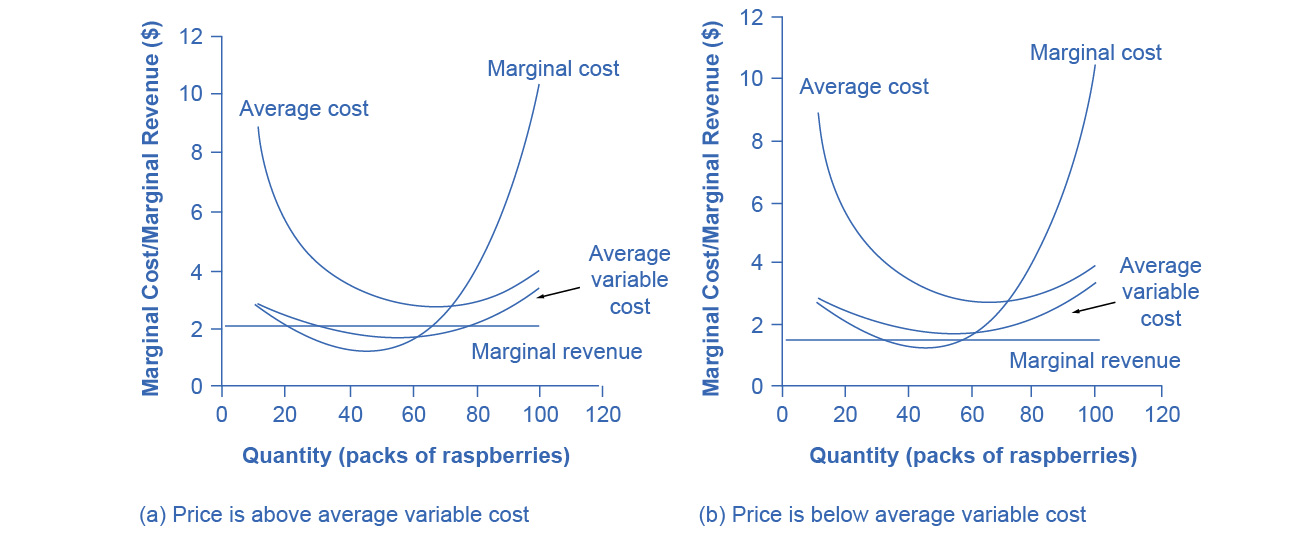

Figure 8.6図 8.6
In (a), the farm produces at a level of 65. It is making losses of $47.50, but price is above average variable cost, so it continues to operate. In (b), total revenues are $90 and total cost is $165, for overall losses of $75. If the farm shuts down, it must pay only its fixed costs of $62. Shutting down is preferable to selling at a price of $1.50 per pack.
英語のヒント
(a)では農場は65を生産する。損失は47.50ドルだが、価格が平均可変費用より高いため操業を続ける。(b)では総収入90ドル、総費用165ドルで、損失は75ドルとなる。停止すれば固定費用62ドルだけを払えばよい。1パック1.50ドルで売るより停止が望ましい。
Looking at Table 8.6, if the price falls below about $1.72, the minimum average variable cost, the firm must shut down.
英語のヒント
表8.6を見ると、価格が平均可変費用の最小値、約1.72ドルを下回れば、操業を停止しなければならない。
Quantity Q 数量Q |
Average Variable Cost AVC 平均可変費用AVC |
Average Cost AC 平均費用AC |
Marginal Cost MC 限界費用MC |
|---|---|---|---|
0 |
- |
- |
- |
10 |
$2.80 |
$9.00 |
$2.80 |
20 |
$2.40 |
$5.50 |
$2.00 |
30 |
$2.13 |
$4.20 |
$1.60 |
40 |
$1.90 |
$3.45 |
$1.20 |
50 |
$1.76 |
$3.00 |
$1.20 |
60 |
$1.72 |
$2.75 |
$1.50 |
70 |
$1.83 |
$2.71 |
$2.50 |
80 |
$2.10 |
$2.88 |
$4.00 |
90 |
$2.60 |
$3.29 |
$6.60 |
100 |
$3.38 |
$4.00 |
$10.40 |
110 |
$4.44 |
$5.00 |
$15.00 |
120 |
$5.44 |
$5.96 |
$31.50 |
The intersection of the average variable cost curve and the marginal cost curve, which shows the price below which the firm would lack enough revenue to cover its variable costs, is called the shutdown point. If the perfectly competitive firm faces a market price above the shutdown point, then the firm is at least covering its average variable costs. At a price above the shutdown point, the firm is also making enough revenue to cover at least a portion of fixed costs, so it should limp ahead even if it is making losses in the short run, since at least those losses will be smaller than if the firm shuts down immediately and incurs a loss equal to total fixed costs. However, if the firm is receiving a price below the price at the shutdown point, then the firm is not even covering its variable costs. In this case, staying open is making the firm’s losses larger, and it should shut down immediately. To summarize, if:
英語のヒント
平均可変費用曲線と限界費用曲線の交点を操業停止点と呼ぶ。それより低い価格では、変動費用を賄う収入が不足する。完全競争企業がそれより高い価格に直面すれば、少なくとも平均可変費用を賄えている。操業停止点より高い価格では、固定費用の少なくとも一部も賄えるので、短期に赤字でも苦しい操業を続けるべきである。即座に停止して総固定費用と同額の損失を負うより、損失は小さいからだ。しかし、操業停止点の価格より低ければ、変動費用さえ賄えない。続けると損失を増やすので、すぐ停止すべきである。まとめると、次のようになる。
- price < minimum average variable cost, then firm shuts down
英語のヒント
価格<平均可変費用の最小値なら、企業は操業を停止する。 - price > minimum average variable cost, then firm stays in business
英語のヒント
価格>平均可変費用の最小値なら、企業は操業を続ける。