第8章完全競争
The Long-Run Adjustment and Industry Types長期の調整と産業の種類
Whenever there are expansions in an industry, costs of production for the existing and new firms could either stay the same, increase, or even decrease. Therefore, we can categorize an industry as being (1) a constant-cost industry (as demand increases, the cost of production for firms stays the same), (2) an increasing-cost industry (as demand increases, the cost of production for firms increases), or (3) a decreasing-cost industry (as demand increases the costs of production for the firms decreases).
英語のヒント
産業が拡大すると、既存企業と新企業の生産費用は、不変、増加、低下のいずれにもなりうる。そのため産業は、(1)需要が増えても費用が変わらない費用不変産業、(2)需要が増えると費用も増える費用逓増産業、(3)需要が増えると費用が減る費用逓減産業に分類できる。
For a constant-cost industry, whenever there is an increase in market demand and price, then the supply curve shifts to the right with new firms’ entry and stops at the point where the new long-run equilibrium intersects at the same market price as before. This is the case of constant returns to scale, which we discussed earlier in the chapter on Production, Costs, and Industry Structure. However, why will costs remain the same? In this type of industry, the supply curve is very elastic. Firms can easily supply any quantity that consumers demand. In addition, there is a perfectly elastic supply of inputs—firms can easily increase their demand for employees, for example, with no increase to wages. Tying in to our Bring it Home discussion, an increased demand for ethanol in recent years has caused the demand for corn to increase. Consequently, many farmers switched from growing wheat to growing corn. Agricultural markets are generally good examples of constant-cost industries.
英語のヒント
費用不変産業では、市場需要と価格が上がると新企業の参入で供給曲線が右へ移り、新しい長期均衡が以前と同じ価格になる点で止まる。これは「生産・費用・産業構造」の章で論じた規模に関する収穫一定の場合である。なぜ費用は同じなのか。この産業の供給曲線は非常に弾力的で、消費者が需要するどんな数量も容易に供給できる。投入物の供給も完全に弾力的であり、たとえば賃金を上げずに労働需要を容易に増やせる。「身近な問題に戻る」と結びつけると、近年のエタノール需要増加はトウモロコシ需要を高めた。その結果、多くの農家が小麦からトウモロコシへ移った。農産物市場は一般に費用不変産業のよい例である。
For an increasing-cost industry, as the market expands, the old and new firms experience increases in their costs of production, which makes the new zero-profit level intersect at a higher price than before. Here companies may have to deal with limited inputs, such as skilled labor. As the demand for these workers rises, wages rise and this increases the cost of production for all firms. The industry supply curve in this type of industry is more inelastic.
英語のヒント
費用逓増産業では、市場が拡大すると新旧企業の費用が増え、新たなゼロ利潤水準は以前より高い価格で交わる。熟練労働などの限られた投入物に直面する場合がある。その労働者への需要が増すと賃金が上がり、全企業の費用が増える。この種の産業の供給曲線は、より非弾力的である。
For a decreasing-cost industry, as the market expands, the old and new firms experience lower costs of production, which makes the new zero-profit level intersect at a lower price than before. In this case, the industry and all the firms in it are experiencing falling average total costs. This can be due to an improvement in technology in the entire industry or an increase in the education of employees. High-tech industries may be a good example of a decreasing-cost market.
英語のヒント
費用逓減産業では、市場拡大に伴い新旧企業の生産費用が下がり、新たなゼロ利潤水準は以前より低い価格で交わる。この場合、産業と全企業の平均総費用が低下している。産業全体の技術改善や従業員の教育向上によることがある。ハイテク産業は費用逓減市場のよい例かもしれない。
Figure 8.8 (a) presents the case of an adjustment process in a constant-cost industry. Whenever there are output expansions in this type of industry, the long-run outcome implies more output produced at exactly the same original price. Note that supply was able to increase to meet the increased demand. When we join the before and after long-run equilibriums, the resulting line is the long run supply (LRS) curve in perfectly competitive markets. In this case, it is a flat curve. Figure 8.8 (b) and Figure 8.8 (c) present the cases for an increasing-cost and decreasing-cost industry, respectively. For an increasing-cost industry, the LRS is upward sloping, while for a decreasing-cost industry, the LRS is downward sloping.
英語のヒント
Adjustment Process in a Constant-Cost Industry費用不変産業の調整過程
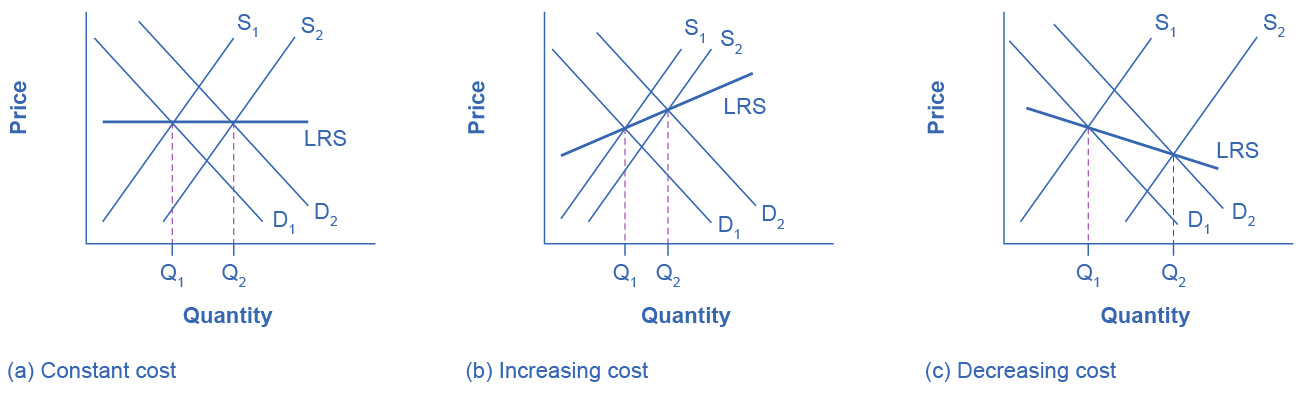

Figure 8.8図 8.8
In (a), demand increased and supply met it. Notice that the supply increase is equal to the demand increase. The result is that the equilibrium price stays the same as quantity sold increases. In (b), notice that sellers were not able to increase supply as much as demand. Some inputs were scarce, or wages were rising. The equilibrium price rises. In (c), sellers easily increased supply in response to the demand increase. Here, new technology or economies of scale caused the large increase in supply, resulting in declining equilibrium price.
英語のヒント
(a)では需要が増え、供給がそれを満たした。供給の増加は需要の増加と等しい。結果として販売量が増えても均衡価格は変わらない。(b)では売り手は需要ほど供給を増やせなかった。一部の投入物が希少だったか、賃金が上がっていた。均衡価格は上がる。(c)では需要増加に応じて容易に供給を増やせた。新技術や規模の経済が供給を大きく増やし、均衡価格を下げた。
Key Concepts and Summary重要概念とまとめ
In the long run, firms will respond to profits through a process of entry, where existing firms expand output and new firms enter the market. Conversely, firms will react to losses in the long run through a process of exit, in which existing firms cease production altogether. Through the process of entry in response to profits and exit in response to losses, the price level in a perfectly competitive market will move toward the zero-profit point, where the marginal cost curve crosses the AC curve at the minimum of the average cost curve.
英語のヒント
長期には企業は、既存企業の増産と新企業の市場参入という過程で利潤に反応する。逆に損失には、既存企業が生産を完全にやめる退出の過程で反応する。利潤への参入と損失への退出によって、完全競争市場の価格は、限界費用曲線が平均費用曲線の最小点で交わるゼロ利潤点へ向かう。
The long-run supply curve shows the long-run output supplied by firms in three different types of industries: constant cost, increasing cost, and decreasing cost.
英語のヒント
長期供給曲線は、費用不変、費用逓増、費用逓減という三種類の産業で、企業が長期に供給する生産量を示す。