第11章独占と反トラスト政策
11.1 Corporate Mergers11.1 企業合併
Learning Objectives学習目標
Learning Objectives学習目標
By the end of this section, you will be able to:
英語のヒント
この節を学ぶと、次のことができるようになる。
- Explain antitrust law and its significance
英語のヒント
反トラスト法とその意義を説明する - Calculate concentration ratios
英語のヒント
集中度を計算する - Calculate the Herfindahl-Hirschman Index (HHI)
英語のヒント
ハーフィンダール=ハーシュマン指数(HHI)を計算する - Evaluate methods of antitrust regulation
英語のヒント
反トラスト規制の方法を評価する
A corporate merger occurs when two formerly separate firms combine to become a single firm. When one firm purchases another, it is called an acquisition. An acquisition may not look just like a merger, since the newly purchased firm may continue to operate under its former company name. Mergers can also be lateral, where two firms of similar sizes combine to become one. However, both mergers and acquisitions lead to two formerly separate firms operating under common ownership, and so they are commonly grouped together.
英語のヒント
企業合併は、以前は別々だった2社が結びつき、単一の企業になるときに起こる。一方の企業が他方を購入する場合は、買収と呼ばれる。買収された企業が以前の社名で事業を続ける場合もあるため、買収は合併とまったく同じに見えるとは限らない。同程度の規模の2社が1社になる、対等な合併もある。しかし合併も買収も、以前は別々だった2社が共通の所有のもとで操業することにつながるため、通常はひとまとめに扱われる。
Regulations for Approving Mergers合併承認のための規制
Since a merger combines two firms into one, it can reduce the extent of competition between firms. Therefore, when two U.S. firms announce a merger or acquisition where at least one of the firms is above a minimum size of sales (a threshold that moves up gradually over time, and was at $101 million in 2022), or certain other conditions are met, they are required under law to notify the U.S. Federal Trade Commission (FTC). The left-hand panel of Figure 11.2 (a) shows the number of mergers submitted for review to the FTC each year from 1999 to 2012. Mergers follow the business cycle, falling after the 2001 recession, peaking in 2007 as the Great Recession struck, and then rising since 2009. The right-hand panel of Figure 11.2 (b) shows the distribution of those mergers submitted for review in 2015 as measured by the size of the transaction. It is important to remember that this total leaves out many small mergers under $50 million, which companies only need to report in certain limited circumstances. In 2012, 26 percent of all reported merger and acquisition transactions exceeded $500 million, while 11 percent exceeded $1 billion.
英語のヒント
合併は2社を1社にするため、企業間の競争の程度を下げる可能性がある。そのため米国の2社が合併または買収を発表し、少なくとも一方の売上規模が最低基準(時間とともに徐々に上昇し、2022年には1億100万ドルだった)を上回る場合、または他の一定の条件を満たす場合、法律により米国連邦取引委員会(FTC)への届出が義務づけられる。図11.2(a)の左側は、1999年から2012年まで毎年FTCの審査に提出された合併の件数を示す。合併は景気循環に沿って動き、2001年の景気後退後に減少し、大不況が始まった2007年に頂点に達し、2009年以降は増加している。図11.2(b)の右側は、2015年に審査に提出された合併の取引規模別の分布を示す。この合計には、特定の限られた状況でのみ報告が必要な、5000万ドル未満の小規模合併が多数含まれないことを覚えておこう。2012年には、報告された合併・買収取引の26パーセントが5億ドルを超え、11パーセントが10億ドルを超えていた。
Number and Size of Mergers合併の件数と規模
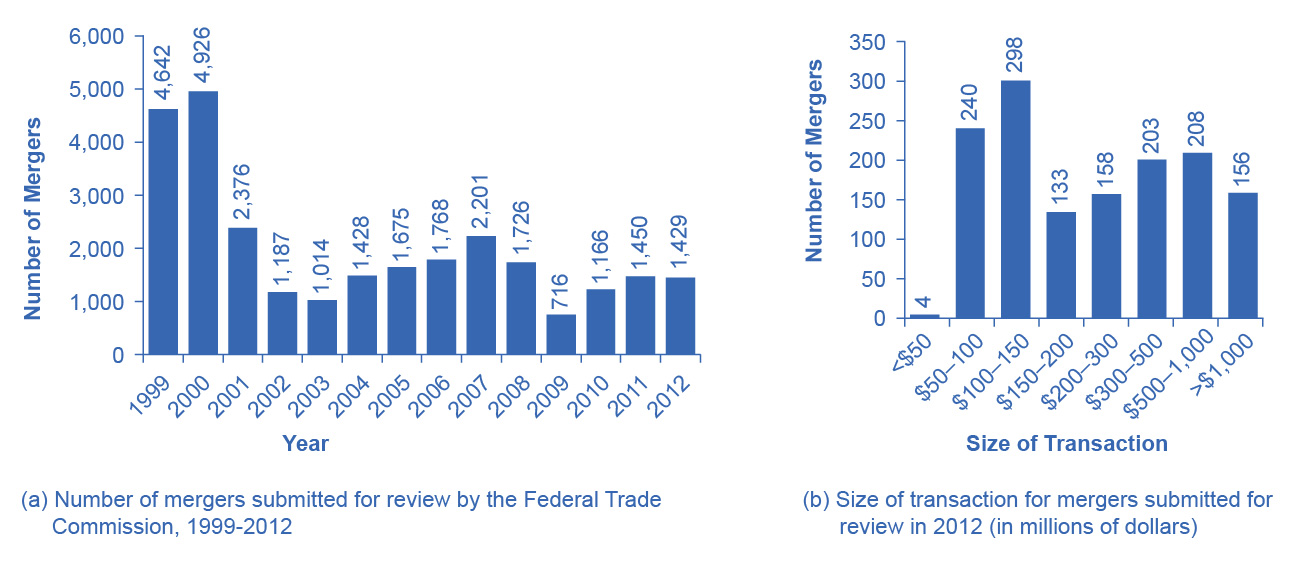

Figure 11.2図 11.2
(a) The number of mergers grew from 2003 to 2007, then fell dramatically during the 2008-2009 Great Recession, before recovering since. (b) In 2012, the greatest number of mergers submitted for review by the Federal Trade Commission was for transactions between $100–$150 million.
英語のヒント
(a)合併件数は2003年から2007年にかけて増加し、2008〜2009年の大不況で大きく減少した後、回復している。(b)2012年に連邦取引委員会の審査に提出された合併では、1億〜1億5000万ドルの取引が最も多かった。
The laws that give government the power to block certain mergers, and even in some cases to break up large firms into smaller ones, are called antitrust laws. Before a large merger happens, the antitrust regulators at the FTC, the FCC, the U.S. Department of Justice, or other regulatory agencies can allow the merger, prohibit it, or allow it if certain conditions are met. One common condition is that the merger will be allowed if the firm agrees to sell off certain parts. For example, in 2006, Johnson & Johnson bought the Pfizer’s “consumer health” division, which included well-known brands like Listerine mouthwash and Sudafed cold medicine. As a condition of allowing the merger, Johnson & Johnson was required to sell off six brands to other firms, including Zantac® heartburn relief medication, Cortizone anti-itch cream, and Balmex diaper rash medication, to preserve a greater degree of competition in these markets.
英語のヒント
特定の合併を阻止し、場合によっては大企業をより小さい企業に分割する権限を政府に与える法律を、反トラスト法と呼ぶ。大型合併が行われる前に、FTC、FCC、米国司法省、その他の規制機関の反トラスト担当者は、合併を認めるか、禁止するか、一定の条件が満たされれば認めるかを決定できる。よくある条件の1つは、企業が特定の部門などを売却することに同意すれば、合併を認めるというものである。たとえば2006年、Johnson & JohnsonはPfizerの「コンシューマーヘルス」部門を買収した。この部門には、洗口液Listerineやかぜ薬Sudafedなどの有名ブランドが含まれていた。買収承認の条件としてJohnson & Johnsonは、これらの市場でより大きな競争を維持するため、胸焼け治療薬Zantac®、かゆみ止めクリームCortizone、おむつかぶれ治療薬Balmexなど、6ブランドを他社に売却することを求められた。
The U.S. government approves most proposed mergers. In a market-oriented economy, firms have the freedom to make their own choices. Private firms generally have the freedom to:
英語のヒント
米国政府は、提案された合併の大部分を承認する。市場志向の経済では、企業は自ら選択する自由を持つ。民間企業には一般に、次の自由がある。
- expand or reduce production
英語のヒント
生産を拡大または縮小する - set the price they choose
英語のヒント
自ら選んだ価格を設定する - open new factories or sales facilities or close them
英語のヒント
新しい工場や販売施設を開設する、または閉鎖する - hire workers or to lay them off
英語のヒント
労働者を雇用する、または解雇する - start selling new products or stop selling existing ones
英語のヒント
新製品の販売を始める、または既存製品の販売をやめる
If the owners want to acquire a firm or be acquired, or to merge with another firm, this decision is just one of many that firms are free to make. In these conditions, the managers of private firms will sometimes make mistakes. They may close down a factory which, it later turns out, would have been profitable. They may start selling a product that ends up losing money. A merger between two companies can sometimes lead to a clash of corporate personalities that makes both firms worse off. However, the fundamental belief behind a market-oriented economy is that firms, not governments, are in the best position to know if their actions will lead to attracting more customers or producing more efficiently.
英語のヒント
所有者が企業を買収したい、買収されたい、他社と合併したいと考えるなら、その決定も企業が自由に行える多くの決定の1つである。この条件のもとでは、民間企業の経営者が判断を誤ることもある。後になって利益が出たはずだとわかる工場を閉鎖するかもしれない。結局赤字になる製品の販売を始めるかもしれない。2社の合併が企業の個性の衝突を招き、両社の状況を悪化させることもある。しかし、市場志向の経済の背後にある基本的な考え方は、自らの行動が顧客の増加や生産効率の向上につながるかを最もよく知る立場にあるのは、政府ではなく企業だというものである。
Government regulators agree that most mergers are beneficial to consumers. As the Federal Trade Commission has noted on its website (as of November, 2013): “Most mergers actually benefit competition and consumers by allowing firms to operate more efficiently.” At the same time, the FTC recognizes, “Some [mergers] are likely to lessen competition. That, in turn, can lead to higher prices, reduced availability of goods or services, lower quality of products, and less innovation. Some mergers create a concentrated market, while others enable a single firm to raise prices.” The challenge for the antitrust regulators at the FTC and the U.S. Department of Justice is to figure out when a merger may hinder competition. This decision involves both numerical tools and some judgments that are difficult to quantify. The following Clear It Up explains the origins of U.S. antitrust law.
英語のヒント
政府の規制担当者も、大部分の合併が消費者に利益をもたらすことに同意している。連邦取引委員会はウェブサイトで(2013年11月時点)、「大部分の合併は、企業のより効率的な操業を可能にすることで、実際に競争と消費者の利益となる」と述べている。同時にFTCは、「一部の[合併]は競争を減らす可能性が高い。それによって、価格の上昇、財やサービスの供給可能性の低下、製品品質の低下、革新の減少が起こりうる。一部の合併は集中した市場を作り、他の合併は単一企業による値上げを可能にする」と認めている。FTCと米国司法省の反トラスト担当者の課題は、どのような場合に合併が競争を妨げるかを見極めることである。この判断には、数値的な道具と、数量化しにくい判断の両方が関わる。次の「疑問を解こう」では、米国の反トラスト法の起源を説明する。