第13章正の外部性と公共財
Why Invest in Human Capital?なぜ人的資本に投資するのか。
The investment in anything, whether it is the construction of a new power plant or research in a new cancer treatment, usually requires a certain upfront cost with an uncertain future benefit. The investment in education, or human capital, is no different. Over the span of many years, a student and her family invest significant amounts of time and money into that student’s education. The idea is that higher levels of educational attainment will eventually serve to increase the student’s future productivity and subsequent ability to earn. Once the student crunches the numbers, does this investment pay off for her?
英語のヒント
新しい発電所の建設でも、新しいがん治療法の研究でも、何かへの投資には通常、一定の初期費用と、不確実な将来の便益が伴う。教育、すなわち人的資本への投資も同じである。長年にわたり、学生とその家族は、学生の教育に多くの時間と金銭を投資する。教育達成度が高まれば、やがてその学生の将来の生産性が上がり、その後の稼ぐ能力も高まるという考えである。学生が数字を計算すると、この投資は本人にとって報われるだろうか。
Almost universally, economists have found that the answer to this question is a clear “Yes.” For example, several studies of the return to education in the United States estimate that the rate of return to a college education is approximately 10-15%. Data in Table 13.2, from the U.S. Bureau of Labor Statistics’ Usual Weekly Earnings of Wage and Salary Workers, Fourth Quarter 2021, demonstrate that median weekly earnings are higher for workers who have completed more education. While these rates of return will beat equivalent investments in Treasury bonds or savings accounts, the estimated returns to education go primarily to the individual worker, so these returns are private rates of return to education.
英語のヒント
経済学者はほぼ例外なく、この問いへの答えは明確な「はい」であると見いだしてきた。たとえば米国の教育収益率に関する複数の研究は、大学教育の収益率を約10〜15%と推計する。米国労働統計局の「賃金・給与労働者の通常の週当たり所得、2021年第4四半期」に基づく表13.2は、修了した教育水準が高い労働者ほど、週当たり所得の中央値が高いことを示す。これらの収益率は、同等の国債や預金口座への投資を上回るが、推計される教育収益は主に個々の労働者に帰属するため、教育の私的収益率である。
Less than a High School Degree 高校卒業未満 |
High School Degree, No College 高校卒業、大学進学なし |
Bachelor's Degree or Higher 学士以上 |
|
|---|---|---|---|
Median Weekly Earnings (full-time workers over the age of 25) 週当たり所得の中央値(25歳を超えるフルタイム労働者) |
$651 |
$831 |
$1,467 |
What does society gain from investing in the education of another student? After all, if the government is spending taxpayer dollars to subsidize public education, society should expect some kind of return on that spending. Economists like George Psacharopoulos have found that, across a variety of nations, the social rate of return on schooling is also positive. After all, positive externalities exist from investment in education. While not always easy to measure, according to Walter McMahon, the positive externalities to education typically include better health outcomes for the population, lower levels of crime, a cleaner environment and a more stable, democratic government. For these reasons, many nations have chosen to use taxpayer dollars to subsidize primary, secondary, and higher education. Education clearly benefits the person who receives it, but a society where most people have a good level of education provides positive externalities for all.
英語のヒント
もう1人の学生の教育に投資することから、社会は何を得るだろうか。政府が税金で公教育を補助するなら、社会はその支出から何らかの収益を期待すべきである。ジョージ・サカロプロスのような経済学者は、さまざまな国で、就学の社会的収益率も正であることを見いだしてきた。教育への投資には正の外部性があるためである。ウォルター・マクマホンによれば、必ずしも測りやすくはないが、教育の正の外部性には通常、人々の健康改善、犯罪の減少、よりきれいな環境、より安定した民主的政府が含まれる。このため、多くの国は税金を使い、初等・中等・高等教育を補助することを選んだ。教育は受ける本人に明らかな利益を与えるが、多くの人が十分な教育を持つ社会は、すべての人に正の外部性をもたらす。
Other Examples of Positive Externalities正の外部性の他の例
Although technology may be the most prominent example of a positive externality, it is not the only one. For example, vaccinations against disease are not only a protection for the individual, but they have the positive spillover of protecting others who may become infected. When a number of homes in a neighborhood are modernized, updated, and restored, not only does it increase the homes' value, but other property values in the neighborhood may increase as well.
英語のヒント
技術は正の外部性の最も目立つ例かもしれないが、唯一の例ではない。たとえば病気の予防接種は、接種した個人を守るだけでなく、感染する可能性のある他者を守るという正の波及効果を持つ。近隣の複数の住宅が近代化され、改修・修復されると、その住宅の価値が上がるだけでなく、近隣の他の不動産価値も上がることがある。
The appropriate public policy response to a positive externality, like a new technology, is to help the party creating the positive externality receive a greater share of the social benefits. In the case of vaccines, like flu shots, an effective policy might be to provide a subsidy to those who choose to get vaccinated.
英語のヒント
新技術のような正の外部性に対する適切な公共政策は、それを生み出す当事者が、社会的便益のより大きな割合を受け取れるよう助けることである。インフルエンザなどの予防接種では、接種を選ぶ人に補助金を与えることが有効な政策かもしれない。
Figure 13.3 shows the market for flu shots. The market demand curve DMarket for flu shots reflects only the marginal private benefits (MPB) that the vaccinated individuals receive from the shots. Assuming that there are no spillover costs in the production of flu shots, the market supply curve is given by the marginal private cost (MPC) of producing the vaccinations.
英語のヒント
図13.3は、インフルエンザ予防接種の市場を示す。予防接種の市場需要曲線DMarketは、接種する個人が受け取る限界私的便益(MPB)だけを反映する。予防接種の生産に波及費用がないと仮定すると、市場供給曲線は、予防接種を生産する限界私的費用(MPC)によって与えられる。
The equilibrium quantity of flu shots produced in the market, where MPB is equal to MPC, is QMarket and the price of flu shots is PMarket. However, spillover benefits exist in this market because others, those who chose not to purchase a flu shot, receive a positive externality in the form of a reduced chance of contracting the flu. When we add the spillover benefits to the marginal private benefit of flu shots, the marginal social benefit (MSB) of flu shots is given by DSocial. Because the MSB is greater than MPB, we see that the socially optimal level of flu shots is greater than the market quantity (QSocial exceeds QMarket) and the corresponding price of flu shots, if the market were to produce QSocial, would be at PSocial. Unfortunately, the marketplace does not recognize the positive externality and flu shots will go under-produced and under-consumed.
英語のヒント
MPBとMPCが等しくなる、市場で生産される予防接種の均衡数量はQMarket、価格はPMarketである。しかしこの市場には波及便益がある。予防接種を購入しないことを選んだ他者も、インフルエンザにかかる可能性が低下するという正の外部性を受けるためである。限界私的便益に波及便益を加えると、予防接種の限界社会的便益(MSB)はDSocialで与えられる。MSBはMPBより大きいため、社会的に最適な予防接種の水準は市場数量より大きい(QSocialはQMarketを上回る)。市場がQSocialを生産するなら、それに対応する予防接種の価格はPSocialとなる。残念ながら市場は正の外部性を認識せず、予防接種の生産と消費は過少になる。
How can government try to move the market level of output closer to the socially desirable level of output? One policy would be to provide a subsidy, like a voucher, to any citizen who wishes to get vaccinated. This voucher would act as “income” that one could use to purchase only a flu shot and, if the voucher were exactly equal to the per-unit spillover benefits, would increase market equilibrium to a quantity of QSocial and a price of PSocial where MSB equals MSC (which equals MPC given the assumption that there are no spillover costs in producing the vaccine). Suppliers of the flu shots would receive payment of PSocial per vaccination, while consumers of flu shots would redeem the voucher and only pay a price of PSubsidy. When the government uses a subsidy in this way, it produces the socially optimal quantity of vaccinations.
英語のヒント
政府は、市場生産量を社会的に望ましい生産量へ近づけるため、何ができるだろうか。1つの政策は、接種を希望するすべての市民に、引換券のような補助金を与えることである。この券は予防接種だけの購入に使える「所得」として働く。券の額が単位当たりの波及便益にちょうど等しければ、市場均衡はMSBとMSCが等しい数量QSocial、価格PSocialまで上昇する(ワクチン生産に波及費用がないという仮定により、MSCはMPCに等しい)。予防接種の供給者は1回当たりPSocialの支払を受け、消費者は券を使ってPSubsidyの価格だけを払う。政府がこのように補助金を使うと、社会的に最適な数量の予防接種が生産される。
The Market for Flu Shots with Spillover Benefits (A Positive Externality)波及便益(正の外部性)があるインフルエンザ予防接種市場
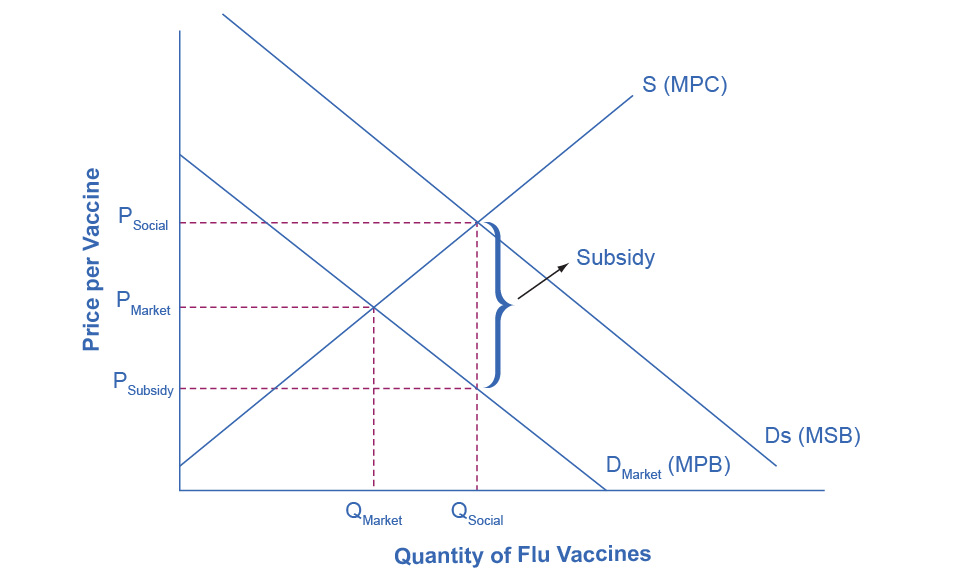

Figure 13.3図 13.3
The market demand curve does not reflect the positive externality of flu vaccinations, so only QMarket will be exchanged. This outcome is inefficient because the marginal social benefit exceeds the marginal social cost. If the government provides a subsidy to consumers of flu shots, equal to the marginal social benefit minus the marginal private benefit, the level of vaccinations can increase to the socially optimal quantity of QSocial.
英語のヒント
市場需要曲線はインフルエンザ予防接種の正の外部性を反映しないため、取引されるのはQMarketだけである。この結果は、限界社会的便益が限界社会的費用を上回るため非効率的である。政府が、限界社会的便益から限界私的便益を引いた額の補助金を消費者に与えれば、接種量は社会的に最適なQSocialまで増やせる。