第10章独占的競争と寡占
10.1 Monopolistic Competition10.1 独占的競争
Learning Objectives学習目標
Learning Objectives学習目標
By the end of this section, you will be able to:
英語のヒント
この節を学ぶと、次のことができるようになる。
- Explain the significance of differentiated products
英語のヒント
差別化された製品の意義を説明する - Describe how a monopolistic competitor chooses price and quantity
英語のヒント
独占的競争企業が価格と数量をどのように選ぶかを説明する - Discuss entry, exit, and efficiency as they pertain to monopolistic competition
英語のヒント
独占的競争に関わる参入、退出、効率性を論じる - Analyze how advertising can impact monopolistic competition
英語のヒント
広告が独占的競争に与えうる影響を分析する
Monopolistic competition involves many firms competing against each other, but selling products that are distinctive in some way. Examples include stores that sell different styles of clothing; restaurants or grocery stores that sell a variety of food; and even products like golf balls or beer that may be at least somewhat similar but differ in public perception because of advertising and brand names. There are over 600,000 restaurants in the United States. When products are distinctive, each firm has a mini-monopoly on its particular style or flavor or brand name. However, firms producing such products must also compete with other styles and flavors and brand names. The term “monopolistic competition” captures this mixture of mini-monopoly and tough competition, and the following Clear It Up feature introduces its derivation.
英語のヒント
独占的競争では、多数の企業が互いに競争しながら、何らかの点で特徴のある製品を販売する。異なるスタイルの衣服を売る店、さまざまな食品を売るレストランや食料品店、さらには、少なくともある程度は似ていても、広告やブランド名によって人々の受け止め方が異なるゴルフボールやビールなどが例に当たる。米国には60万軒を超えるレストランがある。製品に特徴がある場合、各企業は特定のスタイル、味、ブランド名について小さな独占を持つ。しかし、そのような製品を生産する企業も、他のスタイル、味、ブランド名と競争しなければならない。「独占的競争」という用語は、小さな独占と厳しい競争が混ざり合う状況を捉えている。次の「疑問を解こう」では、その由来を紹介する。
Differentiated Products差別化された製品
A firm can try to make its products different from those of its competitors in several ways: physical aspects of the product, location from which it sells the product, intangible aspects of the product, and perceptions of the product. We call products that are distinctive in one of these ways differentiated products.
英語のヒント
企業は、製品の物理的な側面、製品を販売する場所、製品の無形の側面、製品の受け止められ方など、いくつかの方法で自社の製品を競合企業の製品と異なるものにしようとすることができる。これらの点のいずれかに特徴のある製品を、差別化された製品と呼ぶ。
Physical aspects of a product include all the phrases you hear in advertisements: unbreakable bottle, nonstick surface, freezer-to-microwave, non-shrink, extra spicy, newly redesigned for your comfort. A firm's location can also create a difference between producers. For example, a gas station located at a heavily traveled intersection can probably sell more gas, because more cars drive by that corner. A supplier to an automobile manufacturer may find that it is an advantage to locate close to the car factory.
英語のヒント
製品の物理的な側面には、広告で耳にするあらゆる表現が含まれる。割れないボトル、こびりつかない表面、冷凍庫からそのまま電子レンジへ、縮まない、特別に辛い、快適さのために新たに設計し直した、といった表現である。企業の立地も、生産者の間に違いを生み出すことがある。たとえば交通量の多い交差点にあるガソリンスタンドは、その角を多くの車が通るため、おそらくより多くのガソリンを売れる。自動車メーカーに部品などを供給する企業は、自動車工場の近くに立地することが有利だと気づくかもしれない。
Intangible aspects can differentiate a product, too. Some intangible aspects may be promises like a guarantee of satisfaction or money back, a reputation for high quality, services like free delivery, or offering a loan to purchase the product. Finally, product differentiation may occur in the minds of buyers. For example, many people could not tell the difference in taste between common varieties of ketchup or mayonnaise if they were blindfolded but, because of past habits and advertising, they have strong preferences for certain brands. Advertising can play a role in shaping these intangible preferences.
英語のヒント
無形の側面も製品を差別化できる。無形の側面には、満足できなければ返金するという保証のような約束、高品質という評判、無料配送のようなサービス、製品購入のための融資などがある。最後に、製品の差別化は買い手の頭の中でも起こりうる。たとえば多くの人は、目隠しをされれば一般的なケチャップやマヨネーズの種類による味の違いを区別できないだろうが、過去の習慣や広告のために特定のブランドを強く好む。広告は、このような無形の好みの形成に役割を果たしうる。
The concept of differentiated products is closely related to the degree of variety that is available. If everyone in the economy wore only blue jeans, ate only white bread, and drank only tap water, then the markets for clothing, food, and drink would be much closer to perfectly competitive. The variety of styles, flavors, locations, and characteristics creates product differentiation and monopolistic competition.
英語のヒント
差別化された製品という概念は、入手できる種類の豊富さと密接に関係する。経済の全員が青いジーンズだけを着て、白いパンだけを食べ、水道水だけを飲むならば、衣服、食べ物、飲み物の市場は、完全競争にはるかに近くなるだろう。スタイル、味、立地、特性の多様さが、製品の差別化と独占的競争を生む。
Perceived Demand for a Monopolistic Competitor独占的競争企業が認識する需要
A monopolistically competitive firm perceives a demand for its goods that is an intermediate case between monopoly and competition. Figure 10.2 offers a reminder that the demand curve that a perfectly competitive firm faces is perfectly elastic or flat, because the perfectly competitive firm can sell any quantity it wishes at the prevailing market price. In contrast, the demand curve, as faced by a monopolist, is the market demand curve, since a monopolist is the only firm in the market, and hence is downward sloping.
英語のヒント
独占的競争企業は、自社の商品に対する需要を、独占と競争の中間の場合として認識する。図10.2は、完全競争企業が直面する需要曲線が完全に弾力的、つまり水平であることを再確認させる。完全競争企業は、そのときの市場価格で望むだけの数量を売れるためである。これに対して、独占企業が直面する需要曲線は市場需要曲線である。独占企業は市場に唯一の企業なので、その需要曲線は右下がりになる。
Perceived Demand for Firms in Different Competitive Settings異なる競争環境の企業が認識する需要
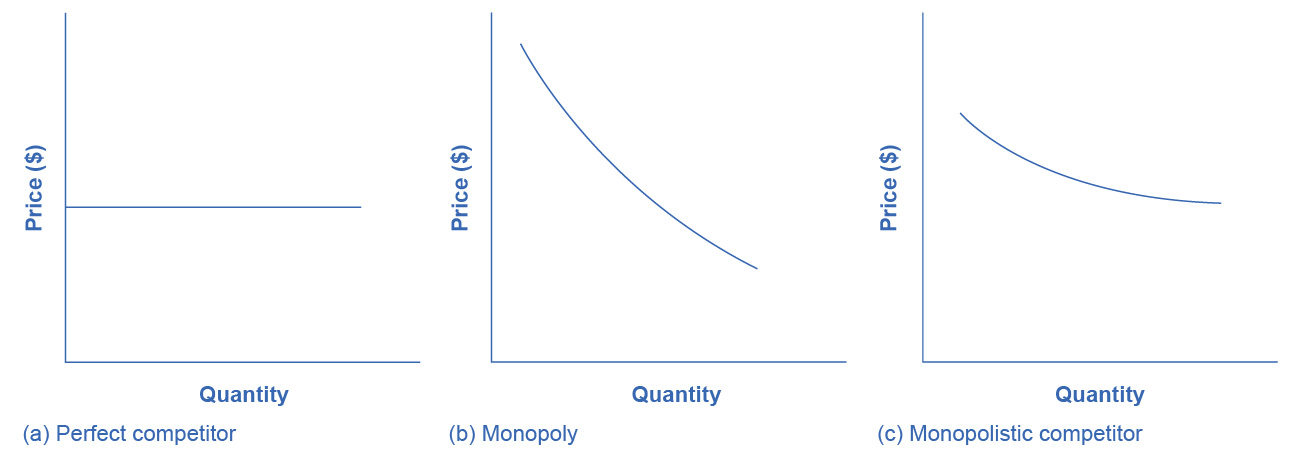

Figure 10.2図 10.2
The demand curve that a perfectly competitive firm faces is perfectly elastic, meaning it can sell all the output it wishes at the prevailing market price. The demand curve that a monopoly faces is the market demand. It can sell more output only by decreasing the price it charges. The demand curve that a monopolistically competitive firm faces falls in between.
英語のヒント
完全競争企業が直面する需要曲線は完全に弾力的であり、そのときの市場価格で望むだけの生産物をすべて販売できることを意味する。独占企業が直面する需要曲線は市場需要である。より多くの生産物を売るには、設定価格を下げるしかない。独占的競争企業が直面する需要曲線は、その中間にある。
The demand curve as a monopolistic competitor faces is not flat, but rather downward-sloping, which means that the monopolistic competitor can raise its price without losing all of its customers or lower the price and gain more customers. Since there are substitutes, the demand curve facing a monopolistically competitive firm is more elastic than that of a monopoly where there are no close substitutes. If a monopolist raises its price, some consumers will choose not to purchase its product—but they will then need to buy a completely different product. However, when a monopolistic competitor raises its price, some consumers will choose not to purchase the product at all, but others will choose to buy a similar product from another firm. If a monopolistic competitor raises its price, it will not lose as many customers as would a perfectly competitive firm, but it will lose more customers than would a monopoly that raised its prices.
英語のヒント
独占的競争企業が直面する需要曲線は水平ではなく、右下がりである。これは、すべての顧客を失わずに価格を引き上げられ、価格を下げればより多くの顧客を得られることを意味する。代替品があるため、独占的競争企業が直面する需要曲線は、近い代替品のない独占企業の需要曲線よりも弾力的である。独占企業が価格を引き上げると、その製品を買わない消費者も現れるが、その場合、まったく異なる製品を買う必要がある。これに対し、独占的競争企業が価格を引き上げると、その製品をまったく買わない消費者もいれば、別の企業から類似の製品を買う消費者もいる。独占的競争企業が価格を引き上げた場合、失う顧客は完全競争企業ほど多くはないが、値上げした独占企業よりは多い。
At a glance, the demand curves that a monopoly and a monopolistic competitor face look similar—that is, they both slope down. However, the underlying economic meaning of these perceived demand curves is different, because a monopolist faces the market demand curve and a monopolistic competitor does not. Rather, a monopolistically competitive firm’s demand curve is but one of many firms that make up the “before” market demand curve. Are you following? If so, how would you categorize the market for golf balls? Take a swing, then see the following Clear It Up feature.
英語のヒント
一見すると、独占企業と独占的競争企業が直面する需要曲線は似ている。どちらも右下がりだからである。しかし、認識されるこれらの需要曲線の背後にある経済的な意味は異なる。独占企業は市場需要曲線に直面するが、独占的競争企業はそうではないためである。独占的競争企業の需要曲線は、むしろ「前の」市場需要曲線を構成する多数の企業の1つにすぎない。ここまで理解できただろうか。できたなら、ゴルフボールの市場をどのように分類するだろうか。ひと振りして考え、次の「疑問を解こう」を読もう。