第10章独占的競争と寡占
Self-Check Questions理解度確認問題
Exercises 13–14練習問題 13–14
Exercise 13問題 13
Consider the curve in the figure below, which shows the market demand, marginal cost, and marginal revenue curve for firms in an oligopolistic industry. In this example, we assume firms have zero fixed costs.
英語のヒント
下の図の曲線を考えよう。図は、寡占産業の企業の市場需要、限界費用、限界収入の曲線を示す。この例では、企業の固定費用はゼロと仮定する。
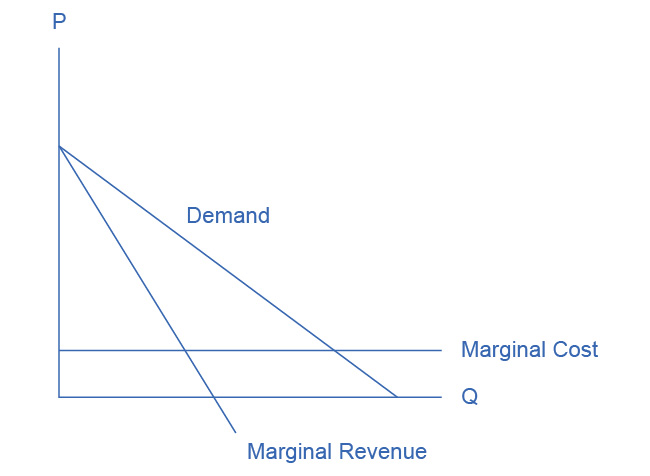
Figure 10.6図 10.6
- Suppose the firms collude to form a cartel. What price will the cartel charge? What quantity will the cartel supply? How much profit will the cartel earn?
英語のヒント
企業が共謀してカルテルを形成するとする。カルテルはいくらの価格を設定するか。どれだけの数量を供給するか。どれだけの利潤を得るか。 - Suppose now that the cartel breaks up and the oligopolistic firms compete as vigorously as possible by cutting the price and increasing sales. What will be the industry quantity and price? What will be the collective profits of all firms in the industry?
英語のヒント
今度はカルテルが崩壊し、寡占企業が値下げと販売増加によって可能なかぎり激しく競争するとする。産業の数量と価格はいくらになるか。産業の全企業を合わせた利潤はいくらになるか。 - Compare the equilibrium price, quantity, and profit for the cartel and cutthroat competition outcomes.
英語のヒント
カルテルと熾烈な競争の結果について、均衡価格、数量、利潤を比較しなさい。
Solution解き方
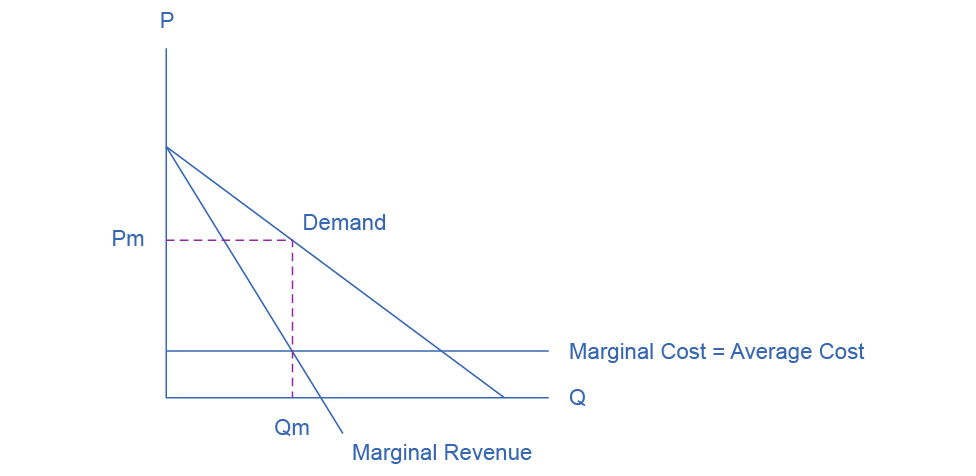
- If the firms form a cartel, they will act like a monopoly, choosing the quantity of output where MR = MC. Drawing a line from the monopoly quantity up to the demand curve shows the monopoly price. Assuming that fixed costs are zero, and with an understanding of cost and profit, we can infer that when the marginal cost curve is horizontal, average cost is the same as marginal cost. Thus, the cartel will earn positive economic profits equal to the area of the rectangle, with a base equal to the monopoly quantity and a height equal to the difference between price (on the demand above the monopoly quantity) and average cost, as shown in the following figure.
英語のヒント
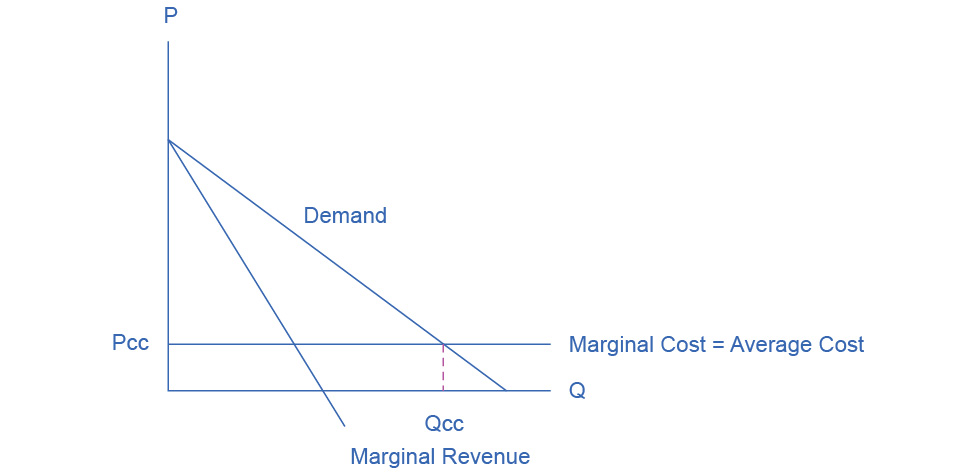
企業がカルテルを形成すると、独占企業のように行動し、MR = MCとなる生産量を選ぶ。独占数量から需要曲線まで上に線を引くと、独占価格がわかる。固定費用がゼロという仮定と、費用と利潤の理解から、限界費用曲線が水平なら、平均費用は限界費用と等しいと推論できる。したがってカルテルは、下の図に示すように、底辺が独占数量、高さが価格(独占数量の上にある需要曲線上の価格)と平均費用の差に等しい長方形の面積に相当する、正の経済的利潤を得る。 - The firms will expand output and cut price as long as there are profits remaining. The long-run equilibrium will occur at the point where average cost equals demand. As a result, the oligopoly will earn zero economic profits due to “cutthroat competition,” as shown in the next figure.
英語のヒント
企業は、利潤が残っているかぎり、生産を拡大し価格を引き下げる。長期均衡は、平均費用と需要が等しくなる点で生じる。その結果、次の図のように、「熾烈な競争」によって寡占の経済的利潤はゼロになる。 - Pc > Pcc. Qc < Qcc. Profit for the cartel is positive and large. Profit for cutthroat competition is zero.
英語のヒント
Pc > Pcc。Qc < Qcc。カルテルの利潤は正で大きい。熾烈な競争の利潤はゼロである。


Exercise 14問題 14
Sometimes oligopolies in the same industry are very different in size. Suppose we have a duopoly where one firm (Firm A) is large and the other firm (Firm B) is small, as the prisoner’s dilemma box in Table 10.5 shows.
英語のヒント
同じ産業の寡占企業でも、規模が大きく異なることがある。表10.5の囚人のジレンマの表が示すように、一方の企業(企業A)が大きく、他方(企業B)が小さい複占を考えよう。
Firm B colludes with Firm A 企業Bが企業Aと共謀する |
Firm B cheats by selling more output 企業Bが裏切って販売量を増やす |
|
Firm A colludes with Firm B 企業Aが企業Bと共謀する |
A gets $1,000, B gets $100 Aは1000ドル、Bは100ドルを得る |
A gets $800, B gets $200 Aは800ドル、Bは200ドルを得る |
Firm A cheats by selling more output 企業Aが裏切って販売量を増やす |
A gets $1,050, B gets $50 Aは1050ドル、Bは50ドルを得る |
A gets $500, B gets $20 Aは500ドル、Bは20ドルを得る |
Assuming that both firms know the payoffs, what is the likely outcome in this case?
英語のヒント
両社が利得を知っていると仮定すると、この場合はどのような結果が起こりそうか。
Solution解き方
Firm B reasons that if it cheats and Firm A does not notice, it will double its money. Since Firm A’s profits will decline substantially, however, it is likely that Firm A will notice and if so, Firm A will cheat also, with the result that Firm B will lose 90% of what it gained by cheating. Firm A will reason that Firm B is unlikely to risk cheating. If neither firm cheats, Firm A earns $1000. If Firm A cheats, assuming Firm B does not cheat, A can boost its profits only a little, since Firm B is so small. If both firms cheat, then Firm A loses at least 50% of what it could have earned. The possibility of a small gain ($50) is probably not enough to induce Firm A to cheat, so in this case it is likely that both firms will collude.
英語のヒント
企業Bは、自社が裏切り、企業Aが気づかなければ、自社の利益を2倍にできると考える。しかし企業Aの利潤は大幅に減るため、Aは気づく可能性が高く、気づけばAも裏切る。その結果、Bは裏切って得たものの90%を失う。企業Aは、Bが裏切りの危険を冒す可能性は低いと考える。どちらも裏切らなければ、企業Aは1000ドルを得る。Bが裏切らないと仮定してAが裏切っても、Bが非常に小さいため、Aの利潤はわずかしか増えない。両社が裏切れば、Aは得られたはずのものの少なくとも50%を失う。小さな利益(50ドル)の可能性だけでは、おそらくAを裏切りに向かわせるには不十分であり、この場合は両社が共謀する可能性が高い。
Review Questions復習問題
Exercises 15–17練習問題 15–17
Exercise 15問題 15
Will the firms in an oligopoly act more like a monopoly or more like competitors? Briefly explain.
英語のヒント
寡占の企業は、独占企業に近い行動をするか、それとも競争者に近い行動をするか。簡潔に説明しなさい。
Exercise 16問題 16
Does each individual in a prisoner’s dilemma benefit more from cooperation or from pursuing self-interest? Explain briefly.
英語のヒント
囚人のジレンマの各個人は、協力からより大きな利益を得るか、それとも私利の追求から得るか。簡潔に説明しなさい。
Exercise 17問題 17
What stops oligopolists from acting together as a monopolist and earning the highest possible level of profits?
英語のヒント
寡占企業が独占企業として共同行動し、可能なかぎり高い利潤を得ることを妨げるのは何か。
Critical Thinking Questions考察問題
Exercises 18–19練習問題 18–19
Exercise 18問題 18
Would you expect the kinked demand curve to be more extreme (like a right angle) or less extreme (like a normal demand curve) if each firm in the cartel produces a near-identical product like OPEC and petroleum? What if each firm produces a somewhat different product? Explain your reasoning.
英語のヒント
OPECと石油のように、カルテルの各企業がほぼ同一の製品を生産する場合、需要曲線の屈折はより極端になる(直角に近くなる)と予想するか、それとも極端でなくなる(通常の需要曲線に近くなる)と予想するか。各企業が多少異なる製品を生産する場合はどうか。理由を説明しなさい。
Exercise 19問題 19
When OPEC raised the price of oil dramatically in the mid-1970s, experts said it was unlikely that the cartel could stay together over the long term—that the incentives for individual members to cheat would become too strong. More than forty years later, OPEC still exists. Why do you think OPEC has been able to beat the odds and continue to collude? Hint: You may wish to consider non-economic reasons.
英語のヒント
1970年代半ばにOPECが石油価格を大幅に引き上げたとき、専門家は、個々の加盟国が裏切る誘因が強くなりすぎるため、カルテルが長期にまとまりを維持する可能性は低いと述べた。40年以上たった後も、OPECは存在する。OPECが不利な予想を覆して共謀を続けられたのはなぜだと思うか。ヒント:経済以外の理由も考えてみるとよい。