第10章独占的競争と寡占
How to Enforce Cooperation協力をどのように実行させるか
How can parties who find themselves in a prisoner’s dilemma situation avoid the undesired outcome and cooperate with each other? The way out of a prisoner’s dilemma is to find a way to penalize those who do not cooperate.
英語のヒント
囚人のジレンマに直面した当事者は、どうすれば望ましくない結果を避け、互いに協力できるだろうか。囚人のジレンマから抜け出すには、協力しない者を罰する方法を見つける必要がある。
Perhaps the easiest approach for colluding oligopolists, as you might imagine, would be to sign a contract with each other that they will hold output low and keep prices high. If a group of U.S. companies signed such a contract, however, it would be illegal. Certain international organizations, like the nations that are members of the Organization of Petroleum Exporting Countries (OPEC), have signed international agreements to act like a monopoly, hold down output, and keep prices high so that all of the countries can make high profits from oil exports. Such agreements, however, because they fall in a gray area of international law, are not legally enforceable. If Nigeria, for example, decides to start cutting prices and selling more oil, Saudi Arabia cannot sue Nigeria in court and force it to stop.
英語のヒント
想像できるように、共謀する寡占企業にとって最も簡単な方法は、生産量を低く抑え、価格を高く維持すると互いに契約することだろう。しかし米国の企業集団がこのような契約を結べば、違法となる。石油輸出国機構(OPEC)の加盟国のような一部の国際的な組織は、すべての国が石油輸出から高い利潤を得られるよう、独占企業のように行動し、生産量を抑え、価格を高く維持する国際的な合意を結んでいる。しかし、これらの合意は国際法の曖昧な領域に属するため、法的に強制できない。たとえばナイジェリアが価格を下げてより多くの石油を売り始めても、サウジアラビアは裁判でナイジェリアを訴え、やめさせることはできない。
Additional Resources追加教材
Because oligopolists cannot sign a legally enforceable contract to act like a monopoly, the firms may instead keep close tabs on what other firms are producing and charging. Alternatively, oligopolists may choose to act in a way that generates pressure on each firm to stick to its agreed quantity of output.
英語のヒント
寡占企業は、独占企業として行動する法的に強制可能な契約を結べないため、代わりに他社の生産量や設定価格を注意深く監視することがある。あるいは、各企業が合意した生産量を守るよう圧力を生み出す行動を選ぶこともある。
One example of the pressure these firms can exert on one another is the kinked demand curve, in which competing oligopoly firms commit to match price cuts, but not price increases. Figure 10.5 shows this situation. Say that an oligopoly airline has agreed with the rest of a cartel to provide a quantity of 10,000 seats on the New York to Los Angeles route, at a price of $500. This choice defines the kink in the firm’s perceived demand curve. The reason that the firm faces a kink in its demand curve is because of how the other oligopolists react to changes in the firm’s price. If the oligopoly decides to produce more and cut its price, the other members of the cartel will immediately match any price cuts—and therefore, a lower price brings very little increase in quantity sold.
英語のヒント
企業が互いに加えられる圧力の一例は、屈折需要曲線である。ここでは、競合する寡占企業は値下げには追随するが、値上げには追随しないと決めている。図10.5がこの状況を示す。寡占的な航空会社が、ニューヨーク―ロサンゼルス線で1万席を500ドルで供給すると、カルテルの他の企業と合意したとしよう。この選択が、企業が認識する需要曲線の屈折点を定める。需要曲線に屈折が生じるのは、その企業の価格変更に他の寡占企業がどう反応するかによる。企業が供給を増やし、値下げを決めれば、カルテルの他の企業はどの値下げにも直ちに追随する。そのため、価格を下げても販売数量はほとんど増えない。
If one firm cuts its price to $300, it will be able to sell only 11,000 seats. However, if the airline seeks to raise prices, the other oligopolists will not raise their prices, and so the firm that raised prices will lose a considerable share of sales. For example, if the firm raises its price to $550, its sales drop to 5,000 seats sold. Thus, if oligopolists always match price cuts by other firms in the cartel, but do not match price increases, then none of the oligopolists will have a strong incentive to change prices, since the potential gains are minimal. This strategy can work like a silent form of cooperation, in which the cartel successfully manages to hold down output, increase price, and share a monopoly level of profits even without any legally enforceable agreement.
英語のヒント
ある企業が価格を300ドルに下げても、売れるのは1万1000席にすぎない。しかし、その航空会社が値上げしようとしても、他の寡占企業は値上げしないため、値上げした企業は販売のかなりの部分を失う。たとえば550ドルに値上げすると、販売は5000席まで減少する。したがって、寡占企業がカルテル内の他社の値下げには常に追随するが、値上げには追随しない場合、得られる利益がごく小さいため、どの寡占企業も価格を変更する強い誘因を持たない。この戦略は、無言の協力の一形態として働きうる。カルテルは、法的に強制可能な合意がなくても、生産量を抑え、価格を引き上げ、独占水準の利潤を分け合うことに成功する。
A Kinked Demand Curve屈折需要曲線
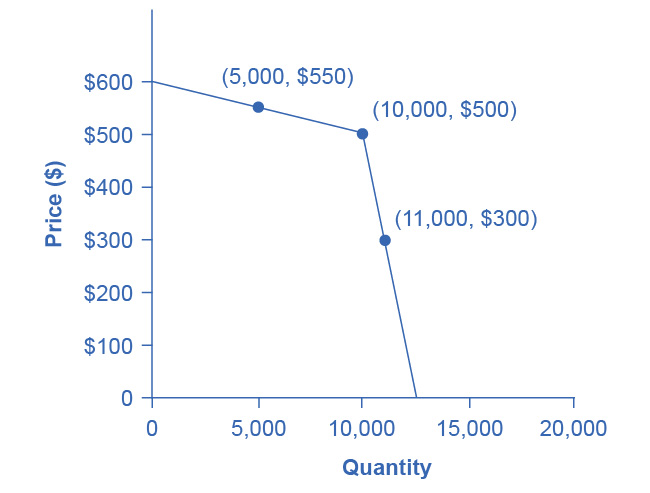

Figure 10.5図 10.5
Consider a member firm in an oligopoly cartel that is supposed to produce a quantity of 10,000 and sell at a price of $500. The other members of the cartel can encourage this firm to honor its commitments by acting so that the firm faces a kinked demand curve. If the oligopolist attempts to expand output and reduce price slightly, other firms also cut prices immediately—so if the firm expands output to 11,000, the price per unit falls dramatically, to $300. On the other side, if the oligopoly attempts to raise its price, other firms will not do so, so if the firm raises its price to $550, its sales decline sharply to 5,000. Thus, the members of a cartel can discipline each other to stick to the pre-agreed levels of quantity and price through a strategy of matching all price cuts but not matching any price increases.
英語のヒント
数量1万を生産し、500ドルで販売することになっている寡占カルテルの加盟企業を考えよう。他の加盟企業は、この企業が屈折需要曲線に直面するように行動することで、約束を守るよう促せる。企業が生産量を増やし、価格を少し下げようとすると、他社も直ちに値下げする。そのため、生産量を1万1000に増やすと、単位当たり価格は300ドルへ大幅に下落する。反対に、企業が値上げしようとしても、他社は値上げしないため、価格を550ドルにすると、販売量は5000に急減する。このように、カルテル加盟企業は、あらゆる値下げには追随するが値上げには一切追随しない戦略を通じ、あらかじめ合意した数量と価格を守るよう互いを規律づけられる。
Many real-world oligopolies, prodded by economic changes, legal and political pressures, and the egos of their top executives, go through episodes of cooperation and competition. If oligopolies could sustain cooperation with each other on output and pricing, they could earn profits as if they were a single monopoly. However, each firm in an oligopoly has an incentive to produce more and grab a bigger share of the overall market; when firms start behaving in this way, the market outcome in terms of prices and quantity can be similar to that of a highly competitive market.
英語のヒント
現実の多くの寡占は、経済の変化、法的・政治的圧力、最高幹部たちの自負に動かされ、協力する時期と競争する時期を経験する。寡占企業が生産量と価格設定について互いの協力を維持できれば、単一の独占企業のように利潤を得られる。しかし、寡占の各企業には生産を増やし、市場全体のより大きなシェアを奪う誘因がある。企業がこのように行動し始めると、価格と数量についての市場の結果は、競争の激しい市場と同様になりうる。