第10章独占的競争と寡占
Monopolistic Competitors and Entry独占的競争企業と参入
If one monopolistic competitor earns positive economic profits, other firms will be tempted to enter the market. A gas station with a great location must worry that other gas stations might open across the street or down the road—and perhaps the new gas stations will sell coffee or have a carwash or some other attraction to lure customers. A successful restaurant with a unique barbecue sauce must be concerned that other restaurants will try to copy the sauce or offer their own unique recipes. A laundry detergent with a great reputation for quality must take note that other competitors may seek to build their own reputations.
英語のヒント
ある独占的競争企業が正の経済的利潤を得れば、他の企業は市場に参入したくなる。立地のよいガソリンスタンドは、通りの向かいや道路の先に別のガソリンスタンドが開業するかもしれないと心配しなければならない。しかも、新しいガソリンスタンドはコーヒーを販売したり、洗車設備や他の魅力を備えたりして顧客を引きつけるかもしれない。独自のバーベキューソースで成功しているレストランは、他の店がそのソースをまねたり、独自のレシピを提供したりしようとすることを懸念しなければならない。品質に非常に定評のある洗濯洗剤も、競合他社が独自の評判を築こうとする可能性に注意しなければならない。
The entry of other firms into the same general market (like gas, restaurants, or detergent) shifts the demand curve that a monopolistically competitive firm faces. As more firms enter the market, the quantity demanded at a given price for any particular firm will decline, and the firm’s perceived demand curve will shift to the left. As a firm’s perceived demand curve shifts to the left, its marginal revenue curve will shift to the left, too. The shift in marginal revenue will change the profit-maximizing quantity that the firm chooses to produce, since marginal revenue will then equal marginal cost at a lower quantity.
英語のヒント
同じ大まかな市場(ガソリン、レストラン、洗剤など)に他の企業が参入すると、独占的競争企業が直面する需要曲線が移動する。市場に参入する企業が増えるにつれ、特定の企業について、ある価格での需要量は減少し、その企業が認識する需要曲線は左へ移動する。需要曲線が左へ移動すると、限界収入曲線も左へ移動する。限界収入の移動により、限界収入と限界費用がより少ない数量で等しくなるため、企業が選ぶ利潤最大化生産量も変わる。
Figure 10.4 (a) shows a situation in which a monopolistic competitor was earning a profit with its original perceived demand curve (D0). The intersection of the marginal revenue curve (MR0) and marginal cost curve (MC) occurs at point S, corresponding to quantity Q0, which is associated on the demand curve at point T with price P0. The combination of price P0 and quantity Q0 lies above the average cost curve, which shows that the firm is earning positive economic profits.
英語のヒント
図10.4(a)は、独占的競争企業が当初認識していた需要曲線(D0)のもとで利潤を得ていた状況を示す。限界収入曲線(MR0)と限界費用曲線(MC)は点Sで交わる。これに対応する数量Q0は、需要曲線上の点Tにおいて価格P0と対応する。価格P0と数量Q0の組合せは平均費用曲線より上にあり、企業が正の経済的利潤を得ていることを示す。
Monopolistic Competition, Entry, and Exit独占的競争、参入、退出
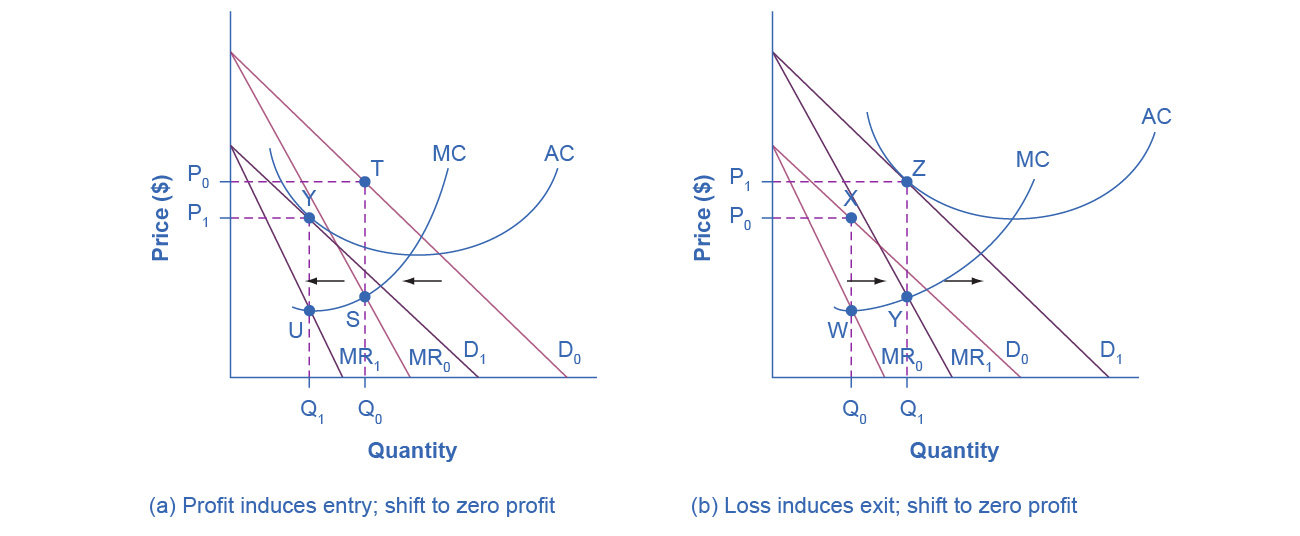

Figure 10.4図 10.4
(a) At P0 and Q0, the monopolistically competitive firm in this figure is making a positive economic profit. This is clear because if you follow the dotted line above Q0, you can see that price is above average cost. Positive economic profits attract competing firms to the industry, driving the original firm’s demand down to D1. At the new equilibrium quantity (P1, Q1), the original firm is earning zero economic profits, and entry into the industry ceases. In (b) the opposite occurs. At P0 and Q0, the firm is losing money. If you follow the dotted line above Q0, you can see that average cost is above price. Losses induce firms to leave the industry. When they do, demand for the original firm rises to D1, where once again the firm is earning zero economic profit.
英語のヒント
(a)P0、Q0では、この図の独占的競争企業は正の経済的利潤を得ている。Q0の上の点線をたどると、価格が平均費用より高いことがわかるため、これは明らかである。正の経済的利潤は競合企業を産業に引きつけ、元の企業の需要をD1まで減少させる。新たな均衡数量(P1、Q1)では、元の企業の経済的利潤はゼロとなり、産業への参入は止まる。(b)では逆のことが起こる。P0、Q0では企業は損失を出している。Q0の上の点線をたどると、平均費用が価格より高いことがわかる。損失は企業の産業からの退出を促す。企業が退出すると、元の企業の需要はD1まで増加し、再び経済的利潤はゼロとなる。
Unlike a monopoly, with its high barriers to entry, a monopolistically competitive firm with positive economic profits will attract competition. When another competitor enters the market, the original firm’s perceived demand curve shifts to the left, from D0 to D1, and the associated marginal revenue curve shifts from MR0 to MR1. The new profit-maximizing output is Q1, because the intersection of the MR1 and MC now occurs at point U. Moving vertically up from that quantity on the new demand curve, the optimal price is at P1.
英語のヒント
高い参入障壁に囲まれた独占企業とは異なり、正の経済的利潤を得る独占的競争企業は競争相手を引きつける。別の競争相手が市場に参入すると、元の企業が認識する需要曲線はD0からD1へ左に移動し、対応する限界収入曲線もMR0からMR1へ移動する。MR1とMCの交点が今度は点Uになるため、新たな利潤最大化生産量はQ1である。この数量から、新しい需要曲線まで垂直に上へ進むと、最適価格はP1になる。
As long as the firm is earning positive economic profits, new competitors will continue to enter the market, reducing the original firm’s demand and marginal revenue curves. The long-run equilibrium is in the figure at point Y, where the firm’s perceived demand curve touches the average cost curve. When price is equal to average cost, economic profits are zero. Thus, although a monopolistically competitive firm may earn positive economic profits in the short term, the process of new entry will drive down economic profits to zero in the long run. Remember that zero economic profit is not equivalent to zero accounting profit. A zero economic profit means the firm’s accounting profit is equal to what its resources could earn in their next best use. Figure 10.4 (b) shows the reverse situation, where a monopolistically competitive firm is originally losing money. The adjustment to long-run equilibrium is analogous to the previous example. The economic losses lead to firms exiting, which will result in increased demand for this particular firm, and consequently lower losses. Firms exit up to the point where there are no more losses in this market, for example when the demand curve touches the average cost curve, as in point Z.
英語のヒント
企業が正の経済的利潤を得ているかぎり、新たな競争相手が市場に参入し続け、元の企業の需要曲線と限界収入曲線を低下させる。長期均衡は図の点Yにあり、企業が認識する需要曲線が平均費用曲線に接する。価格が平均費用に等しいとき、経済的利潤はゼロである。したがって、独占的競争企業は短期には正の経済的利潤を得られる場合があるが、新規参入の過程により長期には経済的利潤がゼロまで押し下げられる。経済的利潤がゼロであることは、会計上の利潤がゼロであることと同じではない点を思い出そう。経済的利潤がゼロとは、企業の会計上の利潤が、その資源を次善の用途に用いた場合に得られる収益と等しいことを意味する。図10.4(b)は逆の状況、つまり独占的競争企業が当初損失を出している場合を示す。長期均衡への調整は前の例と同様である。経済的損失は企業の退出につながり、その結果、この特定企業に対する需要が増加し、損失が減る。企業は、この市場で損失がなくなる時点まで退出する。たとえば点Zのように、需要曲線が平均費用曲線に接するときである。
Monopolistic competitors can make an economic profit or loss in the short run, but in the long run, entry and exit will drive these firms toward a zero economic profit outcome. However, the zero economic profit outcome in monopolistic competition looks different from the zero economic profit outcome in perfect competition in several ways relating both to efficiency and to variety in the market.
英語のヒント
独占的競争企業は短期には経済的利潤や損失を生じうるが、長期には参入と退出により経済的利潤がゼロとなる結果へ向かう。しかし、独占的競争で経済的利潤がゼロとなる結果は、市場の効率性と多様性の両方に関わるいくつかの点で、完全競争で経済的利潤がゼロとなる結果と異なる。