第30章宇宙の生命Life in the Universe
Radio Searches電波による探索
Although the cosmic haystack problem seems daunting, many other research problems in astronomy also require a large investment of time, equipment, and patient effort. And, of course, if we don’t search, we’re sure not to find anything.
英語のヒント
宇宙の干し草の山の問題は、気が遠くなるほど難しそうに見える。しかし、天文学のほかの多くの研究課題も、時間と装置と、辛抱強い努力への大きな投資を必要とする。そして、探さなければ何も見つからないことだけは、確かである。
The very first search was conducted by astronomer Frank Drake in 1960, using the 85-foot antenna at the National Radio Astronomy Observatory (Figure 30.19). Called Project Ozma, after the queen of the exotic Land of Oz in the children’s stories of L. Frank Baum, his experiment involved looking at about 7200 channels and two nearby stars over a period of 200 hours. Although he found nothing, Drake demonstrated that we had the technology to do such a search, and set the stage for the more sophisticated projects that followed.
英語のヒント
最初の探索は、天文学者フランク・ドレイクが、1960年にアメリカ国立電波天文台の85フィートアンテナを使って行った(図30.19)。ライマン・フランク・ボームの児童文学に登場する、不思議なオズの国の女王にちなんで、オズマ計画と名付けられた。実験では、近くの二つの恒星を、約7200のチャンネルで、200時間にわたり調べた。何も見つからなかったが、ドレイクは、そのような探索を行う技術を私たちが持つことを示し、その後に続く、より高度な計画への道を開いた。
Project Ozma and the Allen Telescope Array.オズマ計画とアレン・テレスコープ・アレイ。
Figure 30.19 (a) This 25th anniversary photo shows some members of the Project Ozma team standing in front of the 85-foot radio telescope with which the 1960 search for extraterrestrial messages was performed. Frank Drake is in the back row, second from the right. (b) The Allen Telescope Array in California is made up of 42 small antennas linked together. This system allows simultaneous observations of multiple sources with millions of separate frequency channels. (credit a: modification of work by NRAO; credit b: modification of work by Colby Gutierrez-Kraybill)
図30.19 (a)25周年記念写真。1960年に地球外からのメッセージ探査を行った85フィート電波望遠鏡の前に、オズマ計画のメンバーの一部が立っている。フランク・ドレイクは後列の右から二番目である。(b)カリフォルニアのアレン・テレスコープ・アレイは、結合された42基の小型アンテナからなる。このシステムは、数百万の独立した周波数チャンネルで、複数の天体を同時観測できる。(クレジットa:NRAOの作品を改変。b:Colby Gutierrez-Kraybillの作品を改変)
Receivers are constantly improving, and the sensitivity of SETI programs—SETI stands for the search for extraterrestrial intelligence—is advancing rapidly. Equally important, modern electronics and software allow simultaneous searches on millions of frequencies (channels). If we can thus cover a broad frequency range, the cosmic haystack problem of guessing the right frequency largely goes away. One powerful array of radio telescopes that was built specifically for SETI searches is the Allen Telescope in Northern California. (It was funded by an initial contribution by Microsoft founder Paul Allen to the nonprofit SETI Institute.)
英語のヒント
受信機は絶えず改良され、SETI、すなわち地球外知的生命探査の感度は急速に高まっている。同じくらい重要なのは、現代の電子技術とソフトウェアによって、数百万の周波数、つまりチャンネルを同時に探せることである。こうして広い周波数範囲を調べられれば、正しい周波数を当てなければならないという、宇宙の干し草の山の問題は、大部分が解消される。SETI探査専用に造られた強力な電波望遠鏡群の一つが、北カリフォルニアのアレン・テレスコープである。マイクロソフト創業者ポール・アレンが、非営利のSETI研究所へ行った初期の寄付を資金として造られた。
Other radio telescopes used for such searches have included the giant Arecibo radio dish in Puerto Rico (which, sadly, collapsed after failures in its cable support system in late 2020), the recently completed, and even larger, FAST dish in China, and the Green Bank Telescope in West Virginia, which is the largest steerable radio telescope in the world. Recently, a powerful new data processing system called “COSMIC,” has allowed SETI scientists to tap into the regularly scheduled observations on the Very Large Array of radio telescopes (which we discussed in Radio Telescopes) and search the data being acquired for other astronomy projects for possible intelligent signals.
英語のヒント
このような探索には、ほかにも、プエルトリコの巨大なアレシボ電波アンテナ、最近完成した中国のさらに大きなFAST、そしてウェストバージニアのグリーンバンク望遠鏡が使われてきた。残念ながらアレシボは、2020年末にケーブル支持系の破損で崩壊した。グリーンバンク望遠鏡は、世界最大の向きを変えられる電波望遠鏡である。最近では、COSMICと呼ばれる強力な新しいデータ処理システムにより、SETIの科学者は、超大型電波干渉計VLAの通常の観測を利用できるようになった。VLAは「電波望遠鏡」で取り上げたものである。他の天文学研究のために取得しているデータから、知的存在の信号の可能性を探すのである。
In 2015, Silicon Valley investor and philanthropist Yuri Milner donated 100 million dollars to the University of California, Berkeley, to enhance the SETI endeavor for ten years. The project, called Breakthrough: Listen, is enlisting more telescopes around the world in the search and is developing sophisticated artificial intelligence programs to scour the incoming signals for intelligent messages. Now headquartered at Oxford University in England, the program’s aim is to search more stars and more channels than any SETI project so far.
英語のヒント
2015年、シリコンバレーの投資家で慈善家のユーリ・ミルナーは、10年間にわたりSETIの取り組みを強化するため、カリフォルニア大学バークレー校へ1億ドルを寄付した。ブレイクスルー・リッスンと呼ばれるこの計画は、世界中のより多くの望遠鏡を探索に加え、受信信号から知的なメッセージをくまなく探す、高度な人工知能プログラムを開発している。現在はイギリスのオックスフォード大学を本拠とし、これまでのどのSETI計画よりも多くの恒星とチャンネルを調べることを目指す。
What kind of signals do we hope to pick up? We on Earth are inadvertently sending out a flood of radio signals, dominated by military radar systems. This is a kind of leakage signal, similar to the wasted light energy that is beamed upward by poorly designed streetlights and advertising signs. Could we detect a similar leakage of radio signals from another civilization? The answer is just barely, but only for the nearest stars. For the most part, therefore, current radio SETI searches are looking for beacons, assuming that civilizations might be intentionally drawing attention to themselves or perhaps sending a message to another world or outpost that lies in our direction. Our prospects for success depend on how often civilizations arise, how long they last, and how patient they are about broadcasting their locations to the cosmos.
英語のヒント
どのような信号を捉えたいのだろうか。地球の私たちは、意図せず大量の電波信号を送り出している。その主なものは軍用レーダーである。これは漏れ出す信号の一種で、設計の悪い街灯や広告看板が上空へ放ち、無駄にする光のエネルギーに似ている。ほかの文明から同じように漏れる電波信号を、私たちは検出できるだろうか。答えは、辛うじてできるが、最も近い恒星に限られる、というものである。そのため、現在の電波SETIは主に、意図的に目立たせた信号、ビーコンを探している。文明が自分たちへ意図的に注意を引こうとしているか、あるいは私たちの方向にある別の天体や前哨基地へメッセージを送っているかもしれない、と想定するのである。成功の見込みは、文明がどれくらいの頻度で生まれ、どれほど長く続き、宇宙へ自分たちの位置を知らせる放送を、どれくらい辛抱強く続けるかにかかっている。
The Drake Equationドレイク方程式
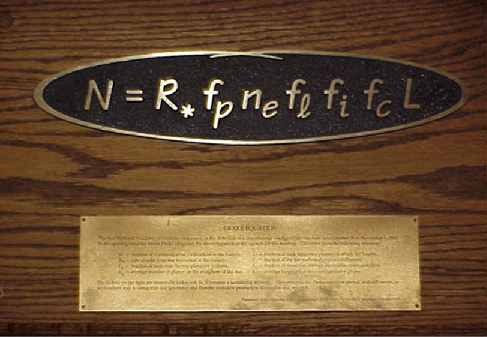
At the first scientific meeting devoted to SETI, Frank Drake wrote an equation on the blackboard that took the difficult question of estimating the number of civilizations in the Galaxy and broke it down into a series of smaller, more manageable questions. Ever since then, both astronomers and students have used this Drake equation as a means of approaching the most challenging question: How likely is it that we are alone? Since this is at present an unanswerable question, astronomer Jill Tarter has called the Drake equation a “way of organizing our ignorance.” (See Figure 30.21.)
英語のヒント
SETIを主題とする最初の科学会議で、フランク・ドレイクは黒板に一つの式を書いた。天の川銀河にある文明の数を推定するという難しい問いを、より小さく扱いやすい問いの列へ分ける式だった。それ以来、天文学者も学生も、このドレイク方程式を使い、「私たちだけしかいない可能性はどれほどか」という最も難しい問いに近づこうとしてきた。現時点では答えられない問いなので、天文学者ジル・ターターは、ドレイク方程式を「私たちの無知を整理する方法」と呼んだ(図30.21参照)。
Drake Equation.ドレイク方程式。
credit: NRAO/NSF/AUI · CC BY 4.0
Figure 30.21 A plaque at the National Radio Astronomy Observatory commemorates the conference where the equation was first discussed. (credit: NRAO/NSF/AUI)
図30.21 アメリカ国立電波天文台にある銘板。方程式が初めて議論された会議を記念している。(クレジット:NRAO/NSF/AUI)
The form of the Drake equation is very simple. To estimate the number of communicating civilizations that currently exist in the Galaxy (we will define these terms more carefully in a moment), we multiply the rate of formation of such civilizations (number per year) by their average lifetime (in years). In symbols,
ドレイク方程式の形は非常に単純である。現在、天の川銀河に存在し、通信している文明の数を推定するには、そのような文明が生まれる率、すなわち1年当たりの数に、文明の平均寿命を年単位で掛ければよい。ここで使う用語は、すぐ後でもう少し慎重に定義する。記号で書けば、次のようになる。
To make this formula easier to use (and more interesting), however, Drake separated the rate of formation Rtotal into a series of probabilities:
ただし、この式を使いやすく、そしてもっと興味深くするために、ドレイクは発生率Rtotalを、確率の列へ分けた。
Rstar is the rate of formation of stars like the Sun in our Galaxy, which is, very roughly, around 10 stars per year. Each of the other terms is a fraction or probability (less than or equal to 1.0), and the product of all these probabilities is itself the total probability that each star will have an intelligent, technological, communicating civilization that we might want to talk to. We have:
英語のヒント
Rstarは、天の川銀河で太陽のような星が形成される率で、ごく大まかには年間10個ほどである。それ以外の各項は、1.0以下の割合、または確率を表す。それらの確率をすべて掛けた積が、各恒星に、私たちが話をしてみたいような、知的で技術を持ち、通信する文明がある総合的な確率となる。各項は次のとおりである。
fp = the fraction of these stars with planets
fp = これらの恒星のうち、惑星を持つものの割合
fe = the fraction of the planetary systems that include habitable planets
fe = 惑星系のうち、生存可能な惑星を含むものの割合
fl = the fraction of habitable planets that actually support life
fl = 生存可能な惑星のうち、実際に生命がいるものの割合
fi = the fraction of inhabited planets that develop advanced intelligence
fi = 生命のいる惑星のうち、高度な知性が発達するものの割合
fc = the fraction of these intelligent civilizations that develop science and the technology to build radio telescopes and transmitters
fc = これらの知的文明のうち、電波望遠鏡や送信機を造る科学と技術を発達させるものの割合
Each of these factors can be discussed and perhaps evaluated, but we must guess at many of the values. In particular, we don’t know how to calculate the probability of something that happened once on Earth but has not been observed elsewhere—and these include the development of life, of intelligent life, and of technological life (the last three factors in the equation). One important advance in estimating the terms of the Drake equation comes from the recent discovery of exoplanets. When the Drake equation was first written, no one had any idea whether planets and planetary systems were common. Now we know they are—another example of the Copernican principle.
英語のヒント
これらの各因子は、それぞれ議論でき、おそらく評価もできる。しかし、多くの値は推測しなければならない。特に、地球では一度起きたが、ほかでは観測されていないことの確率を、どう計算すればよいかはわからない。それには、生命の発生、知的生命の発達、技術を持つ生命の発達、つまり式の最後の三因子が含まれる。ドレイク方程式の項を推定するうえでの重要な進歩の一つは、最近の系外惑星の発見から得られた。方程式が初めて書かれたとき、惑星や惑星系がありふれているかどうかは、誰にもわからなかった。現在では、ありふれているとわかっている。これも、コペルニクスの原理の一例である。
Solution解き方
Even if we don’t know the answers, we can make some guesses and calculate the resulting number N. Let’s start with the optimism implicit in the Copernican principle and set the last three terms equal to 1.0. If R is 10 stars/year and if we measure the average lifetime of a technological civilization in years, the units of years cancel. If we also assume that fp is 0.1, and fe is 1.0, the equation becomes
英語のヒント
答えがわからなくても、いくつか仮の値を置いて、結果の数Nを計算することはできる。まず、コペルニクスの原理に含まれる楽観的な見方から出発し、最後の三項を1.0にしよう。Rが年間10個で、技術文明の平均寿命を年単位で測るなら、年の単位は打ち消し合う。さらにfpを0.1、feを1.0と仮定すると、式は次のようになる。
Now we see the importance of the term L, the lifetime of a communicating civilization (measured in years). We have had this capability (to communicate at the distances of the stars) for only a few decades.
ここで、通信する文明の寿命を年単位で表す項Lの重要性がわかる。私たちが、恒星間の距離を越えて通信する能力を持つようになってからは、まだ数十年しかたっていない。
Check Your Learning理解を確かめよう
Suppose we assume that this stage in our history lasts only one century.
私たちの歴史のこの段階が、わずか1世紀しか続かないと仮定しよう。