第30章宇宙の生命Life in the Universe
Messages on Spacecraft探査機に託すメッセージ
While space travel by living creatures seems very difficult, robot probes can travel over long distances and over long periods of time. Five spacecraft—two Pioneers, two Voyagers, and New Horizons—are now leaving the solar system. At their coasting speeds, they will take hundreds of thousands or millions of years to get anywhere close to another star. On the other hand, they were the first products of human technology to go beyond our home system, so we wanted to put messages on board to show where they came from.
英語のヒント
生きた生物による宇宙旅行は非常に難しそうだが、無人探査機なら、長い時間をかけて遠くまで進める。二機のパイオニア、二機のボイジャー、そしてニューホライズンズという五機が、いま太陽系を離れつつある。惰性で飛ぶ現在の速度では、別の恒星の近くまで行くのに数十万年から数百万年かかる。それでも、これらは私たちの故郷の惑星系を出ていく、人間の技術が生んだ最初の製品だった。そこで私たちは、その出発地がわかるように、メッセージを搭載したいと考えた。
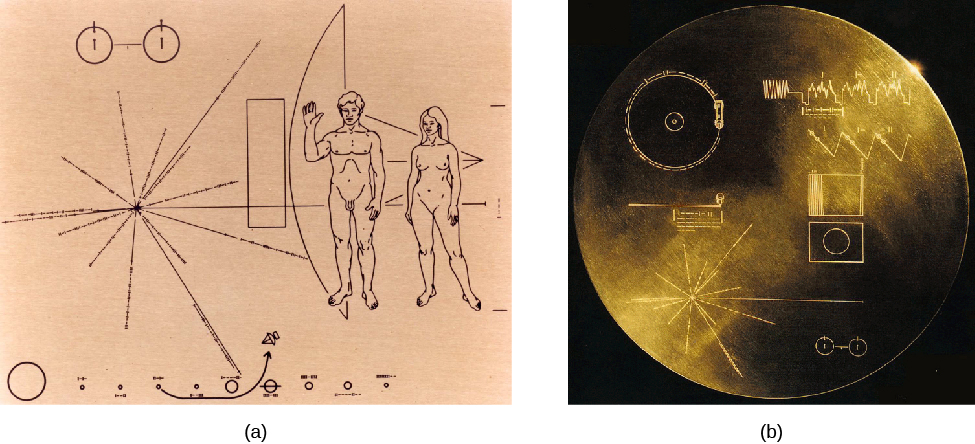
Each Pioneer carries a plaque with a pictorial message engraved on a gold-anodized aluminum plate (Figure 30.18). The Voyagers, launched in 1977, have audio and video records attached, which allowed the inclusion of over 100 photographs and a selection of music from around the world. Given the enormous space between stars in our section of the Galaxy, it is very unlikely that these messages will ever be received by anyone. They are more like a note in a bottle thrown into the sea by a shipwrecked sailor, with no realistic expectation of its being found soon but a slim hope that perhaps someday, somehow, someone will know of the sender’s fate.
英語のヒント
各パイオニアには、金色に陽極酸化処理したアルミ板に、絵によるメッセージを刻んだ銘板が取り付けられている(図30.18)。1977年に打ち上げられたボイジャーには、音声と映像の記録が取り付けられ、100点以上の写真と、世界各地から選んだ音楽を収めることができた。天の川銀河の私たちがいる領域では、恒星間の空間があまりに広いため、これらのメッセージが誰かに受け取られる可能性は非常に低い。むしろそれは、難破した船乗りが海へ投げる、瓶に入れた手紙に似ている。すぐに見つかるという現実的な期待はないが、いつか、何らかの方法で、誰かが送り手の運命を知ってくれるかもしれないという、かすかな望みを託しているのである。
Interstellar Messages.恒星間メッセージ。
credit a, b: modification of work by NASA · NASA media use guidelines
Figure 30.18 (a) This is the image engraved on the plaques aboard the Pioneer 10 and 11 spacecraft. The human figures are drawn in proportion to the spacecraft, which is shown behind them. The Sun and planets in the solar system can be seen at the bottom, with the trajectory that the spacecraft followed. The lines and markings in the left center show the positions and pulse periods for a number of pulsars, which might help locate the spacecraft’s origins in space and time. (b) Encoded onto a gold-coated copper disk, the Voyager record contains 115 images, 90 minutes of music from around the world, greetings in 55 languages, and other audio material. It is a summary of the sights and sounds of Earth. (credit a, b: modification of work by NASA)
英語のヒント
図30.18 (a)パイオニア10号・11号の銘板に刻まれた図。人物は、その背後に示した探査機との大きさの比がわかるように描かれている。下部には、太陽系の太陽と惑星、そして探査機がたどった軌道が示される。左中央の線や記号は、複数のパルサーの位置とパルス周期を示す。これらから、探査機が空間と時間のどこから来たかを特定できるかもしれない。(b)金で覆った銅の円盤に符号化されたボイジャーのレコードには、115枚の画像、世界各地の音楽90分、55言語のあいさつ、その他の音声が収められている。地球の光景と音をまとめた記録である。(クレジットa・b:NASAの作品を改変)
Communicating with the Stars星々との通信
If direct visits among stars are unlikely, we must turn to the alternative for making contact: exchanging messages. Here the news is a lot better. We already use a messenger—light or, more generally, electromagnetic waves—that moves through space at the fastest speed in the universe. Traveling at 300,000 kilometers per second, light reaches the nearest star in only 4 years and does so at a tiny fraction of the cost of sending material objects. These advantages are so clear and obvious that we assume they will occur to any other species of intelligent beings that develop technology.
英語のヒント
恒星間を直接訪問する見込みが薄いなら、接触するためのもう一つの方法、メッセージの交換へ目を向けなければならない。こちらの見通しは、ずっと明るい。私たちはすでに、宇宙で最も速い速度で空間を進む伝令を使っている。光、より一般的には電磁波である。光は秒速30万kmで進み、最も近い恒星へわずか4年で届く。しかも、その費用は物体を送る場合のごくわずかな割合ですむ。この利点は非常にはっきりしているため、技術を発達させたほかの知的生物種も、当然それに気付くだろうと考えられる。
However, we have access to a wide spectrum of electromagnetic radiation, ranging from the longest-wavelength radio waves to the shortest-wavelength gamma rays. Which would be the best for interstellar communication? It would not be smart to select a wavelength that is easily absorbed by interstellar gas and dust, or one that is unlikely to penetrate the atmosphere of a planet like ours. Nor would we want to pick a wavelength that has lots of competition for attention in our neighborhood.
英語のヒント
しかし、利用できる電磁波は、最も波長の長い電波から、最も波長の短いガンマ線まで、広いスペクトルにわたる。恒星間通信には、どれが最適なのだろうか。恒星間のガスや塵に吸収されやすい波長や、地球のような惑星の大気を通り抜けそうにない波長を選ぶのは、賢明ではない。また、私たちの周辺で、ほかの多くの信号に埋もれてしまうような波長も選びたくない。
One final criterion makes the selection easier: we want the radiation to be inexpensive enough to produce in large quantities. When we consider all these requirements, radio waves turn out to be the best answer. Being the lowest-frequency (and lowest-energy) band of the spectrum, they are not very expensive to produce, and we already use them extensively for communications on Earth. They are not significantly absorbed by interstellar dust and gas. With some exceptions, they easily pass through Earth’s atmosphere and through the atmospheres of the other planets we are acquainted with.
英語のヒント
最後の一つの基準で、選択は簡単になる。大量に作っても費用が十分に安い放射が望ましい。これらの必要条件をすべて考えると、最適な答えは電波となる。電波はスペクトルの中で最も周波数が低く、エネルギーも低い波長域なので、作るのにあまり費用がかからない。私たちはすでに地球上の通信で広く利用している。電波は恒星間の塵やガスに大きく吸収されることもない。一部の例外を除けば、地球の大気も、私たちが知っているほかの惑星の大気も、容易に通り抜ける。
The Cosmic Haystack宇宙の干し草の山
Having made the decision that radio is the most likely means of communication among intelligent civilizations, we still have many questions and a daunting task ahead of us. Shall we send a message, or try to receive one? Obviously, if every civilization decides to receive only, then no one will be sending, and everyone will be disappointed. On the other hand, it may be appropriate for us to begin by listening, since we are likely to be among the most primitive civilizations in the Galaxy who are interested in exchanging messages.
英語のヒント
知的文明どうしの最もありそうな通信手段は電波だと決めても、まだ多くの問いと、気の遠くなるような仕事が残っている。メッセージを送るべきか、それとも受信を試みるべきか。どの文明も受信だけを選べば、誰も送らず、全員ががっかりするのは明らかである。しかし私たちの場合、まず耳を傾けるのが適切かもしれない。メッセージの交換に関心を持つ天の川銀河の文明の中で、私たちは最も初歩的なものの一つである可能性が高いからである。
We do not make this statement to insult the human species (which, with certain exceptions, we are rather fond of). Instead, we base it on the fact that humans have had the ability to receive (or send) a radio message across interstellar distances for only a few decades. Compared to the ages of the stars and the Galaxy, this is a mere instant. If there are civilizations out there that are ahead of us in development by even a short time (in the cosmic sense), they are likely to have a technology head start of many, many years.
英語のヒント
人類を侮辱するために、そう言っているのではない。いくつかの例外はあるにせよ、私たちは人類をかなり気に入っている。そう考える根拠は、人間が恒星間の距離を越える電波メッセージを受信、あるいは送信する能力を得てから、まだ数十年しかたっていないという事実である。恒星や銀河の年齢に比べれば、それはほんの一瞬だ。宇宙の尺度で見て、ほんの少しでも私たちより発達が先行した文明があるなら、その技術には、非常に長い年月の先行分があるだろう。
In other words, we, who have just started, may well be the “youngest” species in the Galaxy with this capability (see the discussion in Example 1). Just as the youngest members of a community are often told to be quiet and listen to their elders for a while before they say something foolish, so may we want to begin our exercise in extraterrestrial communication by listening.
英語のヒント
言い換えると、始めたばかりの私たちは、この能力を持つ天の川銀河の種の中で、最も「若い」のかもしれない(例題1の議論を参照)。共同体の最年少の子どもたちが、うっかりしたことを言う前に、しばらく黙って年長者の話を聞くよう言われることが多いのと同じように、私たちも地球外との通信の練習を、まず聞くことから始めるのがよいかもしれない。
Even restricting our activities to listening, however, leaves us with an array of challenging questions. For example, if an extraterrestrial civilization’s signal is too weak to be detected by our present-day radio telescopes, we will not detect them. In addition, it would be very expensive for an extraterrestrial civilization to broadcast on a huge number of channels. Most likely, they select one or a few channels for their particular message. Communicating on a narrow band of channels also helps distinguish an artificial message from the radio static that comes from natural cosmic processes. But the radio band contains an astronomically large number of possible channels. How can we know in advance which one they have selected, and how they have coded their message into the signal?
英語のヒント
それでも、活動を受信だけに限っても、難しい問いがずらりと残る。たとえば地球外文明の信号が、現在の電波望遠鏡で捉えるには弱すぎるなら、検出できない。また、膨大な数のチャンネルで送信するのは、地球外文明にとっても非常に費用がかかるだろう。おそらく、特定のメッセージには一つか少数のチャンネルを選ぶはずである。狭い帯域のチャンネルで通信すれば、自然の宇宙の過程から来る電波雑音と、人工的なメッセージとを区別しやすくもなる。しかし電波の帯域には、天文学的な数のチャンネルの候補が含まれる。相手がどれを選び、どのようにメッセージを信号に符号化したかを、どうすればあらかじめ知ることができるのだろうか。
Table 30.1 summarizes these and other factors that scientists must grapple with when trying to tune in to radio messages from distant civilizations. Because their success depends on either guessing right about so many factors or searching through all the possibilities for each factor, some scientists have compared their quest to looking for a needle in a haystack. Thus, they like to say that the list of factors in Table 30.1 defines the cosmic haystack problem.
英語のヒント
表30.1は、遠い文明からの電波メッセージに周波数を合わせようとするとき、科学者が取り組まなければならない、これらを含むさまざまな要因をまとめたものである。成功するには、多くの要因を正しく推測するか、各要因について可能性をすべて調べなければならない。このため一部の科学者は、探索を、干し草の山から一本の針を探すことになぞらえている。そこで、表30.1の要因の一覧が「宇宙の干し草の山の問題」を定める、とよく表現するのである。
The Cosmic Haystack Problem: Some Questions about an Extraterrestrial Message 宇宙の干し草の山の問題――地球外からのメッセージをめぐる問い |
|---|
Factors 検討すべき要因 |
From which direction (which star) is the message coming? メッセージはどの方向、どの恒星から来るのか。 |
On what channels (or frequencies) is the message being broadcast? どのチャンネル、どの周波数で送信されているのか。 |
How wide in frequency is the channel? そのチャンネルの周波数幅はどれくらいか。 |
How strong is the signal (can our radio telescopes detect it)? 信号はどれくらい強いか。私たちの電波望遠鏡で検出できるか。 |
Is the signal continuous, or does it shut off at times (as, for example, a lighthouse beam does when it turns away from us)? 信号は連続しているか、それともときどき途切れるか。たとえば灯台の光は、私たちと反対方向を向くと見えなくなる。 |
Does the signal drift (change) in frequency because of the changing relative motion of the source and the receiver? 送信源と受信側の相対運動の変化によって、信号の周波数がずれていくことはあるか。 |
How is the message encoded in the signal (how do we decipher it)? メッセージは信号にどう符号化されているか。どうすれば解読できるか。 |
Can we even recognize a message from a completely alien species? Might it take a form we don’t at all expect? まったく異質な種からのメッセージを、そもそもメッセージだと認識できるか。私たちがまったく予想しない形を取る可能性はないか。 |