第30章宇宙の生命Life in the Universe
30.3 Searching for Life beyond Earth30.3 地球外の生命を探す
Learning Objectives学習の目標
By the end of this section, you will be able to:
この節を学ぶと、次のことができるようになる。
Outline what we have learned from exploration of the environment on Mars
火星の環境の探査から何がわかってきたかを概説する。
Identify where in the solar system life is most likely sustainable and why
太陽系のどこで生命が最も存続しやすいと考えられるかを挙げ、その理由を説明する。
Describe some key missions and their findings in our search for life beyond our solar system
太陽系外の生命を探すうえで重要な探査・観測計画と、その成果を説明する。
Explain the use of biomarkers in the search for evidence of life beyond our solar system
太陽系外の生命の証拠を探す際に、生命指標をどう利用するかを説明する。
Astronomers and planetary scientists continue to search for life in the solar system and the universe at large. In this section, we discuss two kinds of searches. First is the direct exploration of planets within our own solar system, especially Mars and some of the icy moons of the outer solar system. Second is the even more difficult task of searching for evidence of life—a biomarker—on planets circling other stars. In the next section, we will examine SETI, the search for extraterrestrial intelligence. As you will see, the approaches taken in these three cases are very different, even though the goal of each is the same: to determine if life on Earth is unique in the universe.
英語のヒント
天文学者と惑星科学者は、太陽系内でも宇宙全体でも、生命の探索を続けている。この節では二種類の探索を扱う。第一は、私たちの太陽系にある惑星、特に火星と、太陽系外縁部にある氷の衛星の一部を直接探査することである。第二は、さらに難しい課題、すなわち他の恒星を回る惑星で生命の証拠――生命指標――を探すことである。次の節では、地球外知的生命探査、SETIを取り上げる。これから見るように、この三つの場合で用いられる手法は大きく異なる。それでも目標は同じで、地球の生命が宇宙で唯一のものなのかを確かめることである。
Life on Mars火星の生命
The possibility that Mars hosts, or has hosted, life has a rich history dating back to the “canals” that some people claimed to see on the martian surface toward the end of the nineteenth century and the beginning of the twentieth. With the dawn of the space age came the possibility to address this question up close through a progression of missions to Mars that began with the first successful flyby of a robotic spacecraft in 1965 and have led to the deployment of capable rovers, like Curiosity and Perseverance, with instruments to look for organic chemistry.
英語のヒント
火星に現在生命がいる、あるいはかつていたという可能性をめぐる歴史は長い。19世紀末から20世紀初めにかけて、火星表面に見えたと一部の人々が主張した「運河」にまでさかのぼる。宇宙時代の幕開けとともに、一連の火星探査によって、この問いを間近で調べられるようになった。その探査は1965年の無人探査機による最初の成功したフライバイに始まり、有機化学の手掛かりを探す機器を備えたキュリオシティやパーサヴィアランスなど、高性能な探査車の投入へとつながってきた。
The earliest missions to Mars provided some hints that liquid water—one of life’s primary requirements—may once have flowed on the surface, and later missions have strengthened this conclusion. The NASA Viking landers, whose purpose was to search directly for evidence of life on Mars, arrived on Mars in 1976. Viking’s instruments did not unambiguously establish the presence of indigenous organic matter or biological activity in the martian soils it analyzed; some detected compounds and the effects of the analytical procedure were later reexamined.
英語のヒント
初期の火星探査は、生命の主要な必要条件の一つである液体の水が、かつて表面を流れていたかもしれないという手掛かりをもたらした。その後の探査で、この結論はさらに裏付けられた。火星の生命の証拠を直接探すことを目的としたNASAのバイキング着陸機は、1976年に火星へ到着した。バイキングの搭載機器は、分析した火星の土壌に、火星由来の有機物や生物活動が存在することを明確に確認できなかった。検出された一部の化合物や、分析方法が測定へ与える影響は、後に再検討された。
This result is not particularly surprising because, despite the evidence of flowing liquid water in the past, liquid water on the surface of Mars is generally not stable today. Over much of Mars, temperatures and pressures at the surface are so low that pure water would either freeze or boil away (under very low pressures, water will boil at a much lower temperature than usual). To make matters worse, unlike Earth, Mars does not have a magnetic field and ozone layer to protect the surface from harmful solar ultraviolet radiation and energetic particles. However, Viking’s analyses of the soil said nothing about whether life may have existed in Mars’ distant past, when liquid water was more abundant. We do know that water in the form of ice exists in abundance on Mars, not so deep beneath its surface. Water vapor is also a constituent of the atmosphere of Mars.
英語のヒント
この結果は、とりわけ驚くようなものではない。過去に液体の水が流れていた証拠はあっても、現在の火星表面では、一般に液体の水は安定して存在できないからである。火星の大部分では、表面の温度と圧力が非常に低いため、純粋な水は凍るか、沸騰して失われてしまう。圧力が非常に低いと、水は通常よりずっと低い温度で沸騰する。さらに悪いことに、火星には地球と違い、有害な太陽紫外線や高エネルギー粒子から表面を守る磁場やオゾン層がない。しかし、バイキングによる土壌分析からは、液体の水がもっと豊富だった火星の遠い過去に、生命が存在していた可能性については何もわからない。氷の形の水が火星に豊富にあり、地表からそれほど深くないところに存在することは確かにわかっている。水蒸気も火星大気の成分である。
Since the visit of Viking, our understanding of Mars has deepened spectacularly. Orbiting spacecraft have provided ever-more detailed images of the surface and detected the presence of minerals that could have formed only in the presence of liquid water. Two bold surface missions, the Mars Exploration Rovers Spirit and Opportunity (2004), followed by the much larger Curiosity Rover (2012), confirmed these remote-sensing data. All three rovers found abundant evidence for a past history of liquid water, revealed not only from the mineralogy of rocks they analyzed, but also from the unique layering of rock formations.
英語のヒント
バイキングの訪問以来、火星についての理解は目覚ましく深まった。周回探査機はますます詳しい表面画像をもたらし、液体の水が存在する条件でしか形成されえない鉱物を検出した。2004年には大胆な二つの地表探査、火星探査車スピリットとオポチュニティが続き、2012年にはさらに大型のキュリオシティが加わって、これらの遠隔観測データを確かめた。三台の探査車はどれも、過去に液体の水が存在した歴史を示す豊富な証拠を見つけた。その証拠は、分析した岩石の鉱物組成だけでなく、岩体に見られる独特の層の重なりにも表れていた。
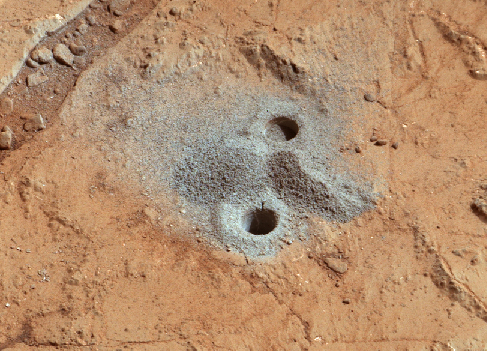
Curiosity has gone a step beyond evidence for water and confirmed the existence of habitable environments on ancient Mars. “Habitable” means not only that liquid water was present, but that life’s requirements for energy and elemental raw materials could also have been met. The strongest evidence of an ancient habitable environment came from analyzing a very fine-grained rock called a mudstone—a rock type that is widespread on Earth but was unknown on Mars until Curiosity found it (see Figure 30.11). The mudstone can tell us a great deal about the wet environments in which it formed. The Perseverance rover is collecting samples of sedimentary rock in a former lakebed, to later return to Earth for laboratory analysis.
英語のヒント
キュリオシティは、水の証拠を探す段階からさらに一歩進み、古代の火星に生命が生存可能な環境が存在したことを確かめた。「生存可能」とは、液体の水があっただけでなく、生命が必要とするエネルギーと、原料となる元素も供給されえたという意味である。古代の生存可能な環境の最も強い証拠は、泥岩と呼ばれる、粒子が非常に細かい岩石の分析から得られた。泥岩は地球では広く見られる岩石だが、火星ではキュリオシティが発見するまで知られていなかった(図30.11参照)。泥岩からは、それが形成された水のある環境について、多くのことを読み取れる。パーサヴィアランスは、かつての湖底で堆積岩の試料を集めている。後に地球へ持ち帰り、実験室で分析するためである。
Mudstone.泥岩。
credit: modification of work by NASA/JPL-Caltech/MSSS · JPL image use policy
Figure 30.11 Shown are the first holes drilled by NASA’s Curiosity Mars rover into a mudstone, with “fresh” drill-pilings around the holes. Notice the difference in color between the red ancient martian surface and the gray newly exposed rock powder that came from the drill holes. Each drill hole is about 0.6 inch (1.6 cm) in diameter. (credit: modification of work by NASA/JPL-Caltech/MSSS)
英語のヒント
図30.11 NASAの火星探査車キュリオシティが泥岩に初めて開けた掘削穴。穴の周りには、掘り出されたばかりの切りくずがある。古くから露出していた火星表面の赤色と、穴から出てきた、新たに露出した岩石粉末の灰色との違いに注目しよう。各穴の直径は約0.6インチ(1.6cm)である。(クレジット:NASA/JPL-Caltech/MSSSの作品を改変)
Five decades of robotic exploration have allowed us to develop a picture of how Mars evolved through time. Early Mars had epochs of warmer and wetter conditions that would have been conducive to life at the surface. However, Mars eventually lost much of its early atmosphere and the surface water began to dry up. As that happened, the ever-shrinking reservoirs of liquid water on the martian surface became saltier and more acidic, until the surface finally had no significant liquid water and was bathed in harsh solar radiation. The surface thus became uninhabitable, but this might not be the case for the planet overall.
英語のヒント
50年にわたる無人探査によって、火星が時とともにどう変化したかという全体像を描けるようになった。初期の火星には、より温暖で水の豊富な時代があり、地表の生命に適した条件があったはずである。しかし火星は、やがて初期の大気の多くを失い、地表の水が干上がり始めた。それに伴って、火星表面の液体の水がたまる場所は縮小し続け、塩分が増し、酸性も強くなっていった。ついには地表にまとまった液体の水がなくなり、強烈な太陽放射を浴びるようになった。こうして地表は生命の生存に適さなくなったが、惑星全体についてもそうだとは限らない。
Reservoirs of ice and liquid water could still exist underground, where pressure and temperature conditions make it stable. There is recent evidence to suggest that liquid water (probably very salty water) can occasionally (and briefly) flow on the surface even today. Thus, Mars might even have habitable conditions in the present day, but of a much different sort than we normally think of on Earth.
英語のヒント
地下には、氷や液体の水の貯留域が今も存在する可能性がある。地下の圧力と温度の条件なら、水は安定して存在できる。最近の証拠は、現在でも液体の水、おそらく塩分が非常に濃い水が、ときおり短時間、表面を流れる可能性を示唆している。したがって、火星には現在でさえ生命が生存可能な条件があるかもしれない。ただしそれは、地球で私たちが通常思い浮かべる条件とは大きく異なる種類のものである。
Our study of Mars reveals a planet with a fascinating history—one that saw its ability to host surface life dwindle billions of years ago, but perhaps allowing life to adapt and survive in favorable environmental niches. Even if life did not survive, we expect that we might find evidence of life if it ever took hold on Mars. If it is there, it is hidden in the crust, and we are still learning how best to decipher that evidence.
英語のヒント
火星の研究からは、興味深い歴史を持つ惑星の姿が浮かぶ。数十億年前に地表の生命を養う能力が衰えていったが、生命が適応し、条件のよい環境の小さな領域で生き延びる余地は残されていたかもしれない。たとえ生命が生き延びなかったとしても、火星に一度でも根付いたのなら、その証拠を見つけられるかもしれないと考えている。証拠があるなら、それは地殻に隠されている。私たちは今も、その証拠をどう読み解けばよいかを学び続けている。