第30章宇宙の生命Life in the Universe
Biomarkers生命指標
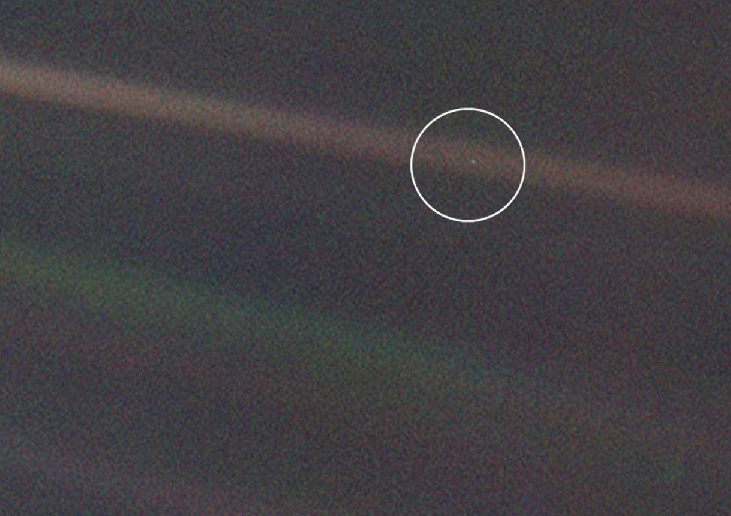
Our observations suggest increasingly that Earth-size planets orbiting within the habitable zone may be common in the Galaxy—current estimates suggest that more than 40% of stars have at least one. But are any of them inhabited? With no ability to send probes there to sample, we will have to derive the answer from the light and other radiation that come to us from these faraway systems (Figure 30.16). What types of observations might constitute good evidence for life?
英語のヒント
観測が進むにつれ、ハビタブルゾーン内を回る地球サイズの惑星は、天の川銀河でありふれている可能性が高まってきた。現在の推定では、恒星の40%以上に、少なくとも一つあるとされる。しかし、その中に生命がいる惑星はあるのだろうか。そこへ探査機を送り、試料を採取することはできない。そのため、これらの遠い系から届く光やほかの放射から、答えを導かなければならない(図30.16)。どのような観測なら、生命の有力な証拠になるのだろうか。
Earth, as Seen by NASA’s Voyager 1.NASAのボイジャー1号から見た地球。
credit: modification of work by NASA/JPL-Caltech · JPL image use policy
Figure 30.16 In this image, taken from 4 billion miles away, Earth appears as a “pale blue dot” representing less than a pixel’s worth of light. Would this light reveal Earth as a habitable and inhabited world? Our search for life on exoplanets will depend on an ability to extract information about life from the faint light of faraway worlds. (credit: modification of work by NASA/JPL-Caltech)
英語のヒント
図30.16 40億マイル離れた地点から撮られたこの画像で、地球は1画素に満たない光を放つ「淡く青い点」に見える。この光から、地球が生存可能で、実際に生命のいる天体だとわかるだろうか。太陽系外惑星の生命探査は、遠い天体のかすかな光から、生命についての情報を取り出す能力にかかっている。(クレジット:NASA/JPL-Caltechの作品を改変)
To be sure, we need to look for robust biospheres (atmospheres, surfaces, and/or oceans) capable of creating planet-scale change. Earth hosts such a biosphere: the composition of our atmosphere and the spectrum of light reflected from our planet differ considerably from what would be expected in the absence of life. Presently, Earth is the only body in our solar system for which this is true, despite the possibility that habitable conditions might prevail in the subsurface of Mars or inside the icy moons of the outer solar system. Even if life exists on these worlds, it is very unlikely that it could yield planet-scale changes that are both telescopically observable and clearly biological in origin.
英語のヒント
確かな検出のためには、大気・表面・海などにおいて、惑星規模の変化を生み出せる、十分に発達した生物圏を探す必要がある。地球には、そのような生物圏がある。私たちの大気の組成も、地球が反射する光のスペクトルも、生命がいない場合に予想されるものと大きく違う。現在、太陽系でこれが当てはまる天体は地球だけである。火星の地下や、太陽系外縁部の氷の衛星の内部に、生存可能な条件があるかもしれないとしても、この点は変わらない。仮にそれらの天体に生命がいても、望遠鏡で観測でき、しかも明らかに生物に由来するとわかるような、惑星規模の変化を生む可能性は非常に低い。
What makes Earth “special” among the potentially habitable worlds in our solar system is that it has a photosynthetic biosphere. This requires the presence of liquid water at the planet’s surface, where organisms have direct access to sunlight. The habitable zone concept focuses on this requirement for surface liquid water—even though we know that subsurface habitable conditions could prevail at more distant orbits—exactly because these worlds would have biospheres detectable at a distance.
英語のヒント
太陽系の潜在的に生存可能な天体の中で、地球を「特別」にしているのは、光合成を行う生物圏があることである。これには、生物が太陽光を直接利用できる惑星表面に、液体の水が存在する必要がある。ハビタブルゾーンの概念が、表面の液体の水という条件を重視するのは、まさに、そのような天体なら遠くから検出できる生物圏を持つからである。もっと遠い軌道でも、地下に生存可能な条件がありうることを知っているにもかかわらず、表面に注目するのはそのためである。
Indeed, plants and photosynthetic microorganisms are so abundant at Earth’s surface that they affect the color of the light that our planet reflects out into space—we appear greener in visible wavelengths and reflect more near-infrared light than we otherwise would. Moreover, photosynthesis has changed Earth’s atmosphere at a large scale—more than 20% of our atmosphere comes from the photosynthetic waste product, oxygen. Such high levels would be very difficult to explain in the absence of life. Other gases, such as nitrous oxide and methane, when found simultaneously with oxygen, have also been suggested as possible indicators of life. When sufficiently abundant in an atmosphere, such gases could be detected by their effect on the spectrum of light that a planet emits or reflects. (As we saw in the chapter on exoplanets, astronomers today are beginning to have the capability of detecting the spectrum of the atmospheres of some planets orbiting other stars.)
英語のヒント
実際、植物や光合成を行う微生物は地球表面に非常に豊富に存在し、地球が宇宙へ反射する光の色にも影響する。それらがいなかった場合より、可視光では緑が強く見え、近赤外線も多く反射する。さらに光合成は、地球の大気を大規模に変えてきた。大気の20%以上は、光合成の廃棄物として生じた酸素である。これほど高い濃度を、生命なしで説明するのは非常に難しい。亜酸化窒素やメタンなどの気体も、酸素と同時に見つかった場合には、生命の指標になりうると提案されている。そのような気体が大気に十分な量あれば、惑星が放出または反射する光のスペクトルに及ぼす効果から検出できるかもしれない。太陽系外惑星の章で見たように、天文学者は現在、ほかの恒星を回る一部の惑星について、大気のスペクトルを検出する能力を得始めている。
Astronomers have thus concluded that, at least initially, a search for life outside our solar system should focus on exoplanets that are as much like Earth as possible—roughly Earth-size planets orbiting in the habitable zone—and look for the presence of gases in the atmosphere or colors in the visible spectrum that are hard to explain except by the presence of biology. Simple, right? In reality, the search for exoplanet life poses many challenges.
英語のヒント
そこで天文学者は、少なくとも最初は、できるだけ地球に似た系外惑星、つまりハビタブルゾーン内を回る、おおよそ地球サイズの惑星に探索を集中すべきだと考えている。そして、生命の存在以外では説明しにくい、大気中の気体や可視光スペクトルの色を探すのである。簡単そうだろうか。実際には、太陽系外惑星での生命探査には、多くの難題がある。
As you might imagine, this task is more challenging for planetary systems that are farther away and, in practical terms, this will limit our search to the habitable worlds closest to our own. Should we become limited to a very small number of nearby targets, it will also become important to consider the habitability of planets orbiting the M-dwarfs we discussed above.
英語のヒント
想像できるように、遠い惑星系ほどこの作業は難しい。実際上、探索は私たちに最も近い、生存可能な天体に限られることになる。対象が近くのごく少数の惑星に絞られるなら、先に述べたM型矮星を回る惑星の生存可能性を検討することも重要になる。
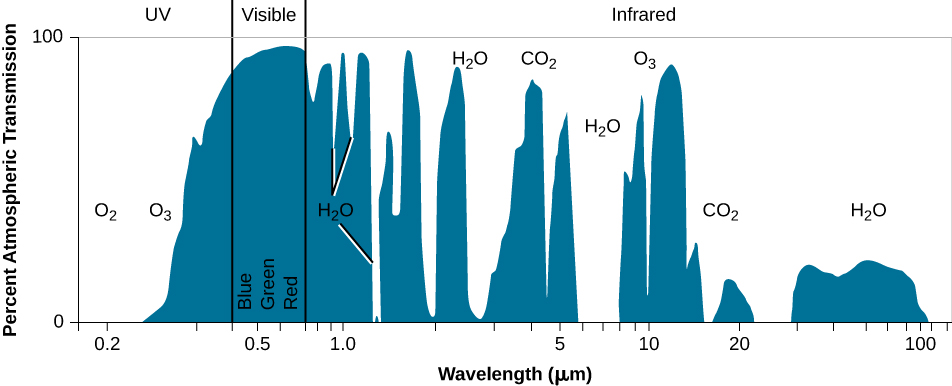
If we manage to separate out a clean signal from the planet and find some features in the light spectrum that might be indicative of life, we will need to work hard to think of any nonbiological process that might account for them. “Life is the hypothesis of last resort,” noted astronomer Carl Sagan—meaning that we must exhaust all other explanations for what we see before claiming to have found evidence of extraterrestrial biology. This requires some understanding of what processes might operate on worlds that we will know relatively little about; what we find on Earth can serve as a guide but also has potential to lead us astray (Figure 30.17).
英語のヒント
惑星からのきれいな信号を分離でき、光のスペクトルに生命を示すかもしれない特徴を見つけたとしても、それを説明しうる非生物的な過程がないか、十分に考えなければならない。天文学者カール・セーガンは、「生命は、最後の手段として持ち出す仮説だ」と述べた。つまり、地球外生命の証拠を見つけたと主張する前に、見えているものについての、ほかのあらゆる説明を検討し尽くさなければならないということである。そのためには、比較的わずかなことしかわからない天体で、どのような過程が働きうるかを、ある程度理解する必要がある。地球で見いだされるものは手掛かりになるが、判断を誤らせる可能性もある(図30.17)。
Recall, for example, that it would be extremely difficult to account for the abundance of oxygen in Earth’s atmosphere except by the presence of biology. But it has been hypothesized that oxygen could build up to substantial levels on planets orbiting M-dwarf stars through the action of ultraviolet radiation on the atmosphere—with no need for biology. It will be critical to understand where such “false positives” might exist in carrying out our search.
英語のヒント
たとえば、地球大気に豊富な酸素があることを、生命の存在以外で説明するのは非常に難しいことを思い出そう。しかしM型矮星を回る惑星では、大気に紫外線が作用することで、生物を必要とせずに酸素がかなり高い濃度まで蓄積する可能性がある、と仮説が立てられている。探索を進めるには、そのような「偽陽性」がどこで起こりうるかを理解することが不可欠になる。
We need to understand that we might not be able to detect biospheres even if they exist. Life has flourished on Earth for perhaps 3.5 billion years, but the atmospheric “biosignatures” that, today, would supply good evidence for life to distant astronomers have not been present for all of that time. Oxygen, for example, accumulated to detectable levels in our atmosphere only a little over 2 billion years ago. Could life on Earth have been detected before that time? Scientists are working actively to understand what additional features might have provided evidence of life on Earth during that early history, and thereby help our chances of finding life beyond.
英語のヒント
生物圏が存在しても、それを検出できない場合があることも理解する必要がある。地球では、おそらく35億年にわたって生命が繁栄してきた。しかし現在なら遠方の天文学者に生命の有力な証拠を与える大気中の「生命の痕跡」が、その全期間を通じて存在したわけではない。たとえば酸素が大気に蓄積し、検出できる濃度に達したのは、20億年より少し前のことにすぎない。それ以前の地球の生命は、検出できただろうか。科学者は、地球のその初期の歴史で、ほかにどのような特徴が生命の証拠になった可能性があるかを、積極的に研究している。それによって、地球外の生命を見つける可能性を高めようとしているのである。
Spectrum of Light Transmitted through Earth’s Atmosphere.地球大気を透過する光のスペクトル。
credit: modification of work by NASA · NASA media use guidelines
Figure 30.17 This graph shows wavelengths ranging from ultraviolet (far left) to infrared. The many downward “spikes” come from absorption of particular wavelengths by molecules in Earth’s atmosphere. Some of these compounds, like water and the combination oxygen/ozone and methane, might reveal Earth as both habitable and inhabited. We will have to rely on this sort of information to seek life on exoplanets, but our spectra will be of much poorer quality than this one, in part because we will receive so little light from the planet. (credit: modification of work by NASA)
英語のヒント
図30.17 このグラフは、左端の紫外線から赤外線までの波長を示す。下向きの多数の鋭い谷は、地球大気の分子が特定の波長を吸収するために生じる。水や、酸素・オゾンとメタンの組み合わせなどは、地球が生存可能で、しかも実際に生命のいる天体だと示すかもしれない。系外惑星の生命を探すにも、この種の情報に頼らなければならない。しかし得られるスペクトルの質は、この図よりはるかに劣るだろう。理由の一つは、惑星から届く光が非常に少ないことである。(クレジット:NASAの作品を改変)