第30章宇宙の生命Life in the Universe
Habitable Environments生命が生存可能な環境
Among the staggering number of objects in our solar system, Galaxy, and universe, some may have conditions suitable for life, while others do not. Understanding what conditions and features make a habitable environment—an environment capable of hosting life—is important both for understanding how widespread habitable environments may be in the universe and for focusing a search for life beyond Earth. Here, we discuss habitability from the perspective of the life we know. We will explore the basic requirements of life and, in the following section, consider the full range of environmental conditions on Earth where life is found. While we can’t entirely rule out the possibility that other life-forms might have biochemistry based on alternatives to carbon and liquid water, such life “as we don’t know it” is still completely speculative. In our discussion here, we are focusing on habitability for life that is chemically similar to that on Earth.
英語のヒント
太陽系、天の川銀河、そして宇宙にある、驚くほど多数の天体の中には、生命に適した条件を持つものもあれば、そうでないものもある。どのような条件や特徴が、生存可能な環境、つまり生命を受け入れられる環境を作るのかを理解することは、そのような環境が宇宙にどれほど広くあるかを理解するうえでも、地球外生命の探査を絞り込むうえでも重要である。ここでは、私たちの知る生命の観点から、生存可能性を論じる。生命の基本的な必要条件を調べ、次の節では、生命が見つかる地球上の環境条件の全体的な広がりを考える。炭素と液体の水とは別のものに基づく生化学を持つ生命体の可能性を、完全に除外することはできない。しかし、そのような「私たちの知らない生命」は、今のところ、まったく推測の域にある。ここでの議論は、地球の生命に化学的に似た生命にとっての、生存可能性に絞る。
Life requires a solvent (a liquid in which chemicals can dissolve) that enables the construction of biomolecules and the interactions between them. For life as we know it, that solvent is water, which has a variety of properties that are critical to how our biochemistry works. Water is abundant in the universe, but life requires that water be in liquid form (rather than ice or gas) in order to properly fill its role in biochemistry. That is the case only within a certain range of temperatures and pressures—too high or too low in either variable, and water takes the form of a solid or a gas. Identifying environments where water is present within the appropriate range of temperature and pressure is thus an important first step in identifying habitable environments. Indeed, a “follow the water” strategy has been, and continues to be, a key driver in the exploration of planets both within and beyond our solar system.
英語のヒント
生命には、生体分子を作り、それらの相互作用を可能にする溶媒が必要である。溶媒とは、化学物質が溶ける液体をいう。私たちの知る生命では、その溶媒は水であり、水には、生化学の働きに決定的なさまざまな性質がある。宇宙には水が豊富にあるが、生化学で適切に役割を果たすには、氷や気体ではなく、液体でなければならない。それが成り立つのは、温度と圧力が一定の範囲内にある場合だけである。どちらの変数も、高すぎたり低すぎたりすれば、水は固体や気体の形を取る。そのため、水が適切な温度・圧力の範囲内で存在する環境を見つけることが、生存可能な環境を特定する重要な第一歩になる。実際、「水を追え」という戦略は、太陽系の内外での惑星探査を進める重要な指針であり続けてきたし、今もそうである。
Our biochemistry is based on molecules made of carbon, hydrogen, nitrogen, oxygen, phosphorus, and sulfur. Carbon is at the core of organic chemistry. Its ability to form four bonds, both with itself and with the other elements of life, allows for the formation of a vast number of potential molecules on which to base biochemistry. The remaining elements contribute structure and chemical reactivity to our biomolecules, and form the basis of many of the interactions among them. These “biogenic elements,” sometimes referred to with the acronym CHNOPS (carbon, hydrogen, nitrogen, oxygen, phosphorus, and sulfur), are the raw materials from which life is assembled, and an accessible supply of them is a second requirement of habitability.
英語のヒント
私たちの生化学は、炭素・水素・窒素・酸素・リン・硫黄からできた分子に基づく。炭素は、有機化学の中核をなす。炭素同士とも、生命を構成するほかの元素とも、4本の結合を作れるため、生化学の基盤にできる分子を、膨大な種類だけ作りうる。残りの元素は、生体分子に構造と化学的な反応性を与え、それらの間の多くの相互作用の基盤になる。これらの「生元素」は、炭素・水素・窒素・酸素・リン・硫黄の頭文字を取って、CHNOPSと呼ばれることもある。生命は、この原材料から組み上げられる。これらを利用可能な形で供給できることが、生存可能性の第2の必要条件となる。
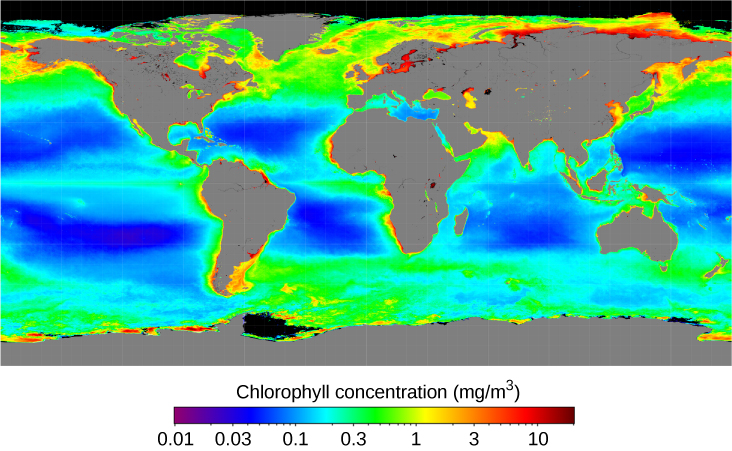
As we learned in previous chapters on nuclear fusion and the life story of the stars, carbon, nitrogen, oxygen, phosphorus, and sulfur are all formed by fusion within stars and then distributed out into their galaxy as those stars die. But how they are distributed among the planets that form within a new star system, in what form, and how chemical, physical, and geological processes on those planets cycle the elements into structures that are accessible to biology, can have significant impacts on the distribution of life. In Earth’s oceans, for example, the abundance of phytoplankton (simple organisms that are the base of the ocean food chain) in surface waters can vary by a thousand-fold because the supply of nitrogen differs from place to place (Figure 30.6). Understanding what processes control the accessibility of elements at all scales is thus a critical part of identifying habitable environments.
英語のヒント
核融合や恒星の一生を扱った前の章で学んだように、炭素・窒素・酸素・リン・硫黄は、すべて恒星内部の核融合で作られ、その恒星が死ぬと、属する銀河へとまき散らされる。しかし、新しい恒星系で形成される惑星の間に、これらがどのように、どのような形で分配されるのか、そして惑星上の化学的・物理的・地質学的な過程が、元素をどう循環させ、生命の利用できる構造に組み込むのかは、生命の分布に大きく影響しうる。たとえば地球の海では、表層水中の植物プランクトンの量が、1000倍も違うことがある。植物プランクトンは、海の食物連鎖の土台になる単純な生物である。その量が違うのは、窒素の供給が場所によって異なるためだ(図30.6)。そのため、あらゆる規模で、どのような過程が元素の利用可能性を左右するのかを理解することは、生存可能な環境を特定するうえで、決定的に重要である。
Chlorophyll Abundance.クロロフィルの存在量。
credit: modification of work by NASA, Gene C. Feldman · NASA media use guidelines
Figure 30.6 The abundance of chlorophyll (an indicator of photosynthetic bacteria and algae) varies by almost a thousand-fold across the ocean basins. That variation is almost entirely due to the availability of nitrogen—one of the major “biogenic elements” in forms that can be used by life. (credit: modification of work by NASA, Gene C. Feldman)
図30.6 光合成を行う細菌や藻類の指標となるクロロフィルの量は、海盆の場所によって、ほぼ1000倍も異なる。この違いは、主要な「生元素」の一つである窒素を、生命が使える形で、どれだけ利用できるかによって、ほぼすべて決まっている。(提供:NASA、Gene C. Feldmanの作品を改変)
With these first two requirements, we have the elemental raw materials of life and a solvent in which to assemble them into the complicated molecules that drive our biochemistry. But carrying out that assembly and maintaining the complicated biochemical machinery of life takes energy. You fulfill your own requirement for energy every time you eat food or take a breath, and you would not live for long if you failed to do either on a regular basis. Life can obtain energy from light or from chemical reactions. In your body, organic molecules in food react with oxygen from the air you breathe to release usable chemical energy. But life overall can use a much wider array of chemicals and, while most animals require oxygen, many bacteria do not. One of the earliest known life processes, which still operates in some modern microorganisms, combines hydrogen and carbon dioxide to make methane, releasing energy in the process. There are microorganisms that “breathe” metals that would be toxic to us, and even some that breathe in sulfur and breathe out sulfuric acid. Plants and photosynthetic microorganisms have also evolved mechanisms to use the energy in light directly.
英語のヒント
最初の二つの必要条件によって、生命の原材料となる元素と、それらを、生化学を動かす複雑な分子へと組み上げるための溶媒がそろった。しかし、その組み立てを実行し、生命の複雑な生化学の仕組みを維持するには、エネルギーが要る。食べ物を食べたり、息をしたりするたびに、あなたは自分に必要なエネルギーを満たしている。そのどちらかを規則的に行わなければ、長く生きることはできない。生命は光や化学反応からエネルギーを得られる。あなたの体内では、食べ物の有機分子が、吸う空気に含まれる酸素と反応し、利用できる化学エネルギーを放出する。しかし、生命全体としては、はるかに幅広い化学物質を使える。ほとんどの動物は酸素を必要とするが、多くの細菌は必要としない。既知の最も初期の生命活動の一つは、水素と二酸化炭素を組み合わせてメタンを作り、その過程でエネルギーを放出するものである。これは、現在の一部の微生物でも働いている。私たちには有毒な金属を「呼吸」する微生物もいれば、硫黄を吸い込み、硫酸を吐き出すものさえいる。植物や光合成を行う微生物は、光のエネルギーを直接使う仕組みも進化させてきた。
Water in the liquid phase, the biogenic elements, and energy are the fundamental requirements for habitability. But are there additional environmental constraints? We consider this in the next section.
英語のヒント
液相の水、生元素、そしてエネルギーが、生存可能性の基本的な必要条件である。では、それ以外の環境上の制約はあるのだろうか。次の節で考えよう。
Grand Prismatic Spring in Yellowstone National Park.イエローストーン国立公園のグランド・プリズマティック・スプリング。
Figure 30.7 This hot spring, where water emerges from the bluish center at high temperatures that vary with location and measurement time, supports a thriving array of microbial life. The green, yellow, and orange colors around the edges come from thick “mats” of photosynthetic bacteria. In fact, their coloration in part demonstrates their use of light energy—some wavelengths of incoming sunlight are selectively captured for energy; the rest are reflected back. Since it lacks the captured wavelengths, this light is now different in color than the sunlight that illuminates it. The blue part of the spring has temperatures too high to allow photosynthetic life (hence the lack of color except that supplied by water itself), but life is still present. In the hottest parts, microorganisms can use the chemical energy supplied by the combination of hydrogen and other chemicals with oxygen. (credit: modification of work by Domenico Salvagnin)
図30.7 この温泉では、青みを帯びた中央部から、場所や測定時によって温度が変わる高温の湯が湧き出し、多様な微生物が盛んに生きている。周辺の緑・黄・オレンジ色は、光合成細菌の厚い「マット」に由来する。実際、その色の一部は、光エネルギーの使い方を示している。入射する太陽光のうち、特定の波長はエネルギーとして選択的に取り込まれ、残りは反射される。取り込まれた波長が欠けているため、反射光は、照らしている太陽光とは異なる色になる。青い部分は、光合成を行う生命には高温すぎる。そのため、水そのものが与える色以外がない。それでも生命は存在する。最も高温の部分では、微生物が、水素などの化学物質と酸素の結合から得られる化学エネルギーを使っている。(提供:Domenico Salvagninの作品を改変)