第30章宇宙の生命Life in the Universe
30.1 The Cosmic Context for Life30.1 宇宙の中で生命を捉える
Learning Objectives学習の目標
By the end of this section, you will be able to:
この節を学ぶと、次のことができるようになる。
Describe the chemical and environmental conditions that make Earth hospitable to life
地球を生命に適した場所にしている、化学的条件と環境条件を説明する。
Discuss the assumption underlying the Copernican principle and outline its implications for modern-day astronomers
コペルニクスの原理の基礎にある仮定を論じ、現代の天文学者にとっての意味を概説する。
Understand the questions underlying the Fermi paradox
フェルミのパラドックスの根底にある問いを理解する。
We saw that the universe was born in the Big Bang about 14 billion years ago. After the initial hot, dense fireball of creation cooled sufficiently for atoms to exist, all matter consisted of hydrogen and helium (with a very small amount of lithium). As the universe aged, processes within stars created the other elements, including those that make up Earth (such as iron, silicon, magnesium, and oxygen) and those required for life as we know it, such as carbon, oxygen, and nitrogen. These and other elements combined in space to produce a wide variety of compounds that form the basis of life on Earth. In particular, life on Earth is based on the presence of a key unit known as an organic molecule, a molecule that contains carbon. Especially important are the hydrocarbons, chemical compounds made up entirely of hydrogen and carbon, which serve as the basis for our biological chemistry, or biochemistry. While we do not understand the details of how life on Earth began, it is clear that to make creatures like us possible, events like the ones we described must have occurred, resulting in what is called the chemical evolution of the universe.
英語のヒント
宇宙が約140億年前のビッグバンで生まれたことは、すでに学んだ。誕生直後の高温・高密度の火の玉が、原子の存在できる温度まで十分に冷えた後、すべての物質は水素とヘリウム、そしてごく少量のリチウムからなっていた。宇宙が年を重ねるにつれて、恒星内部の過程が、それ以外の元素を作り出した。地球を構成する鉄・ケイ素・マグネシウム・酸素などの元素も、私たちの知る生命に必要な炭素・酸素・窒素などの元素も、そこに含まれる。これらの元素やほかの元素が宇宙空間で結びつき、地球の生命の基礎となる、多様な化合物を作った。特に、地球の生命は、有機分子と呼ばれる重要な単位の存在を基盤としている。有機分子とは、炭素を含む分子である。中でも重要なのは、水素と炭素だけからできた化合物、炭化水素である。これは、生物の化学、すなわち生化学の基礎となる。地球の生命がどのように始まったのか、その細部はまだわからない。しかし、私たちのような生物が存在できるためには、いま説明したような出来事が起き、いわゆる宇宙の化学進化をもたらしていなければならなかったことは、明らかである。
What Made Earth Hospitable to Life?何が地球を生命に適した場所にしたのか
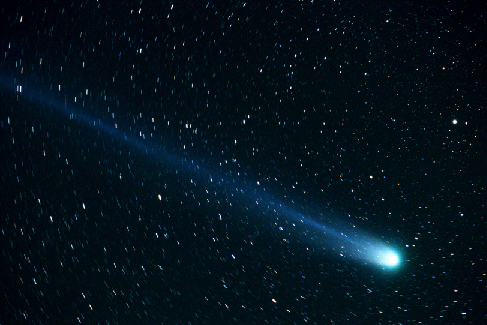
About 5 billion years ago, a cloud of gas and dust in this cosmic neighborhood began to collapse under its own weight. Out of this cloud formed the Sun and its planets, together with all the smaller bodies, such as comets, that also orbit the Sun (Figure 30.2). The third planet from the Sun, as it cooled, eventually allowed the formation of large quantities of liquid water on its surface.
英語のヒント
約50億年前、この宇宙の近隣領域で、ガスと塵の雲が自分自身の重さで収縮し始めた。この雲から太陽と惑星が生まれ、彗星など、太陽を周回する小さな天体もすべて生まれた(図30.2)。太陽から3番目の惑星は、冷えていくにつれて、ついには地表に大量の液体の水を生じさせられるようになった。
Comet Hyakutake.百武彗星。
credit: NASA/Bill Ingalls · NASA media use guidelines
Figure 30.2 This image was captured in 1996 by NASA photographer Bill Ingalls. Comet impacts can deliver both water and a variety of interesting chemicals, including some organic chemicals, to Earth. (credit: NASA/Bill Ingalls)
図30.2 NASAの写真家ビル・インガルスが1996年に撮影した画像。彗星の衝突は、水とともに、有機化合物の一部を含む、さまざまな興味深い化学物質を地球へ運ぶことができる。(提供:NASA/Bill Ingalls)
The chemical variety and moderate conditions on Earth eventually led to the formation of molecules that could make copies of themselves (reproduce), which is essential for beginning life. Over the billions of years of Earth history, life evolved and became more complex. The course of evolution was punctuated by occasional planet-wide changes caused by collisions with some of the smaller bodies that did not make it into the Sun or one of its accompanying worlds. As we saw in the chapter on Earth as a Planet, mammals may owe their domination of Earth’s surface to just such a collision 66 million years ago, which led to the extinction of the non-avian dinosaurs (along with the majority of other living things). The details of such mass extinctions are currently the focus of a great deal of scientific interest.
英語のヒント
地球の多様な化学物質と穏やかな環境は、やがて、自分自身のコピーを作れる、つまり複製できる分子の形成につながった。自己複製は、生命が始まるために不可欠である。数十億年にわたる地球の歴史の中で、生命は進化し、より複雑になっていった。その進化の道筋には、ときおり、惑星全体に及ぶ変化が挟まった。太陽や、それに伴う惑星などの世界の一員にならずに残った小天体の一部が、地球へ衝突したためである。「惑星としての地球」の章で見たように、哺乳類が地表で優勢になったのは、6600万年前に起きた、まさにそのような衝突のおかげかもしれない。その衝突は、ほかの生物の大部分とともに、鳥類以外の恐竜を絶滅へと導いた。このような大量絶滅の詳細は、現在、科学の大きな関心の的となっている。
Through many twisting turns, the course of evolution on Earth produced a creature with self-consciousness, able to ask questions about its own origins and place in the cosmos (Figure 30.3). Like most of Earth, this creature is composed of atoms that were forged in earlier generations of stars—in this case, assembled into both its body and brain. We might say that through the thoughts of human beings, the matter in the universe can become aware of itself.
英語のヒント
曲がりくねった数多くの道をたどり、地球の進化は、自分自身を意識し、自らの起源や宇宙での位置について問うことのできる生物を生み出した(図30.3)。地球の大部分と同じく、この生物も、以前の世代の恒星で鍛え上げられた原子からできている。この場合、その原子は体と脳の両方に組み上げられている。人間の思考を通じて、宇宙の物質が自らを意識できるようになった、と言ってもよいだろう。
Young Human.幼い人間。

credit: Andrew Fraknoi · CC BY 4.0
Figure 30.3 Human beings have the intellect to wonder about their planet and what lies beyond it. Through them (and perhaps other intelligent life), the universe becomes aware of itself. (credit: Andrew Fraknoi)
図30.3 人間には、自らの惑星と、その先にあるものについて考える知性がある。人間を通じて、そしておそらくはほかの知的生命を通じても、宇宙は自分自身を意識するようになる。(提供:Andrew Fraknoi)
Think about those atoms in your body for a minute. They are merely on loan to you from the lending library of atoms that make up our local corner of the universe. Atoms of many kinds circulate through your body and then leave it—with each breath you inhale and exhale and the food you eat and excrete. Even the atoms that take up more permanent residence in your tissues will not be part of you much longer than you are alive. Ultimately, you will return your atoms to the vast reservoir of Earth, where they will be incorporated into other structures and even other living things in the millennia to come.
英語のヒント
自分の体の原子について、少し考えてみよう。それらは、宇宙のこの一角を形作る原子の貸出図書館から、あなたに一時的に貸し出されているだけである。息を吸って吐くたびに、食べ物を食べて排泄するたびに、さまざまな原子が体の中をめぐり、やがて出ていく。組織の中に、より長く住みつく原子でさえ、あなたが生きている期間をはるかに超えて、あなたの一部であり続けるわけではない。最終的には、あなたは自分の原子を地球という巨大な貯蔵庫へ返す。その原子は、これから何千年もの間に、別の構造物や、さらには別の生物へと取り込まれていく。
This picture of cosmic evolution, of our descent from the stars, has been obtained through the efforts of scientists in many fields over many decades. Some of its details are still tentative and incomplete, but we feel reasonably confident in its broad outlines. It is remarkable how much we have been able to learn in the short time we have had the instruments to probe the physical nature of the universe.
英語のヒント
宇宙の進化を、私たちが星々から受け継いだ系譜として見るこの描像は、多くの分野の科学者が、何十年にもわたって努力して得たものである。細部には、まだ暫定的で不完全なところもあるが、大筋については、かなり確かな自信を持っている。宇宙の物理的な性質を調べる装置を手にしてからの短い期間に、これほど多くを学べたことは、驚くべきことである。
The Copernican Principleコペルニクスの原理
Our study of astronomy has taught us that we have always been wrong in the past whenever we have claimed that Earth is somehow unique. Galileo, using the newly invented technology of the telescope, showed us that Earth is not the center of the solar system, but merely one of a number of objects orbiting the Sun. Our study of the stars has demonstrated that the Sun itself is a rather undistinguished star, halfway through its long main-sequence stage like so many billions of others. There seems nothing special about our position in the Milky Way Galaxy either, and nothing surprising about our Galaxy’s position in either its own group or its supercluster.
英語のヒント
天文学を学ぶ中で、私たちは、過去に地球が何らかの意味で特別だと主張するたびに、いつも間違っていたと知った。ガリレオは、新しく発明された望遠鏡の技術を使って、地球が太陽系の中心ではなく、太陽を周回する多数の天体の一つにすぎないことを示した。恒星の研究は、太陽自体も、ほかの何十億もの星と同じように、長い主系列段階の半ばにある、かなり平凡な恒星だと明らかにした。天の川銀河の中での私たちの位置にも、特別なところは見当たらない。また、天の川銀河が、自身の属する銀河群や超銀河団のどこに位置するかも、驚くようなことではない。
The discovery of planets around other stars confirms our idea that the formation of planets is a natural consequence of the formation of stars. We have identified thousands of exoplanets—planets orbiting around other stars, from huge ones orbiting close to their stars (informally called “hot Jupiters”) down to planets smaller than Earth. A steady stream of exoplanet discoveries is leading to the conclusion that earthlike planets occur frequently—enough that there are likely many billions of “exo-Earths” in our own Milky Way Galaxy alone. From a planetary perspective, Earth-size planets are not unusual.
英語のヒント
ほかの恒星の周りで惑星が発見されたことは、惑星の形成が、恒星の形成から自然に生じる結果だという考えを裏づけている。私たちは、ほかの恒星の周りを公転する太陽系外惑星を、数千個も特定してきた。恒星の近くを回る、通称「ホットジュピター」と呼ばれる巨大なものから、地球より小さな惑星まである。系外惑星が絶えず発見されるにつれ、地球に似た惑星はよく見られ、私たちの天の川銀河だけでも、何十億もの「系外の地球」が存在しそうだという結論へと導かれている。惑星という観点からすれば、地球サイズの惑星は珍しくない。
Philosophers of science sometimes call the idea that there is nothing special about our place in the universe the Copernican principle. Given all of the above, most scientists would be surprised if life were limited to our planet and had started nowhere else. There are billions of stars in our Galaxy old enough for life to have developed on a planet around them, and there are billions of other galaxies as well. Astronomers and biologists have long conjectured that a series of events similar to those on the early Earth probably led to living organisms on many planets around other stars, and possibly even on other planets in our solar system, such as Mars.
英語のヒント
科学哲学者は、宇宙での私たちの場所に特別なところはない、という考えを、コペルニクスの原理と呼ぶことがある。ここまでのすべてを踏まえると、生命が私たちの惑星だけに限られ、ほかではどこにも始まっていなかったとしたら、科学者の大半は驚くだろう。天の川銀河には、その周囲の惑星で生命が発達するのに十分な年齢を持つ恒星が、何十億個もある。さらに、ほかの銀河も何十億個もある。天文学者と生物学者は、初期の地球での出来事に似た一連の出来事が、ほかの恒星の周りの多くの惑星で生物を生み、おそらく火星など、太陽系のほかの惑星でも生物を生んだのではないかと、長く推測してきた。
The real scientific issue (which we do not currently know the answer to) is whether organic biochemistry is likely or unlikely in the universe at large. Are we a fortunate and exceedingly rare outcome of chemical evolution, or is organic biochemistry a regular part of the chemical evolution of the cosmos? We do not yet know the answer to this question, but data, even an exceedingly small amount (like finding “unrelated to us” living systems on a world like Europa), will help us arrive at it.
英語のヒント
本当に科学的な問題となるのは、宇宙全体で見たとき、有機物に基づく生化学が起きやすいのか、それとも起きにくいのか、ということである。現時点では、その答えはわかっていない。私たちは、化学進化がもたらした、幸運できわめてまれな結果なのだろうか。それとも、有機物に基づく生化学は、宇宙の化学進化に通常含まれるものなのだろうか。この問いへの答えは、まだわからない。しかし、エウロパのような世界で「私たちと系統的に無関係な」生命系を見つけるといった、ごくわずかな量のデータであっても、答えへとたどり着く助けになる。