第10章地球に似た惑星――金星と火星Earthlike Planets: Venus and Mars
10.5 Water and Life on Mars10.5 火星の水と生命
Learning Objectives学習の目標
By the end of this section, you will be able to:
この節を学び終えると、次のことができるようになる。
Describe the general composition of the atmosphere on Mars
火星大気のおおまかな組成を説明する。
Explain what we know about the polar ice caps on Mars and how we know it
火星の極地の氷冠について何がわかっているか、また、どのようにわかったかを説明する。
Describe the evidence for the presence of water in the past history of Mars
火星の過去に水が存在したことを示す証拠を説明する。
Summarize the evidence for and against the possibility of life on Mars
火星に生命が存在する可能性を支持する証拠と、否定的な証拠をまとめる。
Of all the planets and moons in the solar system, Mars seems to be the most promising place to look for life, both fossil microbes and (we hope) some forms of life deeper underground that still survive today. But where (and how) should we look for life? We know that the one requirement shared by all life on Earth is liquid water. Therefore, the guiding principle in assessing habitability on Mars and elsewhere has been to “follow the water.” That is the perspective we take in this section, to follow the water on the red planet and hope it will lead us to life.
英語のヒント
太陽系のすべての惑星と衛星の中で、火星は生命を探すのに最も有望な場所に見える。微生物の化石に加えて、できれば、地下深くで今日も生き延びている何らかの生命も探したい。しかし、どこで、どのように探せばよいのだろうか。地球上のすべての生命が共通して必要とするものは、液体の水である。そのため、火星やほかの場所で生命が生存できるかを評価する際には、「水をたどれ」という原則が指針になってきた。この節でもその観点を採る。赤い惑星の水をたどり、その先で生命に行き着くことを期待するのである。
Atmosphere and Clouds on Mars火星の大気と雲
The atmosphere of Mars today has an average surface pressure of only 0.007 bar, less than 1% that of Earth. (This is how thin the air is about 30 kilometers above Earth’s surface.) Martian air is composed primarily of carbon dioxide (95%), with about 3% nitrogen and 2% argon. The proportions of different gases are similar to those in the atmosphere of Venus (see Table 10.2), but a lot less of each gas is found in the thin air on Mars.
英語のヒント
現在の火星大気の地表での平均圧力は、わずか0.007 barで、地球の1%未満である。(これは、地表から約30 km上空の地球の空気と同じくらいの薄さだ。)火星の大気は主に二酸化炭素(95%)でできており、窒素が約3%、アルゴンが2%含まれる。各気体の比率は金星の大気に似ているが(表10.2参照)、火星の薄い大気に含まれる各気体の量は、はるかに少ない。
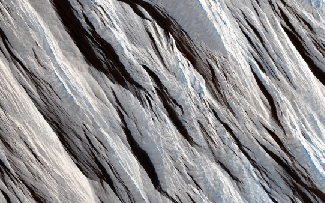
While winds on Mars can reach high speeds, they exert much less force than wind of the same velocity would on Earth because the atmosphere is so thin. The wind is able, however, to loft very fine dust particles, which can sometimes develop planet-wide dust storms. It is this fine dust that coats almost all the surface, giving Mars its distinctive red color. In the absence of surface water, wind erosion plays a major role in sculpting the martian surface (Figure 10.24).
英語のヒント
火星の風は高速になることがあるものの、大気が非常に薄いため、地球で同じ速さの風が吹く場合より、及ぼす力はずっと小さい。それでも風は、きわめて細かい塵を巻き上げることができ、それが惑星全体に広がる砂嵐へ発達することもある。表面のほとんどを覆い、火星特有の赤い色を与えているのは、この細かい塵である。地表の水がない火星では、風による侵食が、地形を形づくるうえで大きな役割を果たしている(図10.24)。
Wind Erosion on Mars.火星の風による侵食
credit: NASA/JPL-Caltech/University of Arizona · JPL image use policy
Figure 10.24 These long straight ridges, called yardangs, are aligned with the dominant wind direction. This is a high-resolution image from the Mars Reconnaissance Orbiter and is about 1 kilometer wide. (credit: NASA/JPL-Caltech/University of Arizona)
図10.24 ヤルダンと呼ばれる、長くまっすぐな尾根が、卓越する風の方向に沿って並んでいる。マーズ・リコネサンス・オービターによる高解像度画像で、幅は約1 kmである。(クレジット:NASA/JPL-Caltech/アリゾナ大学。)
Although the atmosphere contains small amounts of water vapor and occasional clouds of water ice, liquid water is not stable under present conditions on Mars. Part of the problem is the low temperatures on the planet. But even if the temperature on a sunny summer day rises above the freezing point, the low pressure means that liquid water still cannot exist on the surface, except at the lowest elevations. At a pressure of less than 0.006 bar, the boiling point is as low or lower than the freezing point, and water changes directly from solid to vapor without an intermediate liquid state (as does “dry ice,” carbon dioxide, on Earth). However, salts dissolved in water lower its freezing point, as we know from the way salt is used to thaw roads after snow and ice forms during winter on Earth. Salty water is therefore sometimes able to exist in liquid form on the martian surface, under the right conditions.
英語のヒント
火星大気には少量の水蒸気が含まれ、ときには水の氷の雲もできるが、現在の火星の条件では、液体の水は安定して存在できない。理由の一つは低温である。しかし、晴れた夏の日に気温が凝固点を超えたとしても、気圧が低いため、標高が最も低い場所を除けば、地表に液体の水はやはり存在できない。圧力が0.006 bar未満では、沸点が凝固点と同じか、それより低くなり、水は途中で液体になることなく、固体から直接、気体へ変わる。地球上の「ドライアイス」、つまり二酸化炭素と同じである。しかし、水に溶けた塩類は、その凝固点を下げる。これは、地球で冬に積雪や凍結が起きた後、道路に塩をまいて融かすことからもわかる。そのため、適切な条件がそろえば、火星の地表にも、塩水が液体として存在できる場合がある。
Several types of clouds can form in the martian atmosphere. First there are dust clouds, discussed above. Second are water-ice clouds similar to those on Earth. These often form around mountains, just as happens on our planet. Finally, the CO2 of the atmosphere can itself condense at high altitudes to form hazes of dry ice crystals. The CO2 clouds have no counterpart on Earth, since on our planet temperatures never drop low enough (down to about 150 K or about –125 °C) for this gas to condense.
英語のヒント
火星の大気には、いくつかの種類の雲ができる。第一は、すでに述べた塵の雲である。第二は、地球のものに似た水の氷の雲で、地球と同じように、山の周辺にできることが多い。最後に、大気中のCO₂そのものが、高い高度で凝結し、ドライアイスの結晶からなるもやをつくることもある。地球では、この気体が凝結するほどの低温、約150 K(約−125 ℃)にまで温度が下がることはないので、CO₂の雲に相当するものはない。
The Polar Caps極冠
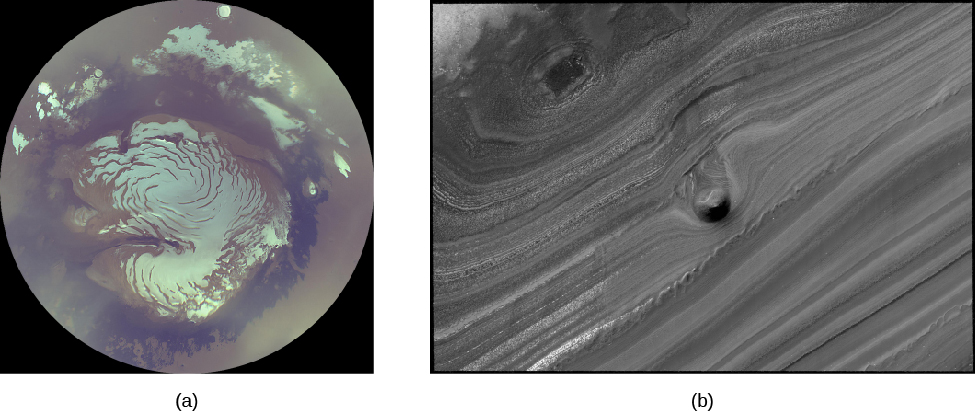
Through a telescope, the most prominent surface features on Mars are the bright polar caps, which change with the seasons, similar to the seasonal snow cover on Earth. We do not usually think of the winter snow in northern latitudes as a part of our polar caps, but seen from space, the thin winter snow merges with Earth’s thick, permanent ice caps to create an impression much like that seen on Mars (Figure 10.25).
英語のヒント
望遠鏡で見る火星の表面で、最も目立つ特徴は明るい極冠である。極冠は季節に伴って変化し、地球の季節的な積雪に似ている。ふつう、北半球の冬の積雪を極冠の一部とは考えない。しかし宇宙から見ると、薄い冬の雪は、地球の厚く恒久的な氷冠と一続きになり、火星で見るものにとてもよく似た印象を与える(図10.25)。
Martian North Polar Cap.火星の北極冠
credit a: modification of work by NASA/JPL/MSSS; credit b: modification of work by NASA/JPL-Caltech/University of Arizona · JPL image use policy
Figure 10.25 (a) This is a composite image of the north pole in summer, obtained in October 2006 by the Mars Reconnaissance Orbiter. It shows the mostly water-ice residual cap sitting atop light, tan-colored, layered sediments. Note that although the border of this photo is circular, it shows only a small part of the planet. (b) Here we see a small section of the layered terrain near the martian north pole. There is a mound about 40 meters high that is sticking out of a trough in the center of the picture. (credit a: modification of work by NASA/JPL/MSSS; credit b: modification of work by NASA/JPL-Caltech/University of Arizona)
図10.25 (a)マーズ・リコネサンス・オービターが2006年10月に取得した、夏の北極の合成画像。明るい黄褐色の層状堆積物の上に、主に水の氷からなる残存極冠が載っている。この写真の縁は円形だが、写っているのは惑星のごく一部であることに注意しよう。(b)火星の北極付近にある層状地形の、小さな一部分。画像中央の溝から、高さ約40 mの丘が突き出ている。(クレジット a:NASA/JPL/MSSSの作品を改変。b:NASA/JPL-Caltech/アリゾナ大学の作品を改変。)
The seasonal caps on Mars are composed not of ordinary snow but of frozen CO2 (dry ice). These deposits condense directly from the atmosphere when the surface temperature drops below about 150 K. The caps develop during the cold martian winters and extend down to about 50° latitude by the start of spring.
英語のヒント
火星の季節極冠は、ふつうの雪ではなく、凍ったCO₂、つまりドライアイスでできている。表面温度が約150 Kを下回ると、大気から直接凝結して堆積する。寒い火星の冬の間に発達し、春が始まるころには、緯度約50°まで広がる。
Quite distinct from these thin seasonal caps of CO2 are the permanent or residual caps that are always present near the poles. The southern permanent cap has a diameter of 350 kilometers and is composed of frozen CO2 deposits together with a great deal of water ice. Throughout the southern summer, it remains at the freezing point of CO2, 150 K, and this cold reservoir is thick enough to survive the summer heat intact.
英語のヒント
この薄いCO₂の季節極冠とは、はっきり異なるものとして、極の近くに常に存在する永久極冠、つまり残存極冠がある。南の永久極冠は直径350 kmで、凍ったCO₂の堆積物と、大量の水の氷でできている。南半球の夏の間も、CO₂の凝固点である150 Kを保つ。この低温の貯蔵層は十分に厚いため、夏の熱にさらされても、そのまま残ることができる。
The northern permanent cap is different. It is much larger, never shrinking to a diameter less than 1000 kilometers, and is composed of water ice. Summer temperatures in the north are too high for the frozen CO2 to be retained. Measurements from the Mars Global Surveyor have established the exact elevations in the north polar region of Mars, showing that it is a large basin about the size of our own Arctic Ocean basin. The ice cap itself is about 3 kilometers thick, with a total volume estimated at about 1.2–1.7 million km3. If Mars ever had extensive liquid water, this north polar basin would have contained a shallow sea. There is some indication of ancient shorelines visible, but better images will be required to verify this suggestion.
英語のヒント
北の永久極冠は、これとは異なる。はるかに大きく、直径が1000 km未満に縮むことはなく、水の氷でできている。北半球の夏の気温は高すぎて、凍ったCO₂を保つことができない。マーズ・グローバル・サーベイヤーの測定によって、火星の北極地域の正確な標高がわかり、地球の北極海の海盆ほどの大きさを持つ、大きな盆地であることが示された。氷冠そのものの厚さは約3 km、総体積は約120万〜170万 km³と推定されている。もし火星にかつて広範囲の液体の水があったなら、この北極の盆地には浅い海があったはずである。古い海岸線らしい痕跡も多少見えるが、この解釈を確かめるには、さらに良い画像が必要になる。
Images taken from orbit also show a distinctive type of terrain surrounding the permanent polar caps, as shown in Figure 10.25. At latitudes above 80° in both hemispheres, the surface consists of recent layered deposits that cover the older cratered ground below. Individual layers are typically ten to a few tens of meters thick, marked by alternating light and dark bands of sediment. Probably the material in the polar deposits includes dust carried by wind from the equatorial regions of Mars.
英語のヒント
軌道上から撮った画像には、図10.25のように、永久極冠を取り囲む特徴的な地形も写っている。両半球の緯度80°より極に近い場所では、比較的新しい層状堆積物が、その下にある古いクレーター地形を覆っている。個々の層の厚さは、典型的には10 mから数十mで、明るい堆積物と暗い堆積物の帯が交互に現れる。極地の堆積物には、火星の赤道地域から風で運ばれた塵も、おそらく含まれている。
What do these terraced layers tell us about Mars? Some cyclic process is depositing dust and ice over periods of time. The time scales represented by the polar layers are tens of thousands of years. Apparently the martian climate experiences periodic changes at intervals similar to those between ice ages on Earth. Calculations indicate that the causes are probably also similar: the gravitational pull of the other planets produces variations in Mars’ orbit and tilt as the great clockwork of the solar system goes through its paces.
英語のヒント
この階段状の層は、火星について何を教えてくれるのだろうか。何らかの周期的な過程が、時間をかけて塵と氷を堆積させている。極地の層が示す時間尺度は、数万年である。どうやら火星の気候は、地球の氷期どうしの間隔に似た周期で、変化を経験しているらしい。計算によれば、その原因もおそらく似ている。太陽系という巨大な時計仕掛けが規則的に動くにつれて、ほかの惑星の引力が、火星の軌道と自転軸の傾きを変化させるのである。
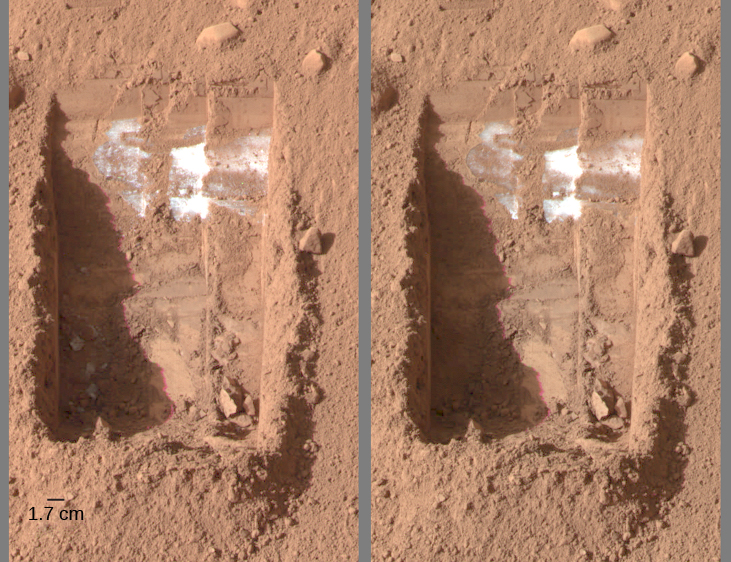
The Phoenix spacecraft landed near the north polar cap in summer (Figure 10.26). Controllers knew that it would not be able to survive a polar winter, but directly measuring the characteristics of the polar region was deemed important enough to send a dedicated mission. The most exciting discovery came when the spacecraft tried to dig a shallow trench under the spacecraft. When the overlying dust was stripped off, they saw bright white material, apparently some kind of ice. From the way this ice sublimated over the next few days, it was clear that it was frozen water.
英語のヒント
探査機フェニックスは、夏に北極冠の近くへ着陸した(図10.26)。管制担当者は、探査機が極地の冬を生き延びられないとわかっていた。それでも、極地の特徴を直接測定することは、専用のミッションを送るに足るほど重要だと判断された。最も心躍る発見は、探査機が自分の下に浅い溝を掘ろうとしたときに訪れた。上を覆う塵を取り除くと、明るい白い物質が見えた。何らかの氷のようだった。その後の数日間に、その氷が昇華していく様子から、それが凍った水であることが明らかになった。
Evaporating Ice on Mars.火星で気体となって消える氷
credit: modification of work by NASA/JPL-Caltech/University of Arizona/Texas A&M University · JPL image use policy
Figure 10.26 We see a trench dug by the Phoenix lander in the north polar region four martian days apart in June 2008. If you look at the shadowed region in the bottom left of the trench, you can see three spots of ice in the left image which have sublimated away in the right image. (credit: modification of work by NASA/JPL-Caltech/University of Arizona/Texas A&M University)
図10.26 2008年6月、火星の北極地域でフェニックス着陸機が掘った溝を、火星の4日間の間隔を置いて撮影した。溝の左下の影になった部分を見ると、左の画像にある三つの氷の斑点が、右の画像では昇華して消えている。(クレジット:NASA/JPL-Caltech/アリゾナ大学/テキサスA&M大学の作品を改変。)
Comparing the Amount of Water on Mars and Earth火星と地球の水の量を比べる
It is interesting to estimate the amount of water (in the form of ice) on Mars and to compare this with the amount of water on Earth. In each case, we can find the total volume of a layer on a sphere by multiplying the area of the sphere by the thickness of the layer. For Earth, the ocean water is equivalent to a layer 3 km thick spread over the entire planet, and the radius of Earth is (see Appendix F). For Mars, most of the water we are sure of is in the form of ice near the poles. We can calculate the amount of ice in one of the residual polar caps if it is (for example) 2 km thick and has a radius of 400 km .
英語のヒント
火星にある水の量を、氷の形で見積もり、地球の水の量と比べてみるのは興味深い。それぞれの場合について、球の上にある層の総体積は、球の表面積に層の厚さを掛けて求められる。地球では、海水を惑星全体に広げると、厚さ3 kmの層に相当する。地球の半径はである(付録F参照)。火星では、確実に存在するとわかっている水の大部分は、極の近くの氷である。残存極冠の一つが、たとえば厚さ2 km、半径400 kmであるとして、その氷の量を計算できる。
Solution解き方
The volume of Earth’s water is therefore the area
したがって、地球の水の体積は、まず表面積を求め、
multiplied by the thickness of 3000 m:
これに厚さ3000 mを掛けて求められる。
This gives of water. Since water has a density of 1 ton per cubic meter (1000 kg/m3), we can calculate the mass:
水の体積はとなる。水の密度は1立方メートルあたり1トン(1000 kg/m³)なので、質量は次のように計算できる。
For Mars, the ice doesn’t cover the whole planet, only the caps; the polar cap area is
火星では、氷は惑星全体ではなく、極冠だけを覆っている。極冠の面積は、
(Note that we converted kilometers to meters.)
となる。キロメートルをメートルに換算したことに注意しよう。
The volume = area × height, so we have:
体積=面積×高さなので、
Therefore, the mass is:
となる。したがって質量は、
This is about 0.1% that of Earth’s oceans.
となる。これは、地球の海水の質量の約0.1%である。
Check Your Learning理解を確かめよう
A better comparison might be to compare the amount of ice in the Mars polar ice caps to the amount of ice in the Greenland ice sheet on Earth, which has been estimated as 2.85 × 10¹⁵ m3. How does this compare with the ice on Mars?
火星の極冠にある氷の量を、地球のグリーンランド氷床の氷の量と比べるほうが、より適切な比較かもしれない。グリーンランド氷床の体積は、2.85×10¹⁵ m³と見積もられている。火星の氷と比べると、どのくらいになるだろうか。