第10章地球に似た惑星――金星と火星Earthlike Planets: Venus and Mars
Martian Samples火星の試料
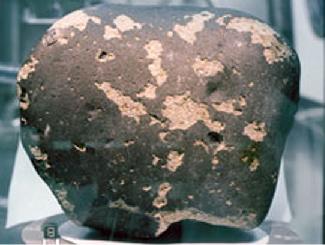
Much of what we know of the Moon, including the circumstances of its origin, comes from studies of lunar samples, but spacecraft have not yet returned martian samples to Earth for laboratory analysis. It is with great interest, therefore, that scientists have discovered that samples of martian material are nevertheless already here on Earth, available for study. These are all members of a rare class of meteorites (Figure 10.16)—rocks that have fallen from space.
英語のヒント
月の起源の事情を含め、月について知っていることの多くは、月試料の研究から得られた。しかし、宇宙機はまだ、実験室で分析するための火星試料を地球へ持ち帰っていない。それなのに、火星の物質の試料がすでに地球上にあり、研究できると科学者が発見したのだから、大いに興味を引かれる。これらはすべて、宇宙から落ちてきた岩石である隕石の、珍しい一群に属する(図10.16)。
Martian Meteorite.火星隕石。
credit: NASA · NASA media use guidelines
Figure 10.16 This fragment of basalt, ejected from Mars in a crater-forming impact, eventually arrived on Earth’s surface. (credit: NASA)
図10.16 クレーターを作る衝突で火星から放出された、この玄武岩の破片は、最終的に地球の表面へ到達した。(提供:NASA)
How would rocks have escaped from Mars? Many impacts have occurred on the red planet, as shown by its heavily cratered surface. Fragments blasted from large impacts can escape from Mars, whose surface gravity is only 38% of Earth’s. A long time later (typically a few million years), a very small fraction of these fragments collide with Earth and survive their passage through our atmosphere, just like other meteorites. (We’ll discuss meteorites in more detail in the chapter on Cosmic Samples and the Origin of the Solar System.) By the way, rocks from the Moon have also reached our planet as meteorites, although we were able to demonstrate their lunar origin only by comparison with samples returned by the Apollo missions
英語のヒント
岩石は、どのように火星から脱出したのだろうか。クレーターの密集した表面が示すように、赤い惑星では多くの衝突が起きてきた。表面重力が地球のわずか38%である火星では、大きな衝突によって吹き飛ばされた破片が、惑星から脱出できる。長い時間、通常は数百万年がたった後、そのごく一部が地球と衝突し、ほかの隕石と同じく、大気を通過しても残る。隕石については、「宇宙からの試料と太陽系の起源」の章で詳しく扱う。ちなみに、月の岩石も隕石として地球へ届いている。ただし、その月起源を実証できたのは、アポロ計画が持ち帰った試料との比較によってだった。
Most of the martian meteorites are volcanic basalts; most of them are also relatively young—about 1.3 billion years old. We know from details of their composition that they are not from Earth or the Moon. Besides, there was no volcanic activity on the Moon to form them as recently as 1.3 billion years ago. It would be very difficult for ejecta from impacts on Venus to escape through its thick atmosphere. By the process of elimination, the only reasonable origin seems to be Mars, where the Tharsis volcanoes were active at that time.
英語のヒント
火星隕石の大部分は火山の玄武岩であり、その大部分は、約13億年と比較的若い。組成の細部から、地球や月に由来しないとわかる。そもそも、13億年前という最近の時代の月には、それらを作る火山活動がなかった。金星への衝突による放出物が、厚い大気を通り抜けて脱出するのも、きわめて難しいだろう。消去法で考えると、合理的な唯一の起源は、当時タルシスの火山群が活動していた火星のように見える。
The martian origin of these meteorites was confirmed by the analysis of tiny gas bubbles trapped inside several of them. These bubbles match the atmospheric properties of Mars as first measured directly by Viking. It appears that some atmospheric gas was trapped in the rock by the shock of the impact that ejected it from Mars and started it on its way toward Earth.
英語のヒント
これらの隕石が火星から来たことは、いくつかの内部に閉じ込められた小さな気泡の分析で確かめられた。気泡は、バイキングが初めて直接測った火星大気の性質と一致する。岩石を火星から放出し、地球へ向かう旅に出した衝突の衝撃によって、大気の一部が岩石中に閉じ込められたようだ。
One of the most exciting results from analysis of these martian samples has been the discovery of both water and organic (carbon-based) compounds in them, which suggests that Mars may once have had oceans and perhaps even life on its surface. As we have already hinted, there is other evidence for the presence of flowing water on Mars in the remote past, and even extending to the present.
英語のヒント
これらの火星試料の分析で得られた、最も心躍る結果の一つは、水と有機化合物、すなわち炭素を基盤とする化合物の両方が見つかったことである。これは、かつて火星に海があり、ことによると表面に生命さえあった可能性を示唆する。すでに触れたように、遠い過去の火星に水の流れがあったことを示す証拠はほかにもあり、その時期が現在にまで及ぶ可能性もある。
In this and the following sections, we will summarize the picture of Mars as revealed by all these exploratory missions and by about 40 samples from Mars.
英語のヒント
この節と続く節では、これらすべての探査ミッションと、火星からの約40個の試料が明らかにした、火星の姿をまとめる。
Global Properties of Mars火星の全体的な性質
Mars has a diameter of 6790 kilometers, just over half the diameter of Earth, giving it a total surface area very nearly equal to the continental (land) area of our planet. Its overall density of 3.9 g/cm3 suggests a composition consisting primarily of silicates but with a small metal core. The planet has no global magnetic field, although there are areas of strong surface magnetization that indicate that there was a global field billions of years ago. InSight seismic observations show that Mars has liquid material in its core; the absence of a global magnetic field does not by itself imply a solid core.
英語のヒント
火星の直径は6790 kmで、地球の半分を少し超える。そのため、総表面積は、私たちの惑星の大陸、すなわち陸地の面積とほぼ等しい。全体の密度が3.9 g/cm³であることから、主にケイ酸塩からなり、小さな金属核も持つ組成が示唆される。火星には全球的な磁場はないが、表面に強く磁化された領域があり、数十億年前には全球的な磁場があったことを示す。インサイトの地震観測は、火星の核に液体の領域があることを示している。全球的な磁場がないというだけでは、核がすべて固体だとは言えない。
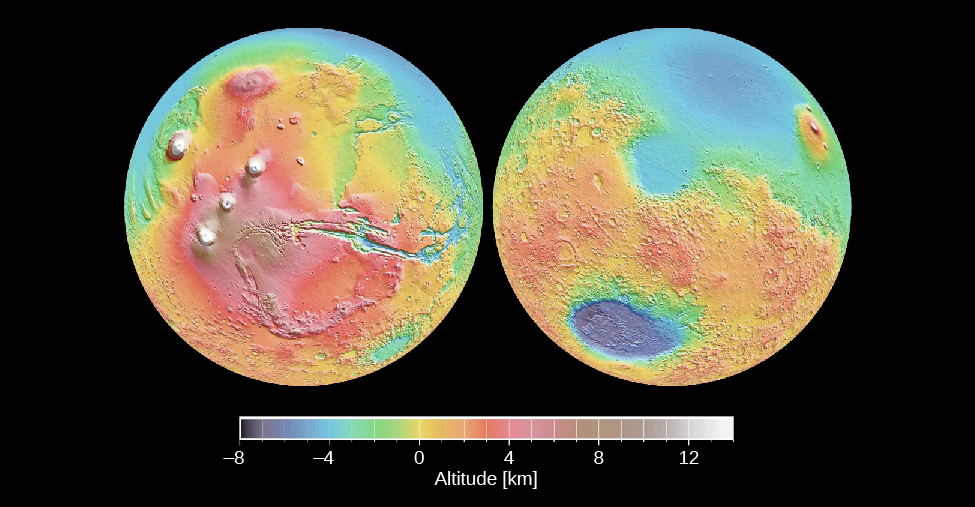
Thanks to the Mars Global Surveyor, we have mapped the entire planet, as shown in Figure 10.17. A laser altimeter on board made millions of separate measurements of the surface topography to a precision of a few meters—good enough to show even the annual deposition and evaporation of the polar caps. Like Earth, the Moon, and Venus, the surface of Mars has continental or highland areas as well as widespread volcanic plains. The total range in elevation from the top of the highest mountain (Olympus Mons) to the bottom of the deepest basin (Hellas) is 31 kilometers.
英語のヒント
マーズ・グローバル・サーベイヤーのおかげで、図10.17に示すように、火星全体を地図化できた。搭載されたレーザー高度計は、数百万回にわたり、表面の地形を個別に測定した。その精度は数mで、極冠が毎年堆積し、蒸発する様子さえ示せるほどだった。火星の表面には、地球、月、金星と同様に、大陸または高地の領域と、広大な火山平原がある。最も高いオリンポス山の頂上から、最も深いヘラス盆地の底までの標高差は、31 kmである。
Mars Map from Laser Ranging.レーザー測距による火星の地図。
credit: modification of work by NASA/JPL · JPL image use policy
Figure 10.17 These globes are highly precise topographic maps, reconstructed from millions of individual elevation measurements made with the Mars Global Surveyor. Color is used to indicate elevation. The hemisphere on the left includes the Tharsis bulge and Olympus Mons, the highest mountain on Mars; the hemisphere on the right includes the Hellas basin, which has the lowest elevation on Mars. (credit: modification of work by NASA/JPL)
図10.17 これらの球体は、マーズ・グローバル・サーベイヤーによる数百万回の個別の標高測定から再構成した、非常に精密な地形図である。色は標高を示す。左の半球には、タルシス隆起と、火星最高の山であるオリンポス山がある。右の半球には、火星で最も標高の低いヘラス盆地がある。(提供:NASA/JPLの作品を改変)
Approximately half the planet consists of heavily cratered highland terrain, found primarily in the southern hemisphere. The other half, which is mostly in the north, contains younger, lightly cratered volcanic plains at an average elevation about 5 kilometers lower than the highlands. Remember that we saw a similar pattern on Earth, the Moon, and Venus. A geological division into older highlands and younger lowland plains seems to be characteristic of all the terrestrial planets except Mercury.
英語のヒント
火星のほぼ半分は、主に南半球にある、クレーターが密集した高地からなる。もう半分は、おもに北側に位置し、より新しく、クレーターの少ない火山平原を持つ。その平均標高は、高地より約5 km低い。地球、月、金星でも、同じような模様を見たことを思い出そう。古い高地と、より若い低地平原に地質が分かれるのは、水星を除く、すべての地球型惑星の特徴のように見える。
Lying across the north-south division of Mars is an uplifted continent the size of North America. This is the 10-kilometer-high Tharsis bulge, a volcanic region crowned by four great volcanoes that rise still higher into the martian sky.
英語のヒント
火星の南北の境界をまたいで、北アメリカほどの大きさの、持ち上がった大陸が横たわっている。これが高さ10 kmのタルシス隆起である。火山地域で、その上には四つの巨大な火山がそびえ、火星の空へさらに高く突き出している。
Volcanoes on Mars火星の火山
The lowland plains of Mars look very much like the lunar maria, and they have about the same density of impact craters. Like the lunar maria, they probably formed between 3 and 4 billion years ago. Apparently, Mars experienced extensive volcanic activity at about the same time the Moon did, producing similar basaltic lavas.
英語のヒント
火星の低地平原は月の海によく似ており、衝突クレーターの密度もほぼ同じである。月の海と同様、おそらく30億〜40億年前にできたのだろう。どうやら火星は、月とほぼ同じ時期に、広範な火山活動を経験し、似た玄武岩質溶岩を作ったらしい。
The largest volcanic mountains of Mars are found in the Tharsis area (you can see them in Figure 10.17), although smaller volcanoes dot much of the surface. The most dramatic volcano on Mars is Olympus Mons (Mount Olympus), with a diameter larger than 500 kilometers and a summit that towers more than 20 kilometers above the surrounding plains—three times higher than the tallest mountain on Earth (Figure 10.18). The volume of this immense volcano is nearly 100 times greater than that of Mauna Loa in Hawaii. Placed on Earth’s surface, Olympus would more than cover the entire state of Missouri.
英語のヒント
火星最大の火山群はタルシス地域にあり、図10.17で見ることができるが、より小さい火山は表面の広い範囲に点在している。火星で最も壮観な火山はオリンポス山で、直径は500 km以上、山頂は周囲の平原より20 km以上高く、地球で最も高い山の3倍に達する(図10.18)。この巨大火山の体積は、ハワイのマウナ・ロアのほぼ100倍である。地球の表面に置けば、ミズーリ州全体を覆って、なお余るだろう。
Olympus Mons.オリンポス山。
Figure 10.18 The largest volcano on Mars, and probably the largest in the solar system, is Olympus Mons, illustrated in this computer-generated rendering based on data from the Mars Global Surveyor’s laser altimeter. Placed on Earth, the base of Olympus Mons would completely cover the state of Missouri; the caldera, the circular opening at the top, is 65 kilometers across, about the size of Los Angeles. (credit: NASA/Corbis)
図10.18 火星最大で、おそらく太陽系でも最大の火山は、オリンポス山である。このコンピューターによる描画は、マーズ・グローバル・サーベイヤーのレーザー高度計のデータに基づく。地球に置けば、山の裾はミズーリ州全体を完全に覆う。頂上の円形の開口部であるカルデラの幅は65 kmで、ロサンゼルスほどの大きさである。(提供:NASA/Corbis)
Images taken from orbit allow scientists to search for impact craters on the slopes of these volcanoes in order to estimate their age. Many of the volcanoes show a fair number of such craters, suggesting that they ceased activity a billion years or more ago. However, Olympus Mons has very, very few impact craters. Its present surface cannot be more than about 100 million years old; it may even be much younger. Some of the fresh-looking lava flows might have been formed a hundred years ago, or a thousand, or a million, but geologically speaking, they are quite young. This leads geologists to the conclusion that Olympus Mons possibly remains intermittently active today—something future Mars land developers may want to keep in mind.
英語のヒント
軌道上からの画像によって、科学者は火山の斜面の衝突クレーターを探し、年代を推定できる。多くの火山には相当数のクレーターがあり、10億年以上前に活動を終えたことが示唆される。しかし、オリンポス山の衝突クレーターは、きわめて少ない。現在の表面は、古くても約1億年であり、もっと若い可能性さえある。新しく見える溶岩流の一部は、100年前、1000年前、あるいは100万年前にできたのかもしれないが、地質学的にはきわめて若い。このことから地質学者は、オリンポス山は現在も断続的に活動している可能性があると考える。将来火星の土地を開発する人々は、覚えておきたい点だろう。