第10章地球に似た惑星――金星と火星Earthlike Planets: Venus and Mars
Channels and Gullies on Mars火星の水路とガリー
Although no bodies of liquid water exist on Mars today, evidence has accumulated that rivers flowed on the red planet long ago. Two kinds of geological features appear to be remnants of ancient watercourses, while a third class—smaller gullies—suggests intermittent outbreaks of liquid water even today. We will examine each of these features in turn.
英語のヒント
現在の火星に液体の水がたまった場所はないものの、はるかな昔、赤い惑星に川が流れていたという証拠は、積み重なってきた。二種類の地形は、古い水路の名残らしい。第三の種類である、より小さなガリーは、現在もときおり液体の水が噴き出すことを示唆している。これらの地形を、一つずつ調べていこう。
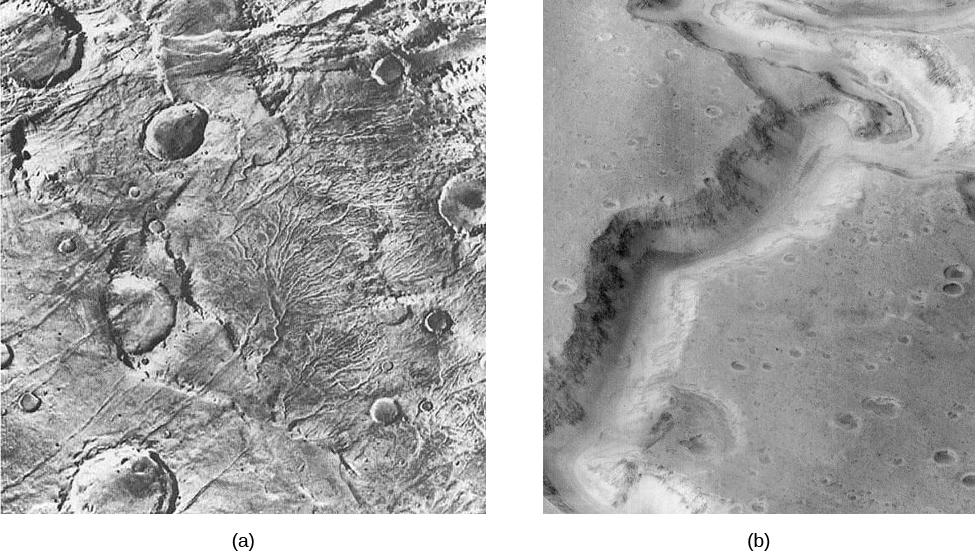
In the highland equatorial plains, there are multitudes of small, sinuous (twisting) channels—typically a few meters deep, some tens of meters wide, and perhaps 10 or 20 kilometers long (Figure 10.27). They are called runoff channels because they look like what geologists would expect from the surface runoff of ancient rain storms. These runoff channels seem to be telling us that the planet had a very different climate long ago. To estimate the age of these channels, we look at the cratering record. Crater counts show that this part of the planet is more cratered than the lunar maria but less cratered than the lunar highlands. Thus, the runoff channels are probably older than the lunar maria, presumably about 4 billion years old.
英語のヒント
赤道付近の高地の平原には、小さく曲がりくねった水路が、無数にある。典型的には深さ数m、幅数十m、長さはおそらく10〜20 kmである(図10.27)。これらは流出水路と呼ばれる。昔の激しい雨が地表を流れた場合に、地質学者が予想する地形に似ているからだ。この流出水路は、はるかな昔、火星の気候が現在と大きく異なっていたことを、物語っているように見える。これらの水路の年代を見積もるには、クレーターの記録を見る。数を調べると、この地域には月の海より多く、月の高地より少ないクレーターがある。したがって流出水路は、月の海より古く、おそらく約40億年前のものだろう。
The second set of water-related features we see consists of outflow channels (Figure 10.27), which are much larger than the runoff channels. The largest of these, which drain into the Chryse basin where Pathfinder landed, are 10 kilometers or more wide and hundreds of kilometers long. Many features of these outflow channels have convinced geologists that they were carved by huge volumes of running water, far too great to be produced by ordinary rainfall. Where could such floodwater have come from on Mars?
英語のヒント
私たちが見る、水に関係する第二の地形は、洪水流出水路である(図10.27)。これは、先ほどの流出水路より、はるかに大きい。最大級のものは、パスファインダーが着陸したクリュセ盆地へ流れ込み、幅10 km以上、長さ数百kmに及ぶ。これらの洪水流出水路の多くの特徴から、地質学者たちは、膨大な量の流水が地形を刻んだと確信するようになった。ふつうの降雨では、とても生じえない水量である。火星のどこから、これほどの洪水の水が来たのだろうか。
Runoff and Outflow Channels.流出水路と洪水流出水路
credit a: modification of work by Jim Secosky/NASA; credit b: modification of work by Jim Secosky/NASA · NASA media use guidelines
Figure 10.27 (a) These runoff channels in the old martian highlands are interpreted as the valleys of ancient rivers fed by either rain or underground springs. The width of this image is about 200 kilometers. (b) This intriguing channel, called Nanedi Valles, resembles Earth riverbeds in some (but not all) ways. The tight curves and terraces seen in the channel certainly suggest the sustained flow of a fluid like water. The channel is about 2.5 kilometers across. (credit a: modification of work by Jim Secosky/NASA; credit b: modification of work by Jim Secosky/NASA)
図10.27 (a)火星の古い高地にある、これらの流出水路は、雨や地下の湧水で養われた古い川の谷だと解釈されている。画像の幅は約200 kmである。(b)ナネディ峡谷と呼ばれる、この興味深い水路は、いくつかの点で、ただしすべての点ではないが、地球の川床に似ている。水路に見える急な曲がりや段丘は、水のような流体が持続的に流れたことを、確かに示唆する。水路の幅は約2.5 kmである。(クレジット a・b:Jim Secosky/NASAの作品を改変。)
As far as we can tell, the regions where the outflow channels originate contained abundant water frozen in the soil as permafrost. Some local source of heating must have released this water, leading to a period of rapid and catastrophic flooding. Perhaps this heating was associated with the formation of the volcanic plains on Mars, which date back to roughly the same time as the outflow channels.
英語のヒント
わかるかぎりでは、洪水流出水路が始まる地域には、永久凍土として土壌中に凍った水が、豊富に含まれていた。何らかの局地的な熱源がこの水を解き放ち、急激で壊滅的な洪水を起こしたに違いない。この加熱は、火星の火山性平原の形成と関係していたのかもしれない。その形成時期は、洪水流出水路とほぼ同じ時代にさかのぼる。
Note that neither the runoff channels nor the outflow channels are wide enough to be visible from Earth, nor do they follow straight lines. They could not have been the “canals” Percival Lowell imagined seeing on the red planet.
英語のヒント
流出水路も洪水流出水路も、地球から見えるほど幅広くはなく、まっすぐに走ってもいないことに注意しよう。パーシヴァル・ローウェルが、赤い惑星に見えたと思い込んだ「運河」が、これらであったはずはない。
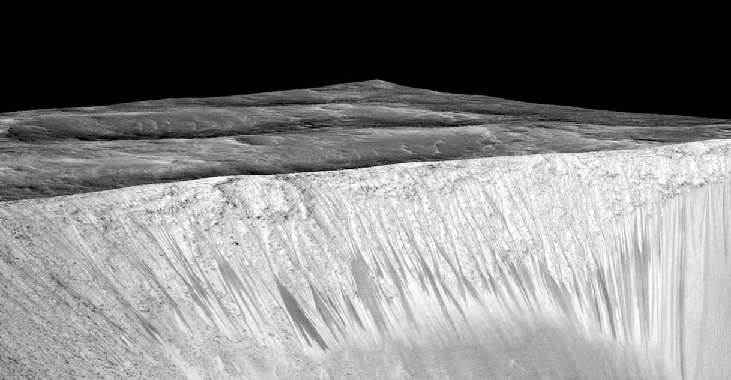
The third type of water feature, the smaller gullies, was discovered by the Mars Global Surveyor (Figure 10.28). The Mars Global Surveyor’s camera images achieved a resolution of a few meters, good enough to see something as small as a truck or bus on the surface. On the steep walls of valleys and craters at high latitudes, there are many erosional features that look like gullies carved by flowing water. These gullies are very young: not only are there no superimposed impact craters, but in some instances, the gullies seem to cut across recent wind-deposited dunes. Perhaps there is liquid water underground that can occasionally break out to produce short-lived surface flows before the water can freeze or evaporate.
英語のヒント
水に関係する第三の地形、より小さなガリーは、マーズ・グローバル・サーベイヤーによって発見された(図10.28)。この探査機のカメラ画像は、数mの分解能を達成した。地表にあるトラックやバスほどの小さなものを、見分けられる精度である。高緯度の谷やクレーターの急な壁には、流水に刻まれたガリーに似た侵食地形が、数多くある。これらのガリーは、きわめて若い。その上に重なる衝突クレーターがないだけでなく、ときには、風が最近つくった砂丘を横切っているように見える。地下に液体の水があり、ときおり噴き出して、凍結や蒸発が起きるまでの短い間、地表を流れるのかもしれない。
Gullies on the Wall of Garni Crater.ガルニ・クレーターの壁にあるガリー
credit: NASA/JPL-Caltech/University of Arizona · JPL image use policy
Figure 10.28 This high-resolution image is from the Mars Reconnaissance Orbiter. The dark streaks, which are each several hundred meters long, change in a seasonal pattern that suggests they are caused by the temporary flow of surface water. (credit: NASA/JPL-Caltech/University of Arizona)
図10.28 マーズ・リコネサンス・オービターによる高解像度画像。長さがそれぞれ数百mある暗い筋は、季節に伴う規則的な変化を示す。このことは、地表を一時的に流れる水によってできたことを示唆している。(クレジット:NASA/JPL-Caltech/アリゾナ大学。)
The gullies also have the remarkable property of changing regularly with the martian seasons. Many of the dark streaks (visible in Figure 10.28) elongate within a period of a few days, indicating that something is flowing downhill—either water or dark sediment. If it is water, it requires a continuing source, either from the atmosphere or from springs that tap underground water layers (aquifers.) Underground water would be the most exciting possibility, but this explanation seems inconsistent with the fact that many of the dark streaks start at high elevations on the walls of craters.
英語のヒント
ガリーには、火星の季節に伴って規則的に変化するという、目を引く性質もある。暗い筋の多くは、数日のうちに伸びる(図10.28)。何かが斜面を流れ下っていることを示している。水か、暗い堆積物かのどちらかである。もし水なら、大気、あるいは地下の水の層である帯水層につながる湧水から、継続して供給されなければならない。地下水なら最も興味深い可能性だが、暗い筋の多くがクレーターの壁の高い位置から始まるという事実とは、この説明は食い違うように見える。
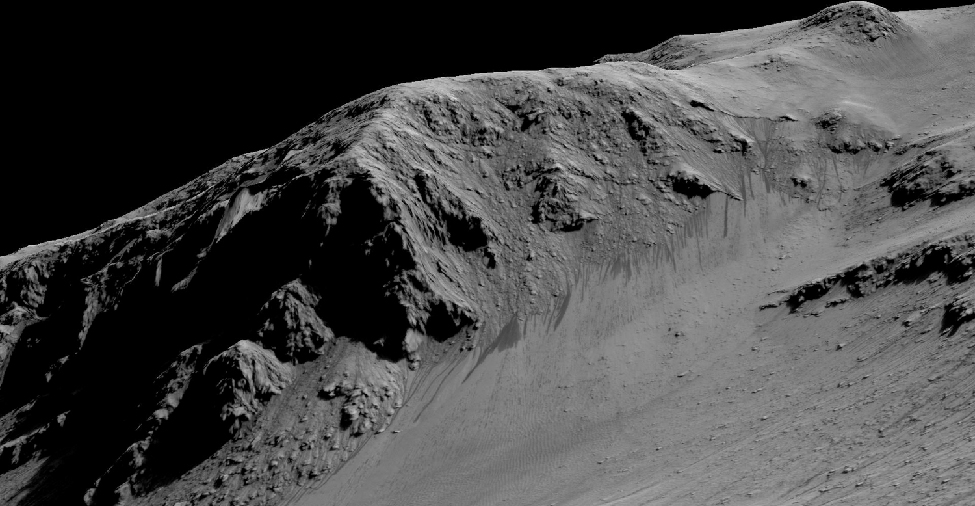
Additional evidence that the dark streaks (called by the scientists recurring slope lineae) are caused by water was found in 2015 when spectra were obtained of the dark streaks (Figure 10.29). These showed the presence of hydrated salts produced by the evaporation of salty water. If the water is salty, it could remain liquid long enough to flow downstream for distances of a hundred meters or more, before it either evaporates or soaks into the ground. However, this discovery still does not identify the ultimate source of the water.
英語のヒント
科学者が「繰り返し現れる斜面の筋」(recurring slope lineae)と呼ぶ暗い筋について、それが水によってできるという追加の証拠が、2015年に得られた。暗い筋のスペクトルが取得されたのである(図10.29)。スペクトルは、塩水の蒸発によって生じる含水塩の存在を示した。水が塩分を含んでいれば、蒸発するか地中へしみ込むまで、100 m以上の距離を流れ下れるだけの時間、液体を保てる可能性がある。しかし、この発見によっても、水の最終的な供給源は特定されていない。
Evidence for Liquid Water on Mars.火星の液体の水を示す証拠
credit: NASA/JPL-Caltech/University of Arizona · JPL image use policy
Figure 10.29 The dark streaks in Horowitz crater, which move downslope, have been called recurring slope lineae. The streaks in the center of the image go down the wall of the crater for about a distance of 100 meters. Spectra taken of this region were initially interpreted as evidence for hydrated salts, but the streaks do not establish that salty liquid water flows on or just below the surface of Mars. (The vertical dimension is exaggerated by a factor of 1.5 compared to horizontal dimensions.) (credit: NASA/JPL-Caltech/University of Arizona)
図10.29 ホロウィッツクレーターの斜面を下る黒い筋は、反復斜面筋と呼ばれている。画像中央の筋は、クレーターの壁を約100 m下る。この領域のスペクトルは当初、水を含む塩の証拠と解釈されたが、この筋だけで火星の表面やそのすぐ下を塩水が流れていると確定できるわけではない。(縦方向は横方向に比べて1.5倍に誇張されている。)(提供:NASA/JPL-Caltech/アリゾナ大学の作品を改変)