第10章地球に似た惑星――金星と火星Earthlike Planets: Venus and Mars
10.1 The Nearest Planets: An Overview10.1 最も近い惑星――全体を見渡す
Learning Objectives学習の目標
By the end of this section, you will be able to:
この節を学び終えると、次のことができるようになる。
Explain why it’s difficult to learn about Venus from Earth-based observation alone
地上からの観測だけで金星を知るのが難しい理由を説明する。
Describe the history of our interest in Mars before the Space Age
宇宙時代より前に、人々が火星へ抱いた関心の歴史を説明する。
Compare the basic physical properties of Earth, Mars, and Venus, including their orbits
軌道を含め、地球・火星・金星の基本的な物理的性質を比較する。
As you might expect from close neighbors, Mars and Venus are among the brightest objects in the night sky. The average distance of Mars from the Sun is 227 million kilometers (1.52 AU), or about half again as far from the Sun as Earth. Venus’ orbit is very nearly circular, at a distance of 108 million kilometers (0.72 AU) from the Sun. Like Mercury, Venus sometimes appears as an “evening star” and sometimes as a “morning star.” Venus approaches Earth more closely than does any other planet: at its nearest, it is only 40 million kilometers from us. The closest Mars ever gets to Earth is about 56 million kilometers.
英語のヒント
近くの隣人なのだから予想できるように、火星と金星は、夜空で最も明るい天体の仲間である。火星の太陽からの平均距離は2億2700万km、すなわち1.52 AUで、地球の太陽からの距離の約1.5倍である。金星の軌道はほぼ完全な円形で、太陽からの距離は1億800万km、すなわち0.72 AUである。金星は水星と同じく、ときには「宵の明星」、ときには「明けの明星」として見える。金星は、ほかのどの惑星よりも地球に近づき、最も近いときには、地球からわずか4000万kmのところにある。火星が地球に最も近づく距離は、約5600万kmである。
Appearance見え方
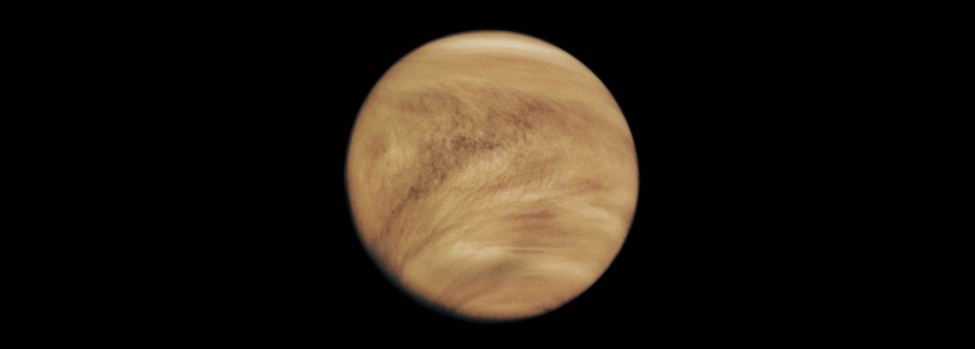
Venus appears very bright, and even a small telescope reveals that it goes through phases like the Moon. Galileo discovered that Venus displays a full range of phases, and he used this as an argument to show that Venus must circle the Sun and not Earth. The planet’s actual surface is not visible because it is shrouded by dense clouds that reflect about 70% of the sunlight that falls on them, frustrating efforts to study the underlying surface, even with cameras in orbit around the planet (Figure 10.2).
英語のヒント
金星は非常に明るく見え、小型の望遠鏡でも、月のように満ち欠けすることがわかる。ガリレオは、金星があらゆる段階の満ち欠けを示すことを発見し、金星が地球ではなく太陽を回っているはずだと示す論拠にした。金星の実際の表面は見えない。入射する太陽光の約70%を反射する厚い雲に包まれているからである。この雲は、金星を周回するカメラを使っても、下にある表面を調べようとする試みを妨げる(図10.2)。
Venus as Photographed by the Pioneer Venus Orbiter.パイオニア・ビーナス周回機が撮影した金星。
credit: modification of work by NASA · NASA media use guidelines
Figure 10.2 This ultraviolet image shows an upper-atmosphere cloud structure that would be invisible at visible wavelengths. Note that there is not even a glimpse of the planet’s surface. (credit: modification of work by NASA)
図10.2 この紫外線画像は、可視光の波長では見えない、大気上層の雲の構造を示している。惑星の表面は一部さえ見えていないことに注目しよう。(提供:NASAの作品を改変)
In contrast, Mars is more tantalizing as seen through a telescope (Figure 10.3). The planet is distinctly red, due (as we now know) to the presence of iron oxides in its soil. This color may account for its association with war (and blood) in the legends of early cultures. The best resolution obtainable from telescopes on the ground is about 100 kilometers, or about the same as what we can see on the Moon with the unaided eye. At this resolution, no hint of topographic structure can be detected: no mountains, no valleys, not even impact craters. On the other hand, bright polar ice caps can be seen easily, together with dusky surface markings that sometimes change in outline and intensity from season to season.
英語のヒント
これに対し、望遠鏡で見た火星は、もっと知りたいと思わせる姿をしている(図10.3)。火星ははっきり赤い色をしており、現在わかっているように、これは土壌中の酸化鉄によるものだ。この色によって、古い文化の伝説で、火星が戦争や血と結びつけられたのかもしれない。地上の望遠鏡で得られる最高の分解能は約100 kmで、月を肉眼で見る場合とほぼ同じである。この分解能では、地形の構造をうかがわせるものは見つけられない。山も谷も、衝突クレーターさえも見えない。その一方で、明るい極冠は容易に見え、暗い表面模様も観察できる。模様の輪郭や濃さは、季節によって変わることがある。
Mars as Seen from Earth’s Surface.地球の表面から見た火星。
Figure 10.3 These are among the best Earth-based photos of Mars, taken in 1988 when the planet was exceptionally close to Earth. The polar caps and dark surface markings are evident, but not topographic features. (credit: modification of work by Steve Larson, Lunar and Planetary Laboratory, University of Arizona)
図10.3 これらは、火星が地球に特に近づいた1988年に撮られた、地上からの火星写真の中でも優れたものである。極冠や暗い表面模様ははっきり見えるが、地形は見えない。(提供:スティーヴ・ラーソン、アリゾナ大学月惑星研究所の作品を改変)
For a few decades around the turn of the twentieth century, some astronomers believed that they saw evidence of an intelligent civilization on Mars. The controversy began in 1877, when Italian astronomer Giovanni Schiaparelli (1835–1910) announced that he could see long, faint, straight lines on Mars that he called canale, or channels. In English-speaking countries, the term was mistakenly translated as “canals,” implying an artificial origin.
英語のヒント
20世紀への変わり目の前後数十年間、一部の天文学者は、火星に知的文明の証拠を見たと信じていた。論争の始まりは1877年で、イタリアの天文学者ジョヴァンニ・スキャパレリ(1835〜1910年)が、火星に長く淡い直線が見えると発表し、それをcanale、つまり水路と呼んだ。英語圏では、この語が誤ってcanals、すなわち人工の「運河」と訳され、人工的な起源が示唆された。
Even before Schiaparelli’s observations, astronomers had watched the bright polar caps change size with the seasons and had seen variations in the dark surface features. With a little imagination, it was not difficult to picture the canals as long fields of crops bordering irrigation ditches that brought water from the melting polar ice to the parched deserts of the red planet. (They assumed the polar caps were composed of water ice, which isn’t exactly true, as we will see shortly.)
英語のヒント
スキャパレリの観測以前にも、天文学者は、明るい極冠が季節によって大きさを変える様子や、暗い表面の特徴の変化を見ていた。少し想像力を働かせれば、運河を、溶ける極の氷から赤い惑星の乾ききった砂漠へ水を運ぶ灌漑用の溝に沿って延びる、長い作物畑だと描くのは難しくなかった。彼らは極冠が水の氷でできていると仮定したが、それは完全には正しくない。まもなく見るとおりである。
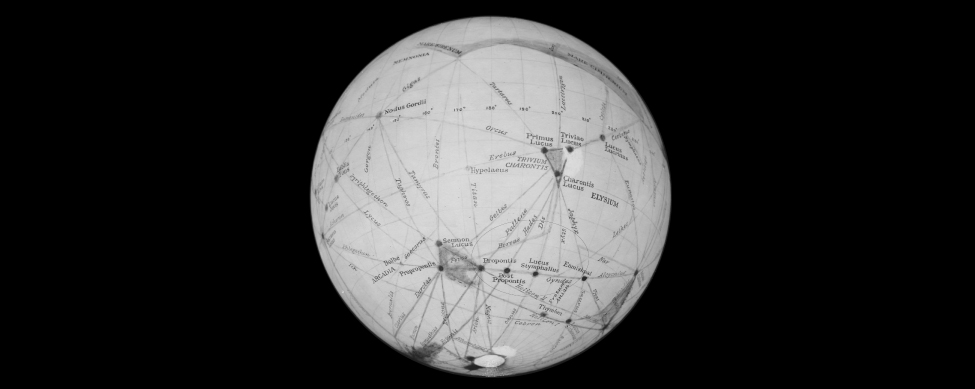
Until his death in 1916, the most effective proponent of intelligent life on Mars was Percival Lowell, a self-made American astronomer and member of the wealthy Lowell family of Boston (see the feature box on Percival Lowell: Dreaming of an Inhabited Mars). A skilled author and speaker, Lowell made what seemed to the public to be a convincing case for intelligent Martians, who had constructed the huge canals to preserve their civilization in the face of a deteriorating climate (Figure 10.4).
英語のヒント
1916年に亡くなるまで、火星の知的生命を最も強力に擁護したのは、独学で天文学者になったアメリカ人、パーシヴァル・ローウェルだった。彼はボストンの裕福なローウェル家の一員でもあった(囲み「パーシヴァル・ローウェル――人の住む火星を夢見て」を参照)。文章と演説に長けたローウェルは、一般の人々には説得力があると思われる議論を展開し、知的な火星人が、悪化する気候に直面しながら文明を守るため、巨大な運河を建設したのだと主張した(図10.4)。
Lowell’s Mars Globe.ローウェルの火星儀。
OpenStax / Rice University · CC BY 4.0
Figure 10.4 One of the remarkable globes of Mars prepared by Percival Lowell, showing a network of dozens of canals, oases, and triangular water reservoirs that he claimed were visible on the red planet.
図10.4 パーシヴァル・ローウェルが作った、目を引く火星儀の一つ。赤い惑星に見えると彼が主張した、数十本の運河、オアシス、三角形の貯水池からなる網目を示す。
The argument for a race of intelligent Martians, however, hinged on the reality of the canals, a matter that remained in serious dispute among astronomers. The canal markings were always difficult to study, glimpsed only occasionally because atmospheric conditions caused the tiny image of Mars to shimmer in the telescope. Lowell saw canals everywhere (even a few on Venus), but many other observers could not see them at all and remained unconvinced of their existence. When telescopes larger than Lowell’s failed to confirm the presence of canals, the skeptics felt vindicated. Now it is generally accepted that the straight lines were an optical illusion, the result of the human mind’s tendency to see order in random features that are glimpsed dimly at the limits of the eye’s resolution. When we see small, dim dots of surface markings, our minds tend to connect those dots into straight lines.
英語のヒント
しかし、知的な火星人の種族がいるという議論は、運河が実在するかどうかにかかっていた。この点については、天文学者の間で深刻な論争が続いていた。運河らしい模様は常に調べにくく、大気の状態によって望遠鏡の中の小さな火星像が揺らめくため、ときおり一瞬見えるだけだった。ローウェルは至る所に運河を見いだし、金星にさえ数本見たが、多くのほかの観測者にはまったく見えず、その存在を納得できなかった。ローウェルのものより大きい望遠鏡でも運河の存在を確認できないと、懐疑派は、自分たちの見方が裏付けられたと感じた。現在では、直線は錯視だったと一般に認められている。目の分解能の限界で、ぼんやりと一瞬だけ見える不規則な模様の中に、人間の心が秩序を見いだそうとする傾向の結果である。小さく暗い表面模様の点を見ると、私たちの心は、その点々を直線で結ぼうとする。