第10章地球に似た惑星――金星と火星Earthlike Planets: Venus and Mars
10.4 The Geology of Mars10.4 火星の地質
Learning Objectives学習の目標
By the end of this section, you will be able to:
この節を学び終えると、次のことができるようになる。
Discuss the main missions that have explored Mars
火星を探査した主なミッションを論じる。
Explain what we have learned from examination of meteorites from Mars
火星から来た隕石の調査で、何がわかったかを説明する。
Describe the various features found on the surface of Mars
火星表面に見られるさまざまな地形を説明する。
Compare the volcanoes and canyons on Mars with those of Earth
火星の火山や峡谷を、地球のものと比較する。
Describe the general conditions on the surface of Mars
火星表面の全般的な環境を説明する。
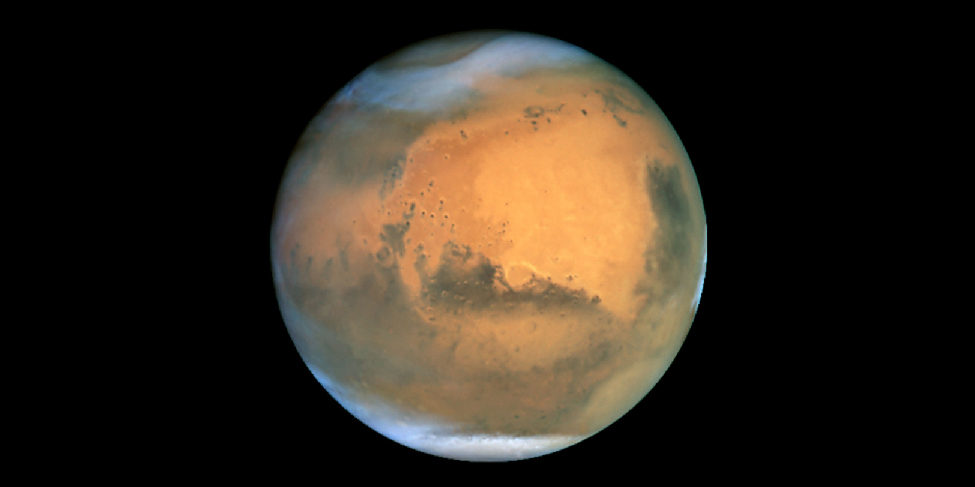
Mars is more interesting to most people than Venus because it is more hospitable. Even from the distance of Earth, we can see surface features on Mars and follow the seasonal changes in its polar caps (Figure 10.13). Although the surface today is dry and cold, evidence collected by spacecraft suggests that Mars once had blue skies and lakes of liquid water. Even today, it is the sort of place we can imagine astronauts visiting and perhaps even setting up permanent bases.
英語のヒント
火星は金星より過ごしやすいため、多くの人にとって、より興味深い惑星である。地球ほど離れた場所からでも、火星の表面の特徴を見て、極冠の季節変化を追うことができる(図10.13)。現在の表面は乾燥して冷たいが、探査機が集めた証拠は、かつて火星に青空と液体の水の湖があったことを示唆している。現在もなお、宇宙飛行士が訪れ、ことによると恒久基地まで設ける姿を想像できる種類の場所である。
Mars Photographed by the Hubble Space Telescope.ハッブル宇宙望遠鏡が撮影した火星。
credit: modification of work by NASA and the Hubble Heritage Team (STScI/AURA) · CC BY 4.0
Figure 10.13 This is one of the best photos of Mars taken from our planet, obtained in June 2001 when Mars was only 68 million kilometers away. The resolution is about 20 kilometers—much better than can be obtained with ground-based telescopes but still insufficient to reveal the underlying geology of Mars. (credit: modification of work by NASA and the Hubble Heritage Team (STScI/AURA))
図10.13 これは、私たちの惑星の近くから撮られた火星の、最良の写真の一つである。火星までわずか6800万kmだった、2001年6月に撮影された。分解能は約20 kmで、地上望遠鏡で得られるものよりはるかに優れているが、火星の表面の地質を明らかにするには、まだ不十分である。(提供:NASAおよびハッブル・ヘリテージ・チーム〈STScI/AURA〉の作品を改変)
Spacecraft Exploration of Mars宇宙機による火星探査
Mars has been intensively investigated by spacecraft. More than 50 spacecraft have been launched toward Mars, but only about half were fully successful. The first visitor was the US Mariner 4, which flew past Mars in 1965 and transmitted 22 photos to Earth. These pictures showed an apparently bleak planet with abundant impact craters. In those days, craters were unexpected; some people who were romantically inclined still hoped to see canals or something like them. In any case, newspaper headlines sadly announced that Mars was a “dead planet.”
英語のヒント
火星は宇宙機によって集中的に調べられてきた。50機以上が火星へ向けて打ち上げられたが、完全に成功したのは半数ほどだった。最初の訪問者はアメリカのマリナー4号で、1965年に火星のそばを飛び、22枚の写真を地球へ送った。画像には、衝突クレーターの多い、一見、荒涼とした惑星が写っていた。当時、クレーターは予想外だった。空想に心を寄せる人々の中には、まだ運河やそれに似たものが見えると期待する人もいた。ともかく新聞の見出しは、火星は「死んだ惑星」だったと、残念そうに伝えた。
In 1971, NASA’s Mariner 9 became the first spacecraft to orbit another planet, mapping the entire surface of Mars at a resolution of about 1 kilometer and discovering a great variety of geological features, including volcanoes, huge canyons, intricate layers on the polar caps, and channels that appeared to have been cut by running water. Geologically, Mars didn’t look so dead after all.
英語のヒント
1971年、NASAのマリナー9号は、別の惑星を周回する初の宇宙機となった。約1 kmの分解能で火星の全表面を地図化し、火山、巨大な峡谷、極冠の複雑な層、流れる水によって削られたように見える水路など、非常に多様な地形を発見した。地質学的に見れば、火星は結局、それほど死んだ世界には見えなかった。
The twin Viking spacecraft of the 1970s were among the most ambitious and successful of all planetary missions. Two orbiters surveyed the planet and served to relay communications for two landers on the surface. After an exciting and sometimes frustrating search for a safe landing spot, the Viking 1 lander touched down on the surface of Chryse Planitia (the Plains of Gold) on July 20, 1976, exactly 7 years after Neil Armstrong’s historic first step on the Moon. Two months later, Viking 2 landed with equal success in another plain farther north, called Utopia. The landers photographed the surface with high resolution and carried out complex experiments searching for evidence of life, while the orbiters provided a global perspective on Mars geology.
英語のヒント
1970年代の2機のバイキングは、すべての惑星探査の中でも、最も意欲的で成功したミッションの一つだった。2機の周回機が惑星を調べ、表面の2機の着陸機との通信を中継した。安全な着陸場所を探す、期待と、ときにはもどかしさに満ちた探索の後、バイキング1号の着陸機は、1976年7月20日にクリュセ平原、すなわち「黄金の平原」に着地した。ニール・アームストロングの歴史的な月面での第一歩から、ちょうど7年後である。2か月後、バイキング2号も、さらに北のユートピアという別の平原に、同じく成功裏に着陸した。着陸機は高分解能で表面を撮影し、生命の証拠を探す複雑な実験を行った。一方、周回機は、火星の地質を全球の視点から見せた。
Mars languished without a new successful landing for about two decades after Viking, although the Soviet Phobos 2 spacecraft reached Mars orbit in 1989. Two more spacecraft were launched toward Mars, by NASA and the Russian Space Agency, but both failed before reaching the planet.
英語のヒント
バイキングの後、火星では約20年間、新しい着陸の成功はなかったが、ソ連のフォボス2号は1989年に火星周回軌道へ到達した。NASAとロシア宇宙庁がさらに2機の探査機を火星へ向けて打ち上げたが、どちらも惑星へ到達する前に失敗した。
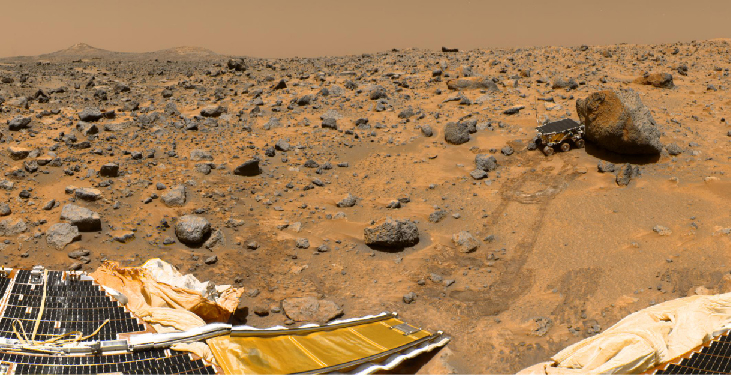
The situation changed, beginning in the 1990s, as NASA began a new exploration program using spacecraft that were smaller and less expensive than Viking. The first of the new missions, appropriately called Pathfinder, landed the first wheeled, solar-powered rover on the martian surface on July 4, 1997 (Figure 10.14). An orbiter called Mars Global Surveyor (MGS) arrived a few months later and began high-resolution photography of the entire surface over more than one martian year. The most dramatic discovery by this spacecraft, which continued to operate until 2006, was evidence of gullies apparently cut by surface water, as we will discuss later. These missions were followed in 2001 by the NASA Mars Odyssey orbiter, and in 2003 by the ESA Mars Express orbiter, both carrying high-resolution cameras. A gamma-ray spectrometer on Odyssey discovered a large amount of subsurface hydrogen (probably in the form of frozen water). Subsequent orbiters included the NASA Mars Reconnaissance Orbiter to evaluate future landing sites, MAVEN to study the upper atmosphere, and India’s Mangalayaan, also focused on study of Mars’ thin layers of air. Several of these orbiters are also equipped to communicate with landers and rovers on the surface and serve as data relays to Earth.
英語のヒント
1990年代に入ると、NASAがバイキングより小さく安い宇宙機を使う、新しい探査計画を始め、状況は変わった。新たなミッションの最初は、ふさわしくも「道を切り開く者」を意味するパスファインダーと名付けられた。1997年7月4日、車輪と太陽電池を持つ初の探査車を、火星の表面へ着陸させた(図10.14)。数か月後、マーズ・グローバル・サーベイヤー(MGS)という周回機が到着し、火星の1年を超える期間にわたって、全表面の高分解能撮影を始めた。2006年まで運用されたこの探査機による、最も目覚ましい発見は、表面の水で削られたように見えるガリー、すなわち小さな谷の証拠だった。これについては後で論じる。これらのミッションに続き、2001年にはNASAのマーズ・オデッセイ周回機、2003年にはESAのマーズ・エクスプレス周回機が登場した。どちらも高分解能カメラを搭載していた。オデッセイのガンマ線分光計は、地下に大量の水素を発見した。おそらく、凍った水として存在するものだった。その後の周回機には、将来の着陸地点を評価するNASAのマーズ・リコネサンス・オービター、大気上層を調べるMAVEN、やはり火星の薄い大気の層の研究を重視する、インドのマンガルヤーンがある。これらの周回機のいくつかは、表面の着陸機や探査車と通信する装置も備え、地球へのデータ中継を担う。
Surface View from Mars Pathfinder.マーズ・パスファインダーから見た表面の眺め。
credit: NASA/JPL · JPL image use policy
Figure 10.14 The scene from the Pathfinder lander shows a windswept plain, sculpted long ago when water flowed out of the martian highlands and into the depression where the spacecraft landed. The Sojourner rover, the first wheeled vehicle on Mars, is about the size of a microwave oven. Its flat top contains solar cells that provided electricity to run the vehicle. You can see the ramp from the lander and the path the rover took to the larger rock that the mission team nicknamed “Yogi.” (credit: NASA/JPL)
図10.14 パスファインダー着陸機からの眺めには、風の吹く平原が写っている。遠い昔、火星の高地から、探査機が着陸したくぼみへ水が流れ込み、この地形を削った。火星初の車輪付き車両であるソジャーナーは、電子レンジほどの大きさである。平らな上面には、走行用の電力を供給する太陽電池が載っている。着陸機のスロープと、ミッションチームが「ヨギ」と愛称を付けた大きな岩へ探査車が進んだ道筋が見える。(提供:NASA/JPL)
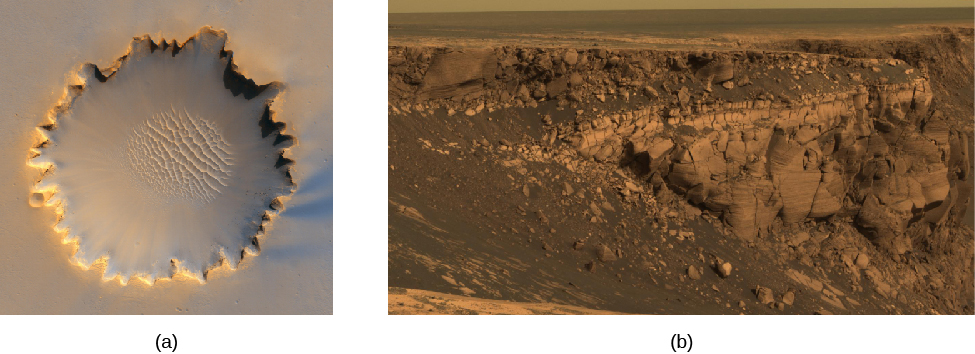
In 2003, NASA began a series of highly successful Mars landers. Twin Mars Exploration Rovers (MER), named Spirit and Opportunity, have been successful far beyond their planned lifetimes. The design goal for the rovers was 600 meters of travel; in fact, they have traveled jointly more than 50 kilometers. After scouting around its rim, Opportunity drove down the steep walls into an impact crater called Victoria, then succeeded with some difficulty in climbing back out to resume its route (Figure 10.15). Dust covering the rovers’ solar cells caused a drop in power, but when a seasonal dust storm blew away the dust, the rovers resumed full operation. In order to survive winter, the rovers were positioned on slopes to maximize solar heating and power generation. In 2006, Spirit lost power on one of its wheels, and subsequently became stuck in the sand, where it continued operation as a fixed ground station. Meanwhile, in 2008, Phoenix (a spacecraft “reborn” of spare parts from a previous Mars mission that had failed) landed near the edge of the north polar cap, at latitude 68°, and directly measured water ice in the soil.
英語のヒント
2003年、NASAは、大きな成功を収める一連の火星着陸機を送り出し始めた。スピリットとオポチュニティという2台のマーズ・エクスプロレーション・ローバー(MER)は、予定の寿命をはるかに超えて成果を上げた。探査車の設計上の走行目標は600 mだったが、実際の合計走行距離は50 kmを超えた。オポチュニティは、ビクトリアという衝突クレーターの縁を偵察した後、急な壁を下って内部へ入った。それから、多少の苦労をしながらも登って外へ戻り、探査の道のりを再開した(図10.15)。太陽電池を覆う塵によって電力は低下したが、季節的な砂塵嵐が塵を吹き払うと、探査車は再び全面的に稼働した。冬を越すため、太陽からの加熱と発電を最大にできる斜面に置かれた。2006年、スピリットは車輪の一つが動力を失い、その後、砂に動きを取られた。そこで固定した地上観測点として活動を続けた。その間の2008年、過去に失敗した火星ミッションの予備部品から「生まれ変わった」探査機フェニックスが、北の極冠の縁に近い北緯68°へ着陸し、土壌中の水の氷を直接測定した。
Victoria Crater.ビクトリアクレーター。
credit a: modification of work by NASA/JPL-Caltech/University of Arizona/Cornell/Phio State University; credit b: modification of work by NASA/JPL/Cornell · JPL image use policy
Figure 10.15 (a) This crater in Meridiani Planum is 800 meters wide, making it slightly smaller than Meteor crater on Earth. Note the dune field in the interior. (b) This image shows the view from the Opportunity rover as it scouted the rim of Victoria crater looking for a safe route down into the interior. (credit a: modification of work by NASA/JPL-Caltech/University of Arizona/Cornell/Ohio State University; credit b: modification of work by NASA/JPL/Cornell)
図10.15 (a)メリディアニ平原にあるこのクレーターの幅は800 mで、地球のメテオクレーターより少し小さい。内部の砂丘地帯に注目しよう。(b)この画像は、オポチュニティが内部へ安全に下る道を探して、ビクトリアクレーターの縁を調べていたときの眺めを示す。(提供a:NASA/JPL-Caltech/アリゾナ大学/コーネル大学/Ohio State Universityの作品を改変、提供b:NASA/JPL/コーネル大学の作品を改変)
In 2011, NASA began sending a new generation of advanced, nuclear-powered rovers to Mars, designed to operate on the surface for many years. The rover Curiosity (the size of a subcompact car) made a pinpoint landing on the floor of Gale crater, a site selected for its complex geology and evidence that it had been submerged by water in the past. Previously, Mars landers had been sent to flat terrains with few hazards, as required by their lower targeting accuracy. The scientific goals of Curiosity include investigations of climate and geology, and assessment of the habitability of past and present Mars environments. In 2018, NASA’s InSight Lander touched down on Mars, carrying a suite of scientific instruments. These include a package (nicknamed “the mole”) that was designed to dig into the surface of Mars 1 mm at a time, hoping to reach a depth of 5 meters with heat sensors. Neither of these missions carries a specific life detection instrument, however. So far, scientists have not been able to devise a simple instrument that could distinguish living from nonliving materials on Mars.
英語のヒント
2011年、NASAは、長年にわたり表面で活動するよう設計された、高性能の新世代の原子力電源式探査車を、火星へ送り始めた。小型乗用車ほどの大きさのキュリオシティは、ゲールクレーターの底へ精密に着陸した。そこは、複雑な地質と、過去に水没していた証拠のために選ばれた場所である。従来の着陸機は、狙った場所へ降りる精度が低かったため、危険の少ない平坦な地形へ送られていた。キュリオシティの科学目標は、気候と地質の調査、および過去と現在の火星環境が生命の生存に適するかの評価である。2018年、NASAのインサイト着陸機は、一式の科学機器を搭載して火星に着地した。その中には、「モグラ」と呼ばれる装置があり、熱センサーを用いて深さ5 mへ達することを目指し、火星の表面を1 mmずつ掘るよう設計されていた。しかし、どちらのミッションも、生命を検出する専用装置は積んでいない。これまでのところ、科学者は火星で、生きている物質と生きていない物質を区別できる単純な装置を考案できていない。
The focus on the possibility of life returned with the 2021 landing of the large rover Perseverance, the near-twin of Curiosity. It touched down in a former lakebed, and part of its mission is to drill into ancient sedimentary rocks and collect small samples of these rocks to be returned (by a later mission) to Earth for laboratory study. NASA’s remarkable helicopter drone, named Ingenuity, has acted like an airborne scout for this mission. This light-weight helicopter, whose rotors have to turn much faster in the thin martian air, has, as of the end of 2023, flown 69 missions (far more than planned), each about 1–2 minutes, but covering a total of 17 kilometers of distance and reaching altitudes as high as 24 meters.
英語のヒント
生命の可能性への焦点は、2021年に、キュリオシティとほぼ双子の大型探査車パーサヴィアランスが着陸したことで戻ってきた。かつての湖底に着地し、ミッションの一部として、古い堆積岩に穴をあけ、小さな岩石試料を採取する。その試料は、後のミッションで地球へ持ち帰り、実験室で調べる予定である。NASAの画期的なヘリコプタードローン、インジェニュイティは、このミッションの空からの偵察役を担ってきた。火星の薄い大気中では、軽量のこのヘリコプターの回転翼は、ずっと速く回る必要がある。2023年末の時点で、計画をはるかに上回る69回の飛行を行った。1回は約1〜2分だが、合計17 kmを飛び、最高24 mの高度に達した。