第10章地球に似た惑星――金星と火星Earthlike Planets: Venus and Mars
Craters and the Age of the Venus Surfaceクレーターと金星表面の年代
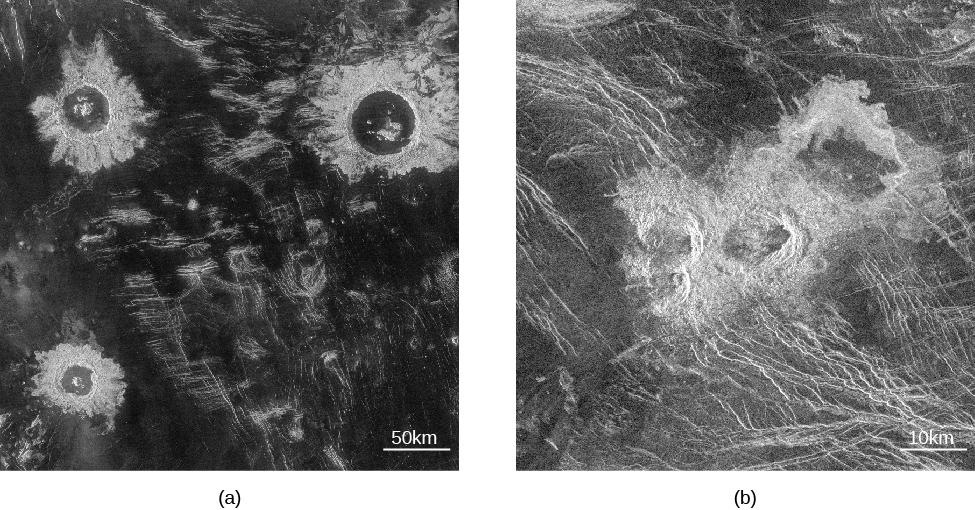
One of the first questions astronomers addressed with the high-resolution Magellan images was the age of the surface of Venus. Remember that the age of a planetary surface is rarely the age of the world it is on. A young age merely implies an active geology in that location. Such ages can be derived from counting impact craters. Figure 10.7 is an example of what these craters look like on the Venus radar images. The more densely cratered the surface, the greater its age. The largest crater on Venus (called Mead) is 275 kilometers in diameter, larger than one of the largest known terrestrial craters (Chicxulub), but much smaller than the lunar impact basins.
英語のヒント
高分解能のマゼラン画像で天文学者が最初に取り組んだ問いの一つは、金星表面の年代だった。惑星の表面の年代は、それがある天体そのものの年代と同じとは限らず、そうであることはむしろ少ないと、思い出してほしい。若い年代は、その場所の地質活動が活発だったことを示すにすぎない。こうした年代は、衝突クレーターを数えることで求められる。図10.7は、金星のレーダー画像でクレーターがどう見えるかの例である。クレーターが密集した表面ほど、年代は古い。金星最大のクレーター、ミードの直径は275 kmで、地球で知られる大きなクレーターの一つ、チクシュルーブより大きいが、月の衝突盆地よりはるかに小さい。
Impact Craters on Venus.金星の衝突クレーター。
credit a: modification of work by NASA/JPL; credit b: modification of work by NASA/JPL · JPL image use policy
Figure 10.7 (a) These large impact craters are in the Lavinia region of Venus. Because they are rough, the crater rims and ejecta appear brighter in these radar images than do the smoother surrounding lava plains. The largest of these craters has a diameter of 50 kilometers. (b) This small, complex crater is named after writer Gertrude Stein. The triple impact was caused by the breaking apart of the incoming asteroid during its passage through the thick atmosphere of Venus. The projectile had an initial diameter of between 1 and 2 kilometers. (credit a: modification of work by NASA/JPL; credit b: modification of work by NASA/JPL)
図10.7 (a)これらの大きな衝突クレーターは、金星のラヴィニア地域にある。クレーターの縁と放出物は起伏が激しいため、このレーダー画像では、より滑らかな周囲の溶岩平原より明るく見える。最大のクレーターの直径は50 kmである。(b)この小さく複雑なクレーターは、作家ガートルード・スタインにちなんで名付けられた。三重衝突は、飛来する小惑星が金星の厚い大気を通過する間に、分裂したことで起きた。飛来物のもとの直径は1〜2 kmだった。(提供a:NASA/JPLの作品を改変、提供b:NASA/JPLの作品を改変)
You might think that the thick atmosphere of Venus would protect the surface from impacts, burning up the projectiles long before they could reach the surface. But this is the case for only smaller projectiles. Crater statistics show very few craters less than 10 kilometers in diameter, indicating that projectiles smaller than about 1 kilometer (the size that typically produces a 10-kilometer crater) were stopped by the atmosphere. Those craters with diameters from 10 to 30 kilometers are frequently distorted or multiple, apparently because the incoming projectile broke apart in the atmosphere before it could strike the ground as shown in the Stein crater in Figure 10.7. If we limit ourselves to impacts that produce craters with diameters of 30 kilometers or larger, however, then crater counts are as useful on Venus for measuring surface age as they are on airless bodies such as the Moon.
英語のヒント
金星の厚い大気は、飛来物が表面へ到達するはるか前に燃え尽きさせ、表面を衝突から守ると思うかもしれない。しかし、そうなるのは小さい飛来物だけである。クレーターの統計では、直径10 km未満のものは非常に少ない。これは、普通なら10 kmのクレーターを作る程度の大きさ、つまり約1 km未満の飛来物が、大気に食い止められたことを示す。直径10〜30 kmのクレーターは、しばしば歪んだ形や複数の構造を持つ。どうやら、図10.7のスタインクレーターに見られるように、飛来物が地面に衝突する前に、大気中で分裂したためらしい。しかし、直径30 km以上のクレーターを作る衝突に対象を限れば、クレーターの数は、月のような大気のない天体と同じくらい、金星でも表面の年代測定に役立つ。
The large craters in the venusian plains indicate an average surface age that is only between 300 and 600 million years. These results indicate that Venus is indeed a planet with persistent geological activity, intermediate between that of Earth’s ocean basins (which are younger and more active) and that of its continents (which are older and less active).
英語のヒント
金星の平原にある大きなクレーターから、平均的な表面年代は、わずか3億〜6億年とわかる。この結果は、金星が確かに、持続的な地質活動を行う惑星であることを示す。その活動の程度は、より若く活発な地球の海盆と、より古く活動の少ない地球の大陸の、中間に位置する。
Almost all of the large craters on Venus look fresh, with little degradation or filling in by either lava or windblown dust. This is one way we know that the rates of erosion or sediment deposition are very low. We have the impression that relatively little has happened since the venusian plains were last resurfaced by large-scale volcanic activity. Apparently Venus experienced some sort of planet-wide volcanic convulsion between 300 and 600 million years ago, a mysterious event that is unlike anything in terrestrial history.
英語のヒント
金星の大きなクレーターはほぼすべて新鮮に見え、溶岩や風で運ばれた塵によって、形が崩れたり埋まったりしたものは少ない。侵食や堆積物の堆積の速度が非常に低いとわかる理由の一つが、これである。金星の平原が最後に大規模な火山活動で作り替えられてから、比較的ほとんど何も起きていないという印象を受ける。どうやら金星は、3億〜6億年前に、惑星全体に及ぶ何らかの火山活動の激変を経験したらしい。これは、地球の歴史にある何とも異なる、謎めいた出来事である。
Volcanoes on Venus金星の火山
Like Earth, Venus is a planet that has experienced widespread volcanism. In the lowland plains, volcanic eruptions are the principal way the surface is renewed, with large flows of highly fluid lava destroying old craters and generating a fresh surface. In addition, numerous younger volcanic mountains and other structures are associated with surface hot spots—places where convection in the planet’s mantle transports the interior heat to the surface.
英語のヒント
金星も地球と同じく、広範囲で火山活動を経験してきた惑星である。低地の平原では、火山噴火が表面を更新する主な仕組みとなり、流動性の高い溶岩の大きな流れが古いクレーターを壊して、新しい表面を作る。さらに、より新しい火山やほかの構造が多数、表面のホットスポットに伴っている。ホットスポットは、惑星のマントルの対流によって、内部の熱が表面へ運ばれる場所である。
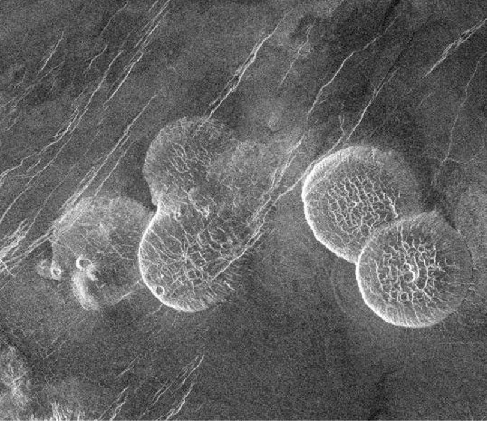
One of the large volcanoes on Venus, called Sif Mons, is about 300 kilometers across and 2 kilometers high—broader but lower than the Hawaiian volcano Mauna Loa. At its top is a volcanic crater, or caldera, about 40 kilometers across, and its slopes show individual lava flows up to 500 kilometers long. Thousands of smaller volcanoes dot the surface, down to the limit of visibility of the Magellan images, which correspond to cones or domes about the size of a shopping mall parking lot. Most of these seem similar to terrestrial volcanoes. Other volcanoes have unusual shapes, such as the “pancake domes” illustrated in Figure 10.8.
英語のヒント
金星の大きな火山の一つ、シフ山は、幅約300 km、高さ2 kmである。ハワイのマウナ・ロア火山より広いが低い。頂上には、幅約40 kmの火口、すなわちカルデラがあり、斜面には長さ最大500 kmの個々の溶岩流が見られる。表面には、より小さい火山が何千も点在し、その小ささはマゼラン画像で見分けられる限界にまで及ぶ。これは、ショッピングモールの駐車場ほどの大きさの円錐丘やドームに相当する。大部分は地球の火山に似ているようだ。それ以外には、図10.8の「パンケーキドーム」のような、変わった形の火山もある。
Pancake-Shaped Volcanoes on Venus.金星のパンケーキ形の火山。
credit: modification of work by NASA/JPL · JPL image use policy
Figure 10.8 These remarkable circular domes, each about 25 kilometers across and about 2 kilometers tall, are the result of eruptions of highly viscous (sludgy) lava that spreads out evenly in all directions. (credit: modification of work by NASA/JPL)
図10.8 それぞれ幅約25 km、高さ約2 kmの、これらの目を引く円形ドームは、非常に粘性の高い、どろりとした溶岩が噴出し、全方向へ均等に広がった結果である。(提供:NASA/JPLの作品を改変)
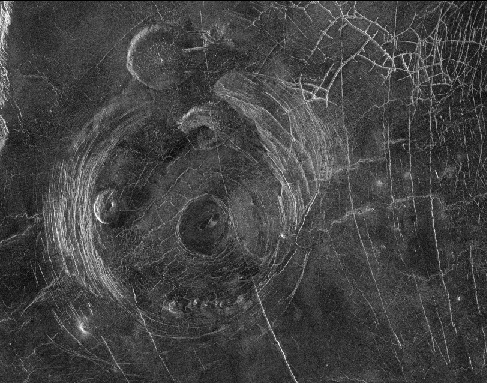
All of the volcanism is the result of eruption of lava onto the surface of the planet. But the hot lava rising from the interior of a planet does not always make it to the surface. On both Earth and Venus, this upwelling lava can collect to produce bulges in the crust. Many of the granite mountain ranges on Earth, such as the Sierra Nevada in California, involve such subsurface volcanism. These bulges are common on Venus, where they produce large circular or oval features called coronae (singular: corona) (Figure 10.9).
英語のヒント
こうした火山活動はすべて、惑星表面へ溶岩が噴出した結果である。しかし、惑星内部から上昇する熱い溶岩が、いつも表面までたどり着くとは限らない。地球でも金星でも、この上昇する溶岩が集まり、地殻に膨らみを作ることがある。カリフォルニアのシエラネバダ山脈など、地球の多くの花崗岩の山脈には、こうした地下での火成活動が関わっている。金星ではこれらの膨らみがよく見られ、コロナと呼ばれる大きな円形または楕円形の地形を作る。ラテン語の複数形はcoronae、単数形はcoronaである(図10.9)。
The “Miss Piggy” Corona.「ミス・ピギー」のコロナ。
credit: NASA/JPL · JPL image use policy
Figure 10.9 Fotla Corona is located in the plains to the south of Aphrodite Terra. Curved fracture patterns show where the material beneath has put stress on the surface. A number of pancake and dome volcanoes are also visible. Fotla was a Celtic fertility goddess. Some students see a resemblance between this corona and Miss Piggy of the Muppets (her left ear, at the top of the picture, is the pancake volcano in the upper center of the image). (credit: NASA/JPL)
図10.9 フォトラ・コロナは、アフロディーテ大陸の南の平原にある。曲がった割れ目の模様は、地下の物質が表面に応力を加えた場所を示す。パンケーキ火山やドーム火山も、いくつか見える。フォトラはケルトの豊穣の女神である。このコロナが、マペッツのミス・ピギーに似ていると見る学生もいる。彼女の左耳に当たる、写真の上側の部分は、画像上中央のパンケーキ火山である。(提供:NASA/JPL)