第10章地球に似た惑星――金星と火星Earthlike Planets: Venus and Mars
10.3 The Massive Atmosphere of Venus10.3 金星の巨大な大気
Learning Objectives学習の目標
By the end of this section, you will be able to:
この節を学び終えると、次のことができるようになる。
Describe the general composition and structure of the atmosphere on Venus
金星大気の全般的な組成と構造を説明する。
Explain how the greenhouse effect has led to high temperatures on Venus
温室効果がどのように金星の高温をもたらしたかを説明する。
The thick atmosphere of Venus produces the high surface temperature and shrouds the surface in a perpetual red twilight. Sunlight does not penetrate directly through the heavy clouds, but the surface is fairly well lit by diffuse light (about the same as the light on Earth under a heavy overcast). The weather at the bottom of this deep atmosphere remains perpetually hot and dry, with calm winds. Because of the heavy blanket of clouds and atmosphere, one spot on the surface of Venus is similar to any other as far as weather is concerned.
英語のヒント
金星の厚い大気は表面を高温にし、絶え間ない赤い薄明の中へ包み込む。太陽光は厚い雲を直接通り抜けないが、表面は拡散光によってかなりよく照らされ、地球の厚い曇天と同じくらい明るい。この深い大気の底の天候は、常に熱く乾燥しており、風は穏やかである。厚い雲と大気に覆われているため、天候に関する限り、金星の表面では、どの場所もほかの場所と似ている。
Composition and Structure of the Atmosphere大気の組成と構造
The most abundant gas on Venus is carbon dioxide (CO2), which accounts for 96% of the atmosphere. The second most common gas is nitrogen. The predominance of carbon dioxide over nitrogen is not surprising when you recall that Earth’s atmosphere would also be mostly carbon dioxide if this gas were not locked up in marine sediments (see the discussion of Earth’s atmosphere in Earth as a Planet).
英語のヒント
金星で最も豊富な気体は二酸化炭素(CO₂)で、大気の96%を占める。二番目に多い気体は窒素である。窒素より二酸化炭素が圧倒的に多いことは、驚くべきことではない。地球の大気も、もしこの気体が海の堆積物に閉じ込められていなければ、大部分が二酸化炭素になっていたはずだと思い出せば、理解できる。「惑星としての地球」での地球大気の議論を参照しよう。
Table 10.2 compares the compositions of the atmospheres of Venus, Mars, and Earth. Expressed in this way, as percentages, the proportions of the major gases are very similar for Venus and Mars, but in total quantity, their atmospheres are dramatically different. With its surface pressure of 90 bars, the venusian atmosphere is more than 10,000 times more massive than its martian counterpart. Overall, the atmosphere of Venus is very dry; the absence of water is one of the important ways that Venus differs from Earth.
英語のヒント
表10.2では、金星、火星、地球の大気の組成を比較している。このように百分率で表すと、主要な気体の割合は金星と火星で非常によく似ているが、大気の総量は大きく異なる。表面気圧90 barの金星大気は、火星の大気より質量が1万倍以上大きい。全体として、金星の大気は非常に乾燥している。水がないことは、金星が地球と異なる重要な点の一つである。
Atmospheric Composition of Earth, Venus, and Mars 地球・金星・火星の大気組成 |
|||
|---|---|---|---|
Gas 気体 |
Earth 地球 |
Venus 金星 |
Mars 火星 |
Carbon dioxide (CO2) 二酸化炭素(CO₂) |
0.0426% (2025 global annual mean) 0.0426%(2025年の全球年平均) |
96% 96% |
95.3% 95.3% |
Nitrogen (N2) 窒素(N₂) |
78.1% 78.1% |
3.5% 3.5% |
2.7% 2.7% |
Argon (Ar) アルゴン(Ar) |
0.93% 0.93% |
0.006% 0.006% |
1.6% 1.6% |
Oxygen (O2) 酸素(O₂) |
21.0% 21.0% |
0.003% 0.003% |
0.15% 0.15% |
Neon (Ne) ネオン(Ne) |
0.002% 0.002% |
0.001% 0.001% |
0.0003% 0.0003% |
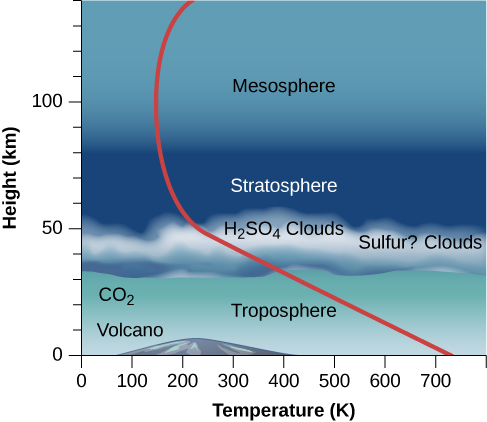
The atmosphere of Venus has a huge troposphere (region of convection) that extends up to at least 50 kilometers above the surface (Figure 10.12). Within the troposphere, the gas is heated from below and circulates slowly, rising near the equator and descending over the poles. Being at the base of the atmosphere of Venus is something like being a kilometer or more below the ocean surface on Earth. There, the mass of water evens out temperature variations and results in a uniform environment—the same effect the thick atmosphere has on Venus.
英語のヒント
金星の大気には、表面から少なくとも高度50 kmまで延びる、巨大な対流圏、すなわち対流の起きる領域がある(図10.12)。その中では、気体が下から熱せられ、赤道付近で上昇し、極の上空で下降しながら、ゆっくり循環する。金星大気の底にいることは、地球の海面下1 km以上にいることに、いくらか似ている。そこでは大量の水が温度の違いをならし、均一な環境を作る。金星の厚い大気も、それと同じ作用をしている。
Venus’ Atmosphere.金星の大気。
OpenStax / Rice University · CC BY 4.0
Figure 10.12 The layers of the massive atmosphere of Venus shown here are based on data from the Pioneer and Venera entry probes. Height is measured along the left axis, the bottom scale shows temperature, and the red line allows you to read off the temperature at each height. Notice how steeply the temperature rises below the clouds, thanks to the planet’s huge greenhouse effect.
図10.12 ここに示す金星の巨大な大気の層は、パイオニアとベネラの大気突入プローブのデータに基づく。左の軸で高度、下の目盛りで温度を示し、赤い線から各高度の温度を読み取れる。金星の非常に大きな温室効果によって、雲の下で温度がどれほど急激に上昇するかに注目しよう。
In the upper troposphere, between 30 and 60 kilometers above the surface, a thick cloud layer is composed primarily of sulfuric acid droplets. Sulfuric acid (H2SO4) is formed from the chemical combination of sulfur dioxide (SO2) and water (H2O). In the atmosphere of Earth, sulfur dioxide is one of the primary gases emitted by volcanoes, but it is quickly diluted and washed out by rainfall. In the dry atmosphere of Venus, this unpleasant substance is apparently stable. Below 30 kilometers, the Venus atmosphere is clear of clouds.
英語のヒント
表面から高度30〜60 kmにある対流圏上部には、主に硫酸の液滴からなる厚い雲の層がある。硫酸(H₂SO₄)は、二酸化硫黄(SO₂)と水(H₂O)の化学的な結合からできる。地球の大気では、二酸化硫黄は火山が放出する主な気体の一つだが、すぐに薄まり、雨によって洗い流される。乾燥した金星の大気では、この不快な物質は安定して存在するらしい。高度30 kmより下の金星大気には、雲がない。
Surface Temperature on Venus金星の表面温度
The high surface temperature of Venus was discovered by radio astronomers in the late 1950s and confirmed by the Mariner and Venera probes. How can our neighbor planet be so hot? Although Venus is somewhat closer to the Sun than is Earth, its surface is hundreds of degrees hotter than you would expect from the extra sunlight it receives. Scientists wondered what could be heating the surface of Venus to a temperature above 700 K. The answer turned out to be the greenhouse effect.
英語のヒント
金星の高い表面温度は、1950年代後半に電波天文学者によって発見され、マリナーとベネラの探査機で確認された。隣の惑星は、どうしてこれほど熱いのだろうか。金星は地球よりいくらか太陽に近いが、その表面は、増えた太陽光から予想されるより、何百度も高温である。科学者は、何が金星表面を700 K以上に加熱しているのかと考えた。答えは、温室効果だった。
The greenhouse effect works on Venus just as it does on Earth, but since Venus has so much more CO2—roughly 140,000 times as much by mass—the effect is much stronger. The thick CO2 acts as a blanket, making it very difficult for the infrared (heat) radiation from the ground to get back into space. As a result, the surface heats up. The energy balance is only restored when the planet is radiating as much energy as it receives from the Sun, but this can happen only when the temperature of the lower atmosphere is very high. One way of thinking of greenhouse heating is that it must raise the surface temperature of Venus until this energy balance is achieved.
英語のヒント
温室効果は金星でも地球と同じように働くが、金星には、総質量で約14万倍という、はるかに多くのCO₂があるため、その効果はずっと強い。厚いCO₂は毛布のように働き、地表からの赤外線、すなわち熱放射が宇宙へ戻るのを非常に難しくする。その結果、表面が加熱される。エネルギー収支がつり合いを取り戻すのは、惑星が太陽から受け取るのと同じだけのエネルギーを放射しているときだけだが、そうなるには、大気下層の温度が非常に高くなければならない。温室効果による加熱は、このエネルギーのつり合いが達成されるまで、金星表面の温度を上げるはずだ、と考えることもできる。
Has Venus always had such a massive atmosphere and high surface temperature, or might it have evolved to such conditions from a climate that was once more nearly earthlike? The answer to this question is of particular interest to us as we look at the increasing levels of CO2 in Earth’s atmosphere. As the greenhouse effect becomes stronger on Earth, are we in any danger of transforming our own planet into a hellish place like Venus?
英語のヒント
金星は、ずっとこれほど巨大な大気と高い表面温度を持っていたのだろうか。それとも、かつてはもっと地球に近い気候から、こうした条件へ進化したのだろうか。この問いの答えは、地球大気のCO₂濃度の上昇を見る私たちにとって、とりわけ興味深い。地球の温室効果が強まるにつれ、私たち自身の惑星を、金星のような地獄のように過酷な場所へ変えてしまう危険はあるのだろうか。
Let us try to reconstruct the possible evolution of Venus from an earthlike beginning to its present state. Venus may once have had a climate similar to that of Earth, with moderate temperatures, water oceans, and much of its CO2 dissolved in the ocean or chemically combined with the surface rocks. Then we allow for modest additional heating—by gradual increase in the energy output of the Sun, for example. When we calculate how Venus’ atmosphere would respond to such effects, it turns out that even a small amount of extra heat can lead to increased evaporation of water from the oceans and the release of gas from surface rocks.
英語のヒント
地球に似た始まりから現在の状態に至る、金星の進化の可能性を再構成してみよう。金星はかつて、穏やかな温度、水の海、そして海に溶けるか表面の岩石と化学的に結びついた大量のCO₂を持ち、地球に似た気候だったのかもしれない。そこへ、たとえば太陽が放出するエネルギーが徐々に増えることで、少し余分な加熱が起こると考える。そのような作用に金星大気がどう応じるかを計算すると、わずかな追加の熱でも、海からの水の蒸発が増え、表面の岩石から気体が放出されることにつながりうるとわかる。
This in turn means a further increase in the atmospheric CO2 and H2O, gases that would amplify the greenhouse effect in Venus’ atmosphere. That would lead to still more heat near Venus’ surface and the release of further CO2 and H2O. Unless some other processes intervene, the temperature thus continues to rise. Such a situation is called the runaway greenhouse effect.
英語のヒント
これによって今度は、大気中のCO₂とH₂Oがさらに増える。これらの気体は、金星大気の温室効果を強めるだろう。すると、表面付近の熱はさらに増し、CO₂とH₂Oもさらに放出される。別の過程が介入しない限り、温度はこうして上がり続ける。このような状況を、暴走温室効果と呼ぶ。
We want to emphasize that the runaway greenhouse effect is not just a large greenhouse effect; it is an evolutionary process. The atmosphere evolves from having a small greenhouse effect, such as on Earth, to a situation where greenhouse warming is a major factor, as we see today on Venus. Once the large greenhouse conditions develop, the planet establishes a new, much hotter equilibrium near its surface.
英語のヒント
強調しておきたいのは、暴走温室効果は、単に大きな温室効果なのではなく、時間とともに進む変化の過程だということである。大気は、地球のように温室効果が小さい状態から、現在の金星のように、温室効果による加熱が主要な要因になる状態へ進化する。大きな温室効果の条件が成立すると、惑星は表面付近で、ずっと高温の新しい平衡状態に落ち着く。
Reversing the situation is difficult because of the role water plays. On Earth, most of the CO2 is either chemically bound in the rocks of our crust or dissolved by the water in our oceans. As Venus got hotter and hotter, its oceans evaporated, eliminating that safety valve. But the water vapor in the planet’s atmosphere will not last forever in the presence of ultraviolet light from the Sun. The light element hydrogen can escape from the atmosphere, leaving the oxygen behind to combine chemically with surface rock. The loss of water is therefore an irreversible process: once the water is gone, it cannot be restored. There is evidence that this is just what happened to the water once present on Venus.
英語のヒント
この状況を逆戻りさせるのは、水の果たす役割のために難しい。地球では、CO₂の大部分が地殻の岩石に化学的に結びついているか、海の水に溶けている。金星がますます熱くなるにつれ、海が蒸発し、この安全弁は失われた。しかし、大気中の水蒸気も、太陽からの紫外線があるところで、永久には残らない。軽い元素である水素は大気から逃げ、残った酸素は表面の岩石と化学的に結びつく。したがって、水の喪失は不可逆な過程であり、一度なくなると、元には戻せない。かつて金星にあった水に起きたのは、まさにこの過程だと示す証拠がある。
We don’t know if the same runaway greenhouse effect could one day happen on Earth. Although we are uncertain about the point at which a stable greenhouse effect breaks down and turns into a runaway greenhouse effect, Venus stands as clear testament to the fact that a planet cannot continue heating indefinitely without a major change in its oceans and atmosphere. It is a conclusion that we and our descendants will surely want to pay close attention to.
英語のヒント
同じ暴走温室効果が、いつか地球でも起こりうるのかはわからない。安定した温室効果が破綻し、暴走温室効果へ転じる境目については確信を持てないが、金星は、惑星が海や大気を大きく変えずに、いつまでも温まり続けることはできないという事実を、はっきり物語っている。これは、私たちも子孫も、必ず十分に注意を払いたい結論である。