第18章公共経済
18.3 Flaws in the Democratic System of Government18.3 民主的な統治制度の欠陥
Learning Objectives学習目標
Learning Objectives学習目標
By the end of this section, you will be able to:
英語のヒント
この節を学ぶと、次のことができるようになる。
- Assess the median voter theory
英語のヒント
中位投票者理論を評価する。 - Explain the voting cycle
英語のヒント
投票の循環を説明する。 - Analyze the interrelationship between markets and government
英語のヒント
市場と政府の相互関係を分析する。
Most developed countries today have a democratic system of government: citizens express their opinions through votes and those votes affect the direction of the country. The advantage of democracy over other systems is that it allows everyone in a society an equal say and therefore may reduce the possibility of a small group of wealthy oligarchs oppressing the masses. There is no such thing as a perfect system, and democracy, for all its popularity, is not without its problems, a few of which we will examine here.
英語のヒント
今日の先進国の大半には民主的な統治制度がある。市民は投票によって意見を表し、その票が国の方向を左右する。他の制度に対する民主主義の利点は、社会の全員に平等な発言権を与え、少数の裕福な寡頭支配者が大衆を抑圧する可能性を減らしうることである。完璧な制度はなく、広く支持される民主主義にも問題はある。ここではそのいくつかを調べる。
We sometimes sum up and oversimplify democracy in two words: “Majority rule.” When voters face three or more choices, however, then voting may not always be a useful way of determining what the majority prefers.
英語のヒント
民主主義は「多数支配」という二語に要約され、単純化されすぎることがある。しかし有権者が三つ以上の選択肢に直面すると、投票は必ずしも多数派の好みを決める有用な方法ではない。
As one example, consider an election in a state where 60% of the population is liberal and 40% is conservative. If there are only two candidates, one from each side, and if liberals and conservatives vote in the same 60–40 proportions in which they are represented in the population, then the liberal will win. What if the election ends up including two liberal candidates and one conservative? It is possible that the liberal vote will split and victory will go to the minority party. In this case, the outcome does not reflect the majority’s preference.
英語のヒント
たとえば人口の60%がリベラル、40%が保守の州での選挙を考えよう。候補者が各陣営1人ずつの2人だけで、それぞれの有権者が人口と同じ60対40の比率で投票すれば、リベラルが勝つ。しかし、リベラル候補2人と保守候補1人が出馬したらどうか。リベラル票が割れて少数派の党が勝つこともありうる。その結果は多数派の選好を反映しない。
Does the majority view prevail in the case of sugar quotas? Clearly there are more sugar consumers in the United States than sugar producers, but the U.S. domestic sugar lobby (www.sugarcane.org) has successfully argued for protection against imports since 1789. By law, therefore, U.S. cookie and candy makers must use 85% domestic sugar in their products. Meanwhile quotas on imported sugar restrict supply and keep the domestic sugar price up—raising prices for companies that use sugar in producing their goods and for consumers. The European Union allows sugar imports, and prices there are 40% lower than U.S. sugar prices. Sugar-producing countries in the Caribbean repeatedly protest the U.S. quotas at the World Trade Organization meetings, but each bite of cookie, at present, costs you more than if there were no sugar lobby. This case goes against the theory of the “median” voter in a democracy. The median voter theory argues that politicians will try to match policies to what pleases the median voter preferences. If we think of political positions along a spectrum from left to right, the median voter is in the middle of the spectrum. This theory argues that actual policy will reflect “middle of the road.” In the case of sugar lobby politics, the minority, not the median, dominates policy.
英語のヒント
砂糖の輸入割当では多数派の見解が優勢だろうか。米国では明らかに砂糖の消費者が生産者より多いが、国内の砂糖ロビー(www.sugarcane.org)は1789年以来、輸入からの保護を勝ち取ってきた。そのため法律上、米国のクッキー・菓子メーカーは製品に85%の国産砂糖を使わなければならない。輸入砂糖の割当は供給を制限し、国内価格を高く保つため、砂糖を使う企業と消費者の価格を引き上げる。欧州連合は砂糖輸入を認め、価格は米国より40%低い。カリブ海の砂糖生産国は世界貿易機関の会合で繰り返し米国の割当に抗議するが、現在クッキーを一口食べるたびに、砂糖ロビーがなければ払わずにすんだ追加額を払う。これは民主主義の「中位」投票者理論に反する。中位投票者理論は、政治家が中位投票者の好みに政策を合わせようとすると主張する。政治的立場を左から右への幅で考えれば、中位投票者はその中央にいる。理論によれば実際の政策は「中道」を反映する。砂糖ロビーの政治では、中位ではなく少数派が政策を支配している。
Sometimes it is not even clear how to define the majority opinion. Step aside from politics for a moment and think about a choice facing three families (the Ortegas, the Schmidts, and the Alexanders) who are planning to celebrate New Year’s Day together. They agree to vote on the menu, choosing from three entrees, and they agree that the majority vote wins. With three families, it seems reasonable that one producing choice will get a 2–1 majority. What if, however, their vote ends up looking like Table 18.1?
英語のヒント
多数派の意見をどう定義するかさえ、はっきりしないこともある。政治から少し離れ、一緒に元日を祝う予定の3家族、オルテガ家、シュミット家、アレクサンダー家の選択を考えよう。主菜3種から投票で献立を選び、多数決に従うと合意する。3家族なら、どれかが2対1で多数を得ると思える。しかし、投票が表18.1のようになったらどうか。
Clearly, the three families disagree on their first choice. However, the problem goes even deeper. Instead of looking at all three choices at once, compare them two at a time. (See Figure 18.2) In a vote of turkey versus beef, turkey wins by 2–1. In a vote of beef versus lasagna, beef wins 2–1. If turkey beats beef, and beef beats lasagna, then it might seem only logical that turkey must also beat lasagna. However, with the preferences, lasagna is preferred to turkey by a 2–1 vote, as well. If lasagna is preferred to turkey, and turkey beats beef, then surely it must be that lasagna also beats beef? Actually, no. Beef beats lasagna. In other words, the majority view may not win. Clearly, as any car salesperson will tell you, the way one presents choices to us influences our decisions.
英語のヒント
3家族の第一希望が異なるのは明らかだ。しかし問題はもっと深い。3種を同時に見る代わりに、2種ずつ比べよう(図18.2)。七面鳥と牛肉では七面鳥が2対1で勝つ。牛肉とラザニアでは牛肉が2対1で勝つ。七面鳥が牛肉に勝ち、牛肉がラザニアに勝つなら、七面鳥はラザニアにも勝つのが論理的に思える。しかしこの選好では、ラザニアも七面鳥に2対1で勝つ。ラザニアが七面鳥より好まれ、七面鳥が牛肉に勝つなら、ラザニアは牛肉にも勝つはずではないか。実際はそうではなく、牛肉がラザニアに勝つ。つまり、多数派の見解が勝つとは限らない。自動車の販売員なら誰でも言うように、選択肢の提示の仕方は意思決定に影響する。
A Voting Cycle投票の循環
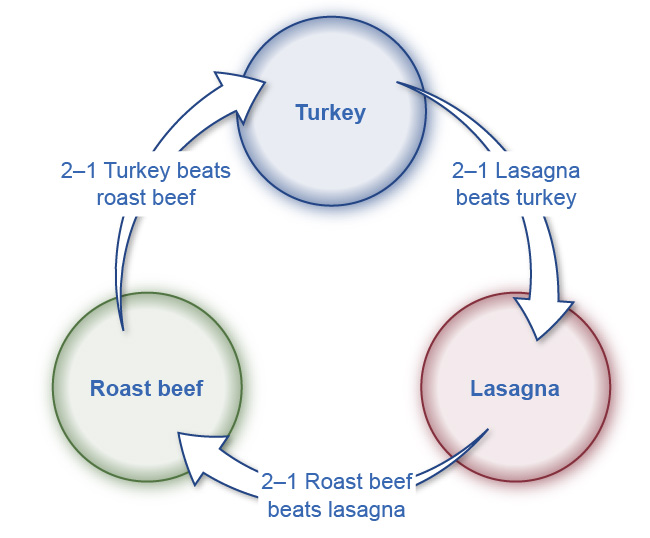

Figure 18.2図 18.2
Given these choices, voting will struggle to produce a majority outcome. Turkey is favored over roast beef by 2–1 and roast beef is favored over lasagna by 2–1. If turkey beats roast beef and roast beef beats lasagna, then it might seem that turkey must beat lasagna, too. However, given these preferences, lasagna is favored over turkey by 2–1.
英語のヒント
この選択肢では、多数派の結果を投票で出すのは難しい。七面鳥はローストビーフより2対1で好まれ、ローストビーフはラザニアより2対1で好まれる。七面鳥がローストビーフに勝ち、ローストビーフがラザニアに勝つなら、七面鳥はラザニアにも勝つはずに見える。しかしこの選好では、ラザニアが七面鳥より2対1で好まれる。
The Ortega Family オルテガ家 |
The Schmidt Family シュミット家 |
The Alexander Family アレクサンダー家 |
|
|---|---|---|---|
First Choice 第一希望 |
Turkey 七面鳥 |
Roast beef ローストビーフ |
Lasagna ラザニア |
Second Choice 第二希望 |
Roast beef ローストビーフ |
Lasagna ラザニア |
Turkey 七面鳥 |
Third Choice 第三希望 |
Lasagna ラザニア |
Turkey 七面鳥 |
Roast beef ローストビーフ |
We call the situation in which Choice A is preferred by a majority over Choice B, Choice B is preferred by a majority over Choice C, and Choice C is preferred by a majority over Choice A a voting cycle. It is easy to imagine sets of government choices—say, perhaps the choice between increased defense spending, increased government spending on health care, and a tax cut—in which a voting cycle could occur. The result will be determined by the order in which interested parties present and vote on choices, not by majority rule, because every choice is both preferred to some alternative and also not preferred to another alternative.
英語のヒント
選択肢Aが多数派によってBより好まれ、BがCより好まれ、CがAより好まれる状況を、投票の循環と呼ぶ。たとえば国防支出の増加、政府医療支出の増加、減税の間の選択など、政府の選択で循環が起きることは容易に想像できる。どの選択肢も別の案より好まれる一方、さらに別の案よりは好まれないため、結果を決めるのは多数支配ではなく、関係者が選択肢を提示して投票する順番になる。