第26章新古典派の視点
Fighting Unemployment or Inflation?失業とインフレのどちらに対処するか
As we explained in Unemployment, economists divide unemployment into two categories: cyclical unemployment and the natural rate of unemployment, which is the sum of frictional and structural unemployment. Cyclical unemployment results from fluctuations in the business cycle and is created when the economy is producing below potential GDP—giving potential employers less incentive to hire. When the economy is producing at potential GDP, cyclical unemployment will be zero. Because of labor market dynamics, in which people are always entering or exiting the labor force, the unemployment rate never falls to 0%, not even when the economy is producing at or even slightly above potential GDP. Probably the best we can hope for is for the number of job vacancies to equal the number of job seekers. We know that it takes time for job seekers and employers to find each other, and this time is the cause of frictional unemployment. Most economists do not consider frictional unemployment to be a “bad” thing. After all, there will always be workers who are unemployed while looking for a job that is a better match for their skills. There will always be employers that have an open position, while looking for a worker that is a better match for the job. Ideally, these matches happen quickly, but even when the economy is very strong there will be some natural unemployment and this is what the natural rate of unemployment measures.
英語のヒント
「失業」で説明したように、経済学者は失業を、循環的失業と、摩擦的失業・構造的失業の合計である自然失業率の二つに分ける。循環的失業は景気循環の変動によるもので、経済が潜在GDPを下回って生産し、雇用する側の誘因が弱くなると生じる。経済が潜在GDPを生産していれば、循環的失業はゼロになる。人々が常に労働力へ出入りするという労働市場の動きのため、潜在GDPまたはそれを少し超えて生産していても、失業率は0%にはならない。おそらく最善に期待できるのは、求人の数と求職者の数が等しいことである。求職者と雇用主が互いを見つけるには時間がかかり、この時間が摩擦的失業の原因だと分かっている。大半の経済学者は摩擦的失業を「悪い」ものとは考えない。結局、自分の技能により合う仕事を探している間、失業している労働者は常にいる。仕事により合う労働者を探している間、空きポストを持つ雇用主も常にいる。理想的にはこうした組み合わせは速く成立するが、経済が非常に強くても自然失業はある程度あり、自然失業率が測るのはこれである。
The neoclassical view of unemployment tends to focus attention away from the cyclical unemployment problem—that is, unemployment caused by recession—while putting more attention on the unemployment rate issue that prevails even when the economy is operating at potential GDP. To put it another way, the neoclassical view of unemployment tends to focus on how the government can adjust public policy to reduce the natural rate of unemployment. Such policy changes might involve redesigning unemployment and welfare programs so that they support those in need, but also offer greater encouragement for job-hunting. It might involve redesigning business rules with an eye to whether they are unintentionally discouraging businesses from taking on new employees. It might involve building institutions to improve the flow of information about jobs and the mobility of workers, to help bring workers and employers together more quickly. For those workers who find that their skills are permanently no longer in demand (for example, the structurally unemployed), economists can design policy to provide opportunities for retraining so that these workers can reenter the labor force and seek employment.
英語のヒント
失業に関する新古典派の見方は、景気後退による循環的失業の問題から注意をそらし、経済が潜在GDPで動いていても残る失業率の問題へ、より注意を向ける傾向がある。言い換えると、自然失業率を下げるために政府が公共政策をどう調整できるかに焦点を当てる。その政策変更には、困窮者を支えつつ求職への励みを強めるように、失業給付と福祉制度を設計し直すことが含まれうる。事業規則が意図せず企業の新規雇用を妨げていないかに注意して、規則を設計し直すことも含まれうる。労働者と雇用主がより速く出会えるよう、求人情報の流れと労働者の移動を改善する制度を築くことも含まれうる。自分の技能の需要が永続的になくなったと分かった労働者、例えば構造的失業者には、再訓練の機会を提供し、労働力に再参入して就職を目指せるような政策を、経済学者は設計できる。
Neoclassical economists will not tend to see aggregate demand as a useful tool for reducing unemployment; after all, with a vertical aggregate supply curve determining economic output, then aggregate demand has no long-run effect on unemployment. Instead, neoclassical economists believe that aggregate demand should be allowed to expand only to match the gradual shifts of aggregate supply to the right—keeping the price level much the same and inflationary pressures low.
英語のヒント
新古典派の経済学者は、総需要を失業削減の有用な手段とは見ない傾向がある。結局、垂直な総供給曲線が生産を決めるなら、総需要は長期の失業に影響しない。それよりも新古典派は、総需要の拡大は、総供給の緩やかな右方シフトに対応する分だけ認め、物価水準をほぼ同じに、インフレ圧力を低く保つべきだと考える。
If aggregate demand rises rapidly in the neoclassical model, in the long run it leads only to inflationary pressures. Figure 26.8 shows a vertical LRAS curve and three different levels of aggregate demand, rising from AD0 to AD1 to AD2. As the macroeconomic equilibrium rises from E0 to E1 to E2, the price level rises, but real GDP does not budge; nor does the rate of unemployment, which adjusts to its natural rate. Conversely, reducing inflation has no long-term costs, either. Think about Figure 26.8 in reverse, as the aggregate demand curve shifts from AD2 to AD1 to AD0, and the equilibrium moves from E2 to E1 to E0. During this process, the price level falls, but, in the long run, neither real GDP nor the natural unemployment rate changes.
英語のヒント
How Aggregate Demand Determines the Price Level in the Long Run長期に総需要は物価水準をどう決めるか
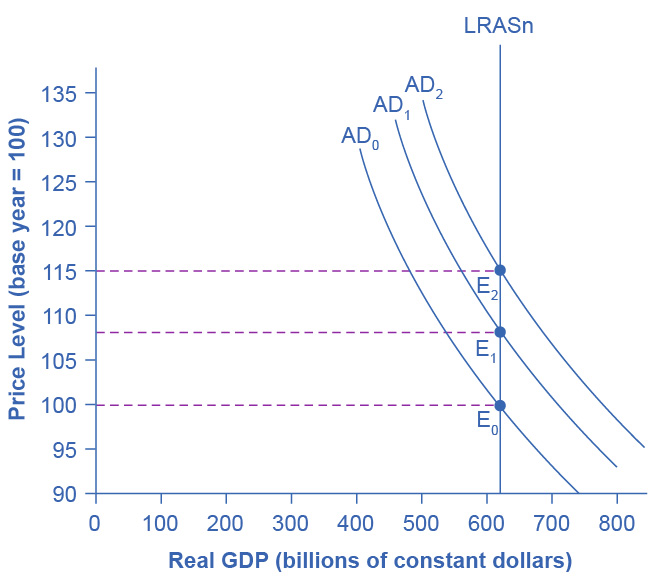

Figure 26.8図 26.8
As aggregate demand shifts to the right, from AD0 to AD1 to AD2, real GDP in this economy and the level of unemployment do not change. However, there is inflationary pressure for a higher price level as the equilibrium changes from E0 to E1 to E2.
英語のヒント
総需要がAD0からAD1、AD2へ右にシフトしても、この経済の実質GDPと失業水準は変わらない。しかし均衡がE0からE1、E2へ変わるにつれ、物価水準を高めるインフレ圧力が生じる。