第26章新古典派の視点
The Role of Flexible Prices柔軟な価格の役割
How does the macroeconomy adjust back to its level of potential GDP in the long run? What if aggregate demand increases or decreases? Economists base the neoclassical view of how the macroeconomy adjusts on the insight that even if wages and prices are “sticky”, or slow to change, in the short run, they are flexible over time. To understand this better, let's follow the connections from the short-run to the long-run macroeconomic equilibrium.
英語のヒント
長期にマクロ経済はどう調整され、潜在GDP水準へ戻るのか。総需要が増減したらどうなるか。マクロ経済がどう調整するかについての新古典派の見方は、賃金と価格が短期には「硬直的」、すなわち変化が遅くても、時間がたてば柔軟であるという洞察に基づく。よりよく理解するため、短期のマクロ経済均衡から長期の均衡へのつながりをたどろう。
The aggregate demand and aggregate supply diagram in Figure 26.4 shows two aggregate supply curves. We draw the original upward sloping aggregate supply curve (SRAS0) as a short-run or Keynesian AS curve. The vertical aggregate supply curve (LRASn) is the long-run or neoclassical AS curve, which is located at potential GDP. The original aggregate demand curve, labeled AD0, so that the original equilibrium occurs at point E0, at which point the economy is producing at its potential GDP.
英語のヒント
図26.4の総需要・総供給図は、2本の総供給曲線を示す。元の右上がりの総供給曲線SRAS0を、短期の、すなわちケインズ派のAS曲線として描く。垂直な総供給曲線LRASnは、潜在GDPに位置する長期の、すなわち新古典派のAS曲線である。元の総需要曲線にはAD0と表示され、元の均衡は点E0にあり、そこで経済は潜在GDPを生産している。
The Rebound to Potential GDP after AD IncreasesAD増加後の潜在GDPへの復帰
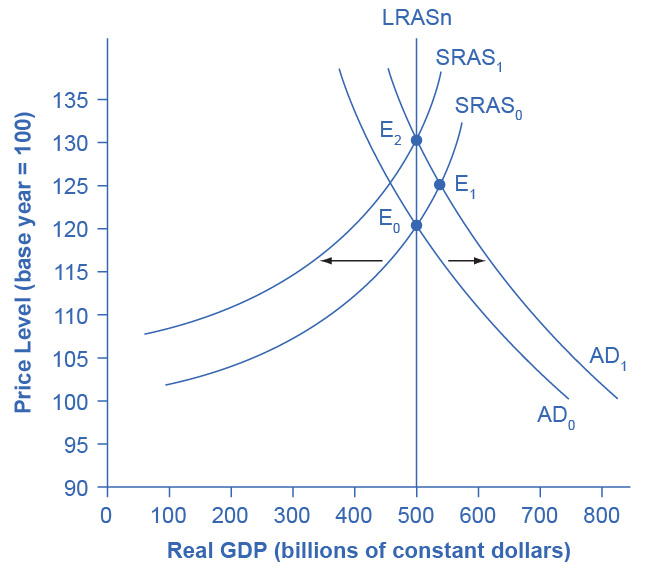
Figure 26.4図 26.4
The original equilibrium (E0), at an output level of 500 and a price level of 120, happens at the intersection of the aggregate demand curve (AD0) and the short-run aggregate supply curve (SRAS0). The output at E0 is equal to potential GDP. Aggregate demand shifts right from AD0 to AD1. The new equilibrium is E1, with a higher output level of 550 and an increase in the price level to 125. With unemployment rates unsustainably low, eager employers bid up wages, which shifts short-run aggregate supply to the left, from SRAS0 to SRAS1. The new equilibrium (E2) is at the same original level of output, 500, but at a higher price level of 130. Thus, the long-run aggregate supply curve (LRASn), which is vertical at the level of potential GDP, determines the level of real GDP in this economy in the long run.
英語のヒント
生産水準500、物価水準120の元の均衡E0は、総需要曲線AD0と短期総供給曲線SRAS0の交点にある。E0の生産は潜在GDPに等しい。総需要はAD0からAD1へ右にシフトする。新しい均衡はE1で、生産水準は550へ、物価水準は125へ上がる。失業率が持続不可能なほど低いため、熱心な雇用主が賃金を競り上げ、短期総供給はSRAS0からSRAS1へ左にシフトする。新しい均衡E2は、元と同じ生産水準500にあるが、物価水準は130へ上がっている。したがって、潜在GDP水準で垂直な長期総供給曲線LRASnが、この経済の長期の実質GDP水準を決める。
Now, imagine that some economic event boosts aggregate demand: perhaps a surge of export sales or a rise in business confidence that leads to more investment, perhaps a policy decision like higher government spending, or perhaps a tax cut that leads to additional aggregate demand. The short-run Keynesian analysis is that the rise in aggregate demand will shift the aggregate demand curve out to the right, from AD0 to AD1, leading to a new equilibrium at point E1 with higher output, lower unemployment, and pressure for an inflationary rise in the price level.
英語のヒント
ここで、何らかの経済的出来事が総需要を押し上げるとしよう。輸出販売の急増や、投資を増やす企業景況感の上昇かもしれない。政府支出の増加という政策決定や、追加的な総需要をもたらす減税かもしれない。短期のケインズ派の分析では、総需要の増加が総需要曲線をAD0からAD1へ右にシフトさせ、新しい均衡点E1に至る。生産が増え、失業が減り、物価水準にはインフレ的な上昇圧力がかかる。
In the long-run neoclassical analysis, however, the chain of economic events is just beginning. As economic output rises above potential GDP, the level of unemployment falls. The economy is now above full employment and there is a labor shortage. Eager employers are trying to bid workers away from other companies and to encourage their current workers to exert more effort and to work longer hours. This high demand for labor will drive up wages. Most employers review their workers salaries only once or twice a year, and so it will take time before the higher wages filter through the economy. As wages do rise, it will mean a leftward shift in the short-run Keynesian aggregate supply curve back to SRAS1, because the price of a major input to production has increased. The economy moves to a new equilibrium (E2). The new equilibrium has the same level of real GDP as did the original equilibrium (E0), but there has been an inflationary increase in the price level.
英語のヒント
しかし長期の新古典派の分析では、一連の経済的出来事は始まったばかりである。生産が潜在GDPを上回ると、失業は減る。経済は完全雇用を超え、労働力不足となる。熱心な雇用主は、他社から労働者を高賃金で引き抜き、今いる労働者にもさらに努力し、長く働くよう促そうとする。この高い労働需要は賃金を押し上げる。大半の雇用主は年1、2回しか労働者の給与を見直さないため、高い賃金が経済に浸透するには時間がかかる。賃金が実際に上がると、生産の主要な投入物の価格が上がるため、短期のケインズ派の総供給曲線は左へシフトし、SRAS1へ戻る。経済は新しい均衡E2へ移る。新しい均衡の実質GDPは元の均衡E0と同じだが、物価水準にはインフレ的な上昇が生じている。
This description of the short-run shift from E0 to E1 and the long-run shift from E1 to E2 is a step-by-step way of making a simple point: the economy cannot sustain production above its potential GDP in the long run. An economy may produce above its level of potential GDP in the short run, under pressure from a surge in aggregate demand. Over the long run, however, that surge in aggregate demand ends up as an increase in the price level, not as a rise in output.
英語のヒント
E0からE1への短期の移動と、E1からE2への長期の移動のこの説明は、単純な要点を段階的に示している。経済は長期には潜在GDPを超える生産を維持できないということだ。短期には、総需要の急増による圧力のもとで潜在GDPを超えて生産することもある。しかし長期には、その総需要の急増は生産増加ではなく、物価水準の上昇に終わる。
The rebound of the economy back to potential GDP also works in response to a shift to the left in aggregate demand. Figure 26.5 again starts with two aggregate supply curves, with SRAS0 showing the original upward sloping short-run Keynesian AS curve and LRASn showing the vertical long-run neoclassical aggregate supply curve. A decrease in aggregate demand—for example, because of a decline in consumer confidence that leads to less consumption and more saving—causes the original aggregate demand curve AD0 to shift back to AD1. The shift from the original equilibrium (E0) to the new equilibrium (E1) results in a decline in output. The economy is now below full employment and there is a surplus of labor. As output falls below potential GDP, unemployment rises. While a lower price level (i.e., deflation) is rare in the United States, it does happen occasionally during very weak periods of economic activity. For practical purposes, we might consider a lower price level in the AD–AS model as indicative of disinflation, which is a decline in the inflation rate. Thus, the long-run aggregate supply curve LRASn, which is vertical at the level of potential GDP, ultimately determines this economy's real GDP.
英語のヒント
経済が潜在GDPへ戻る仕組みは、総需要の左方シフトに対しても働く。図26.5も2本の総供給曲線から始まる。SRAS0は元の右上がりの短期ケインズ派AS曲線、LRASnは垂直な長期新古典派総供給曲線である。例えば消費者信頼感が低下して消費が減り、貯蓄が増えることで総需要が減ると、元の総需要曲線AD0はAD1へ戻る。元の均衡E0から新しい均衡E1への移動は、生産の減少をもたらす。経済は完全雇用を下回り、労働は供給超過となる。生産が潜在GDPを下回るにつれ、失業が増える。米国では物価水準の低下、すなわちデフレはまれだが、経済活動が非常に弱い時期には時折起きる。実務的には、AD–ASモデルの低い物価水準を、インフレ率の低下であるディスインフレを示すものと考えられる。したがって、潜在GDP水準で垂直な長期総供給曲線LRASnが、最終的にこの経済の実質GDPを決める。
A Rebound Back to Potential GDP from a Shift to the Left in Aggregate Demand総需要の左方シフトから潜在GDPへ戻る
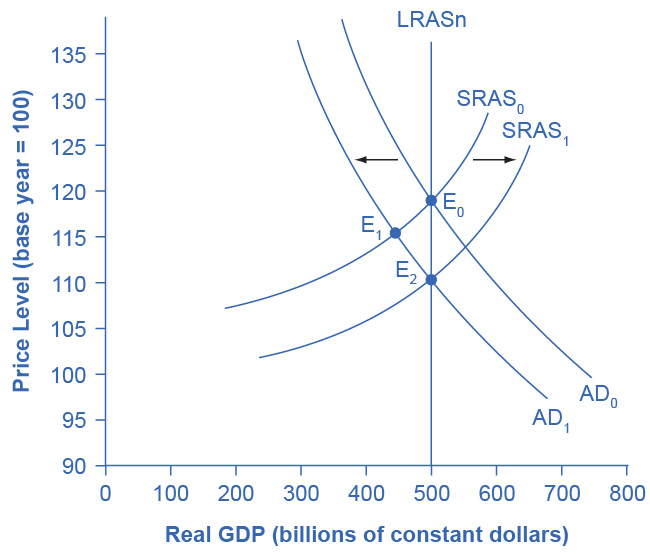


Figure 26.5図 26.5
The original equilibrium (E0), at an output level of 500 and a price level of 120, happens at the intersection of the aggregate demand curve (AD0) and the short-run aggregate supply curve (SRAS0). The output at E0 is equal to potential GDP. Aggregate demand shifts left, from AD0 to AD1. The new equilibrium is at E1, with a lower output level of 450 and downward pressure on the price level of 115. With high unemployment rates, wages are held down. Lower wages are an economy-wide decrease in the price of a key input, which shifts short-run aggregate supply to the right, from SRAS0 to SRAS1. The new equilibrium (E2) is at the same original level of output, 500, but at a lower price level of 110.
英語のヒント
生産水準500、物価水準120の元の均衡E0は、総需要曲線AD0と短期総供給曲線SRAS0の交点にある。E0の生産は潜在GDPに等しい。総需要はAD0からAD1へ左にシフトする。新しい均衡はE1で、生産水準は450へ下がり、物価水準には115への下押し圧力がかかる。高い失業率のもとで、賃金は抑えられる。賃金低下は、経済全体で重要な投入物の価格が下がることであり、短期総供給をSRAS0からSRAS1へ右にシフトさせる。新しい均衡E2は、元と同じ生産水準500にあるが、物価水準は110へ下がっている。
Again, from the neoclassical perspective, this short-run scenario is only the beginning of the chain of events. The higher level of unemployment means more workers looking for jobs. As a result, employers can hold down on pay increases—or perhaps even replace some of their higher-paid workers with unemployed people willing to accept a lower wage. As wages stagnate or fall, this decline in the price of a key input means that the short-run Keynesian aggregate supply curve shifts to the right from its original (SRAS0 to SRAS1). The overall impact in the long run, as the macroeconomic equilibrium shifts from E0 to E1 to E2, is that the level of output returns to potential GDP, where it started. There is, however, downward pressure on the price level. Thus, in the neoclassical view, changes in aggregate demand can have a short-run impact on output and on unemployment—but only a short-run impact. In the long run, when wages and prices are flexible, potential GDP and aggregate supply determine real GDP's size.
英語のヒント
ここでも新古典派の見方では、この短期の状況は一連の出来事の始まりにすぎない。失業が多いということは、仕事を探す労働者が多いということである。その結果、雇用主は賃上げを抑えられ、場合によっては高賃金の労働者の一部を、低い賃金を受け入れる失業者に置き換えることさえできる。賃金が停滞または低下すると、重要な投入物の価格低下を意味するため、短期ケインズ派総供給曲線は元のSRAS0からSRAS1へ右にシフトする。マクロ経済均衡がE0からE1、さらにE2へ移るなかで、長期の全体的な結果は、生産水準が出発点の潜在GDPへ戻ることである。ただし、物価水準には下押し圧力がある。したがって新古典派の見方では、総需要の変化は生産と失業に短期的な影響を与えうるが、短期に限られる。賃金と価格が柔軟な長期には、潜在GDPと総供給が実質GDPの大きさを決める。