第26章新古典派の視点
The Neoclassical Phillips Curve Tradeoff新古典派のフィリップス曲線のトレードオフ
The Keynesian Perspective introduced the Phillips curve and explained how it is derived from the aggregate supply curve. The short run upward sloping aggregate supply curve implies a downward sloping Phillips curve; thus, there is a tradeoff between inflation and unemployment in the short run. By contrast, a neoclassical long-run aggregate supply curve will imply a vertical shape for the Phillips curve, indicating no long run tradeoff between inflation and unemployment. Figure 26.6 (a) shows the vertical AS curve, with three different levels of aggregate demand, resulting in three different equilibria, at three different price levels. At every point along that vertical AS curve, potential GDP and the rate of unemployment remains the same. Assume that for this economy, the natural rate of unemployment is 5%. As a result, the long-run Phillips curve relationship, in Figure 26.6 (b), is a vertical line, rising up from 5% unemployment, at any level of inflation. Read the following Work It Out feature for additional information on how to interpret inflation and unemployment rates.
英語のヒント
「ケインズ派の見方」ではフィリップス曲線を紹介し、総供給曲線からどう導くかを説明した。短期の右上がりの総供給曲線は右下がりのフィリップス曲線を意味し、短期にはインフレと失業にトレードオフがある。対照的に、新古典派の長期総供給曲線は垂直なフィリップス曲線を意味し、長期にはインフレと失業のトレードオフがないことを示す。図26.6(a)は垂直なAS曲線と三つの異なる総需要水準を示し、三つの異なる物価水準で三つの均衡を生む。この垂直なAS曲線上のどの点でも、潜在GDPと失業率は同じである。この経済の自然失業率を5%と仮定しよう。その結果、図26.6(b)の長期フィリップス曲線の関係は、どのインフレ水準でも失業率5%から上に伸びる垂直線となる。インフレ率と失業率の読み取り方については、次の「計算してみよう」を読もう。
From a Long-Run AS Curve to a Long-Run Phillips Curve長期AS曲線から長期フィリップス曲線へ
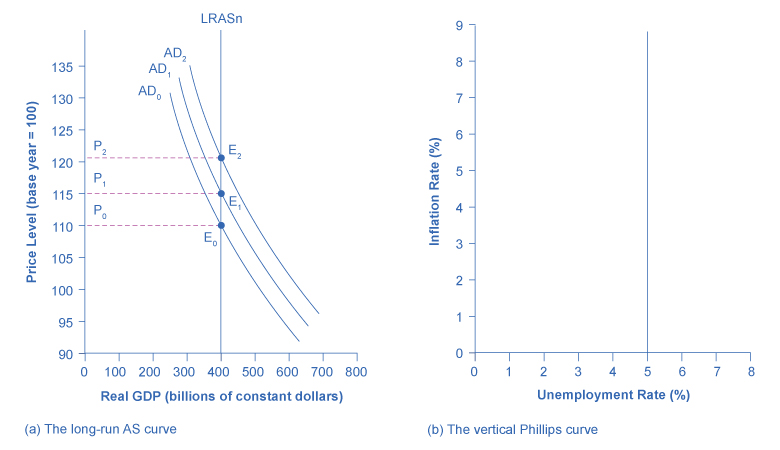

Figure 26.6図 26.6
(a) With a vertical LRAS curve, shifts in aggregate demand do not alter the level of output but do lead to changes in the price level. Because output is unchanged between the equilibria E0, E1, and E2, all unemployment in this economy will be due to the natural rate of unemployment. (b) If the natural rate of unemployment is 5%, then the Phillips curve will be vertical. That is, regardless of changes in the price level, the unemployment rate remains at 5%.
英語のヒント
(a)LRAS曲線が垂直なら、総需要のシフトは生産水準を変えず、物価水準を変える。均衡E0、E1、E2の間で生産は同じなので、この経済のすべての失業は自然失業率による。(b)自然失業率が5%なら、フィリップス曲線は垂直になる。つまり物価水準の変化にかかわらず、失業率は5%にとどまる。
The unemployment rate on the long-run Phillips curve will be the natural rate of unemployment. A small inflationary increase in the price level from AD0 to AD1 will have the same natural rate of unemployment as a larger inflationary increase in the price level from AD0 to AD2. The macroeconomic equilibrium along the vertical aggregate supply curve can occur at a variety of different price levels, and the natural rate of unemployment can be consistent with all different rates of inflation. The great economist Milton Friedman (1912–2006) summed up the neoclassical view of the long-term Phillips curve tradeoff in a 1967 speech: “[T]here is always a temporary trade-off between inflation and unemployment; there is no permanent trade-off.”
英語のヒント
長期フィリップス曲線上の失業率は、自然失業率となる。AD0からAD1への小さなインフレ的物価上昇でも、AD0からAD2への大きなインフレ的物価上昇でも、自然失業率は同じである。垂直な総供給曲線上のマクロ経済均衡は、さまざまな物価水準で生じ、自然失業率はあらゆる異なるインフレ率と両立しうる。偉大な経済学者ミルトン・フリードマン(1912~2006年)は、1967年の演説で、長期フィリップス曲線のトレードオフについての新古典派の見方を、こう要約した。「インフレと失業には常に一時的なトレードオフがある。永続的なトレードオフはない」。
In the Keynesian perspective, the primary focus is on getting the level of aggregate demand right in relationship to an upward-sloping aggregate supply curve. That is, the government should adjust AD so that the economy produces at its potential GDP, not so low that cyclical unemployment results and not so high that inflation results. In the neoclassical perspective, aggregate supply will determine output at potential GDP, the natural rate of unemployment determines unemployment, and shifts in aggregate demand are the primary determinant of changes in the price level.
英語のヒント
ケインズ派の見方では、右上がりの総供給曲線との関係で、総需要を適切な水準にすることが主な焦点となる。つまり政府は、循環的失業を生むほど低くも、インフレを生むほど高くもなく、経済が潜在GDPを生産するようADを調整すべきである。新古典派の見方では、総供給が潜在GDPでの生産を決め、自然失業率が失業を決め、総需要のシフトが物価水準の変化の主要な決定要因となる。