第4章微分の応用
Initial-Value Problems初期値問題
We look at techniques for integrating a large variety of functions involving products, quotients, and compositions later in the text. Here we turn to one common use for antiderivatives that arises often in many applications: solving differential equations.
積・商・合成を含むさまざまな関数の積分法は、後で学ぶ。ここでは、原始関数のよく使われる応用である、微分方程式を解くことに注目する。
A differential equation is an equation that relates an unknown function and one or more of its derivatives. The equation
微分方程式とは、未知の関数と、その導関数を1つ以上含む関係式である。たとえば、
(4.9)
is a simple example of a differential equation. Solving this equation means finding a function with a derivative Therefore, the solutions of Equation 4.9 are the antiderivatives of If is one antiderivative of every function of the form is a solution of that differential equation. For example, the solutions of
は、簡単な微分方程式である。これを解くとは、導関数がになる関数を求めることである。したがって、式4.9の解はの原始関数である。がの原始関数の1つなら、という形の関数はすべて、この微分方程式の解となる。たとえば、
are given by
の解は、次で与えられる。
Sometimes we are interested in determining whether a particular solution curve passes through a certain point —that is, The problem of finding a function that satisfies a differential equation
解の曲線が、指定された点を通るかどうか、つまりを満たすかどうかに関心がある場合もある。次の微分方程式を満たす関数を、
(4.10)
with the additional condition
さらに次の条件のもとで求める問題は、
(4.11)
is an example of an initial-value problem. The condition is known as an initial condition. For example, looking for a function that satisfies the differential equation
英語のヒント
初期値問題の例である。条件を初期条件という。たとえば、関数が次の微分方程式を満たし、
and the initial condition
さらに次の初期条件を満たすように求める問題も、
is an example of an initial-value problem. Since the solutions of the differential equation are to find a function that also satisfies the initial condition, we need to find such that From this equation, we see that and we conclude that is the solution of this initial-value problem as shown in the following graph.
初期値問題である。微分方程式の解はなので、初期条件も満たす関数を求めるには、となるを選べばよい。この式からとわかり、初期値問題の解はとなる。次のグラフを見よう。
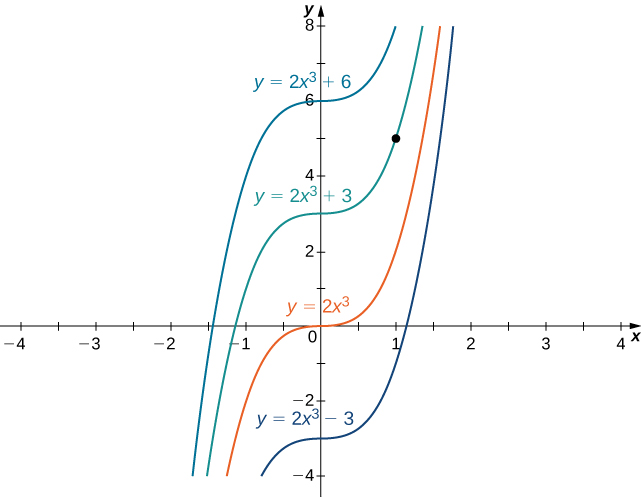
OpenStax, Rice University; Calculus Volume 1. · CC BY-NC-SA 4.0
Figure 4.86図 4.86
Some of the solution curves of the differential equation are displayed. The function satisfies the differential equation and the initial condition
微分方程式の解の曲線をいくつか示す。関数は、微分方程式と初期条件の両方を満たす。
Example 4.53例題 4.53
Solving an Initial-Value Problem初期値問題を解く
Solve the initial-value problem
次の初期値問題を解け。
Solution解き方
First we need to solve the differential equation. If then
まず微分方程式を解く。なら、
Next we need to look for a solution that satisfies the initial condition. The initial condition means we need a constant such that Therefore,
次に、初期条件を満たす解を選ぶ。初期条件より、となる定数が必要である。したがって、
The solution of the initial-value problem is
この初期値問題の解は、である。
Initial-value problems arise in many applications. Next we consider a problem in which a driver applies the brakes in a car. We are interested in how long it takes for the car to stop. Recall that the velocity function is the derivative of a position function and the acceleration is the derivative of the velocity function. In earlier examples in the text, we could calculate the velocity from the position and then compute the acceleration from the velocity. In the next example we work the other way around. Given an acceleration function, we calculate the velocity function. We then use the velocity function to determine the position function.
英語のヒント
初期値問題は多くの応用に現れる。次に、自動車の運転者がブレーキをかける問題を考え、停止までの時間を求めよう。速度は位置の導関数であり、加速度は速度の導関数である。これまでの例では、位置から速度を、速度から加速度を求めてきた。今度は逆に、加速度から速度を求め、さらに速度から位置を求める。
Example 4.54例題 4.54
Decelerating Car減速する自動車
A car is traveling at the rate of ft/sec mph) when the brakes are applied. The car begins decelerating at a constant rate of ft/sec2.
自動車が秒速フィート(マイル毎時)で走っているとき、ブレーキをかける。車は一定の減速度フィート毎秒2で減速し始める。
- How many seconds elapse before the car stops?停止するまで何秒かかるか。
- How far does the car travel during that time?その間に、どれだけの距離を進むか。
Solution解き方
- First we introduce variables for this problem. Let be the time (in seconds) after the brakes are first applied. Let be the acceleration of the car (in feet per seconds squared) at time Let be the velocity of the car (in feet per second) at time Let be the car’s position (in feet) beyond the point where the brakes are applied at time
The car is traveling at a rate of Therefore, the initial velocity is ft/sec. Since the car is decelerating, the acceleration isまず変数を定める。をブレーキをかけてからの時間(秒)、を時刻での加速度(フィート毎秒の2乗)、を時刻での速度(フィート毎秒)とする。は、ブレーキをかけた地点から測った時刻での位置(フィート)とする。車はで走っていたので、初速度はフィート毎秒である。減速しているので、加速度は、
The acceleration is the derivative of the velocity,加速度は速度の導関数なので、
Therefore, we have an initial-value problem to solve:したがって、次の初期値問題を解けばよい。
Integrating, we find that積分すると、
Since Thus, the velocity function isとなる。したがって、速度は、
To find how long it takes for the car to stop, we need to find the time such that the velocity is zero. Solving we obtain sec.停止までの時間を求めるには、速度が0になる時刻を求めればよい。を解くと、秒となる。 - To find how far the car travels during this time, we need to find the position of the car after sec. We know the velocity is the derivative of the position Consider the initial position to be Therefore, we need to solve the initial-value problemこの間に進む距離を求めるには、秒後の位置を求める。速度は位置の導関数である。初期位置をとすると、次の初期値問題を解けばよい。
Integrating, we have積分すると、
Since the constant is Therefore, the position function isなので、定数はとなる。したがって、位置は、
After sec, the position is ft.秒後の位置は、フィートである。