第4章微分の応用
4.2 Linear Approximations and Differentials4.2 線形近似と微分量
Learning Objectives学習目標
- Describe the linear approximation to a function at a point.ある点における関数の線形近似を説明する。
- Write the linearization of a given function.与えられた関数の線形化を式で表す。
- Draw a graph that illustrates the use of differentials to approximate the change in a quantity.微分量で量の変化を近似する様子が分かるグラフを描く。
- Calculate the relative error and percentage error in using a differential approximation.微分量による近似での相対誤差と百分率誤差を計算する。
We have just seen how derivatives allow us to compare related quantities that are changing over time. In this section, we examine another application of derivatives: the ability to approximate functions locally by linear functions. Linear functions are the easiest functions with which to work, so they provide a useful tool for approximating function values. In addition, the ideas presented in this section are generalized later in the text when we study how to approximate functions by higher-degree polynomials Introduction to Power Series and Functions.
英語のヒント
前の節では、時間とともに変化する関連した量を、微分を使って比較する方法を学んだ。この節では別の応用として、関数を一次関数で局所的に近似する方法を調べる。一次関数は最も扱いやすい関数なので、関数の値を近似する際の有用な道具になる。この節の考え方は、後に関数を高次の多項式で近似する方法を学ぶとき、さらに一般化される(「べき級数と関数の導入」参照)。
Linear Approximation of a Function at a Pointある点での関数の線形近似
Consider a function that is differentiable at a point Recall that the tangent line to the graph of at is given by the equation
点で微分可能な関数を考える。におけるのグラフの接線は、次の式で与えられることを思い出そう。
For example, consider the function at Since is differentiable at and we see that Therefore, the tangent line to the graph of at is given by the equation
例えば、関数をで考える。はで微分可能で、だから、となる。したがって、におけるのグラフの接線は、次の式で与えられる。
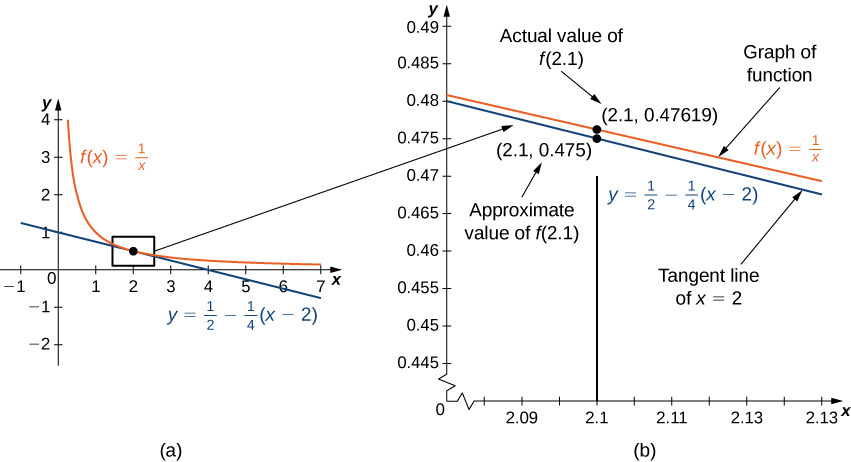
Figure 4.7(a) shows a graph of along with the tangent line to at Note that for near 2, the graph of the tangent line is close to the graph of As a result, we can use the equation of the tangent line to approximate for near 2. For example, if the value of the corresponding point on the tangent line is
英語のヒント
図4.7(a)には、のグラフと、におけるの接線を示している。が2に近いところでは、接線のグラフものグラフに近いことに注目しよう。そのため、が2に近ければ、接線の式を使ってを近似できる。例えばなら、接線上の対応する点の座標は、
The actual value of is given by
一方、の実際の値は、
Therefore, the tangent line gives us a fairly good approximation of (Figure 4.7(b)). However, note that for values of far from 2, the equation of the tangent line does not give us a good approximation. For example, if the -value of the corresponding point on the tangent line is
英語のヒント
したがって、接線はのかなりよい近似を与える(図4.7(b))。しかし、が2から遠く離れると、接線の式はよい近似を与えなくなることに注意しよう。例えばなら、接線上の対応する点の座標は、
whereas the value of the function at is
英語のヒント
これに対し、での関数の値はである。
OpenStax, Rice University; Calculus Volume 1. · CC BY-NC-SA 4.0
Figure 4.7図 4.7
(a) The tangent line to at provides a good approximation to for near 2. (b) At the value of on the tangent line to is 0.475. The actual value of is which is approximately 0.47619.
(a) のにおける接線は、が2に近いとき、のよい近似を与える。(b) のとき、の接線上の座標は0.475である。実際のの値はで、約0.47619である。
In general, for a differentiable function the equation of the tangent line to at can be used to approximate for near Therefore, we can write
一般に、微分可能な関数について、でのの接線の式を使えば、がに近いところでのを近似できる。したがって、次のように書ける。
We call the linear function
次の一次関数を考えよう。
(4.1)
the linear approximation, or tangent line approximation, of at This function is also known as the linearization of at
英語のヒント
これを、におけるの線形近似、または接線近似と呼ぶ。この関数は、におけるの線形化とも呼ばれる。
To show how useful the linear approximation can be, we look at how to find the linear approximation for at
線形近似の有用性を見るために、でのの線形近似を求めてみよう。
Example 4.5例題 4.5
Linear Approximation of の線形近似
Find the linear approximation of at and use the approximation to estimate
におけるの線形近似を求め、それを使っての近似値を求めよ。
Solution解き方
Since we are looking for the linear approximation at using Equation 4.1 we know the linear approximation is given by
での線形近似を求めるので、式4.1を使うと、その近似は次のように表せる。
We need to find and
とを求める必要がある。
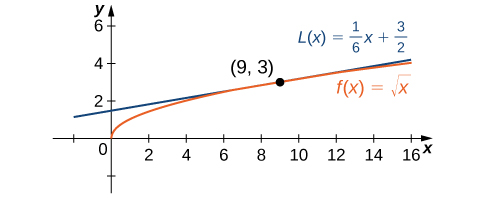
Therefore, the linear approximation is given by Figure 4.8.
したがって、線形近似は次のようになる(図4.8)。
Using the linear approximation, we can estimate by writing
この線形近似を使うと、は次のように近似できる。
OpenStax, Rice University; Calculus Volume 1. · CC BY-NC-SA 4.0
Figure 4.8図 4.8
The local linear approximation to at provides an approximation to for near 9.
におけるの局所的な線形近似は、が9に近いところでを近似する。
Example 4.6例題 4.6
Linear Approximation of の線形近似
Find the linear approximation of at and use it to approximate
におけるの線形近似を求め、それを使っての近似値を求めよ。
Solution解き方
First we note that since rad is equivalent to using the linear approximation at seems reasonable. The linear approximation is given by
英語のヒント
まず、 radはに等しいので、での線形近似を使うのは妥当だと分かる。その線形近似は、
We see that
次の値が得られる。
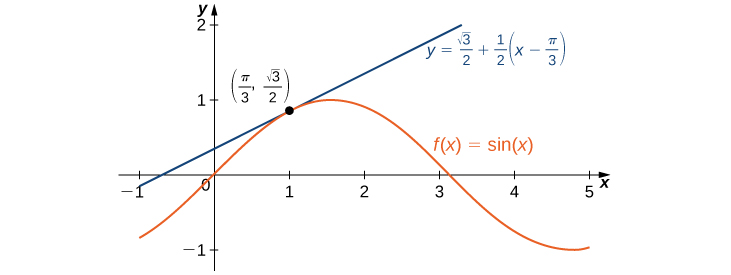
Therefore, the linear approximation of at is given by Figure 4.9.
したがって、におけるの線形近似は、次のようになる(図4.9)。
To estimate using we must first convert to radians. We have radians, so the estimate for is given by
英語のヒント
を使ってを近似するには、まずをラジアンに換算する必要がある。ラジアンなので、の近似値は次のようになる。
OpenStax, Rice University; Calculus Volume 1. · CC BY-NC-SA 4.0
Figure 4.9図 4.9
The linear approximation to at provides an approximation to for near
におけるの線形近似は、がに近いところでを近似する。
Linear approximations may be used in estimating roots and powers. In the next example, we find the linear approximation for at which can be used to estimate roots and powers for real numbers near 1. The same idea can be extended to a function of the form to estimate roots and powers near a different number
英語のヒント
線形近似は、累乗根や累乗の値を求めるのにも使える。次の例では、におけるの線形近似を求める。これは、1に近い実数の累乗根や累乗を近似するために使える。同じ考え方をという形の関数に拡張すると、別の数の近くで、累乗根や累乗を近似できる。
Example 4.7例題 4.7
Approximating Roots and Powers累乗根と累乗を近似する
Find the linear approximation of at Use this approximation to estimate
におけるの線形近似を求めよ。その近似を使っての近似値を求めよ。
Solution解き方
The linear approximation at is given by
における線形近似は、
Because
ここで、次の値を使う。
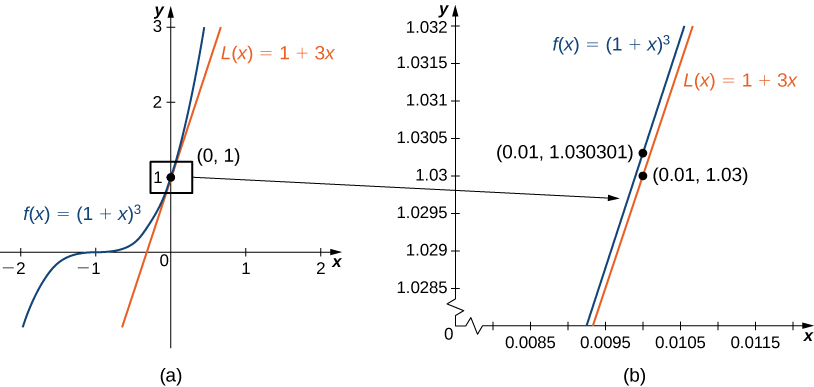
the linear approximation is given by Figure 4.10(a).
したがって、線形近似は次のようになる(図4.10(a))。
We can approximate by evaluating when We conclude that
としてを計算すれば、を近似できる。したがって、
OpenStax, Rice University; Calculus Volume 1. · CC BY-NC-SA 4.0
Figure 4.10図 4.10
(a) The linear approximation of at is (b) The actual value of is 1.030301. The linear approximation of at estimates to be 1.03.
(a) におけるの線形近似はである。(b) の実際の値は1.030301である。におけるの線形近似によって、の近似値は1.03となる。