第4章微分の応用
4.4 The Mean Value Theorem4.4 平均値の定理
Learning Objectives学習目標
- Explain the meaning of Rolle’s theorem.ロルの定理の意味を説明できる。
- Describe the significance of the Mean Value Theorem.平均値の定理の意義を説明できる。
- State three important consequences of the Mean Value Theorem.平均値の定理から得られる三つの重要な結果を述べられる。
The Mean Value Theorem is one of the most important theorems in calculus. We look at some of its implications at the end of this section. First, let’s start with a special case of the Mean Value Theorem, called Rolle’s theorem.
英語のヒント
平均値の定理は、微積分で最も重要な定理の一つである。この節の終わりでは、定理から得られるいくつかの結論を学ぶ。まず、その特別な場合であるロルの定理から始めよう。
Rolle’s Theoremロルの定理
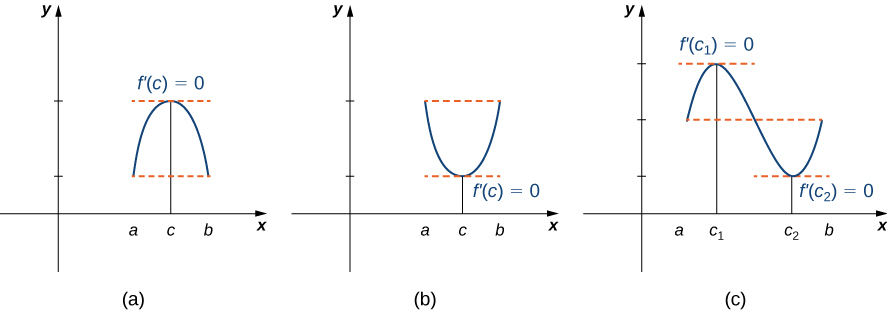
Informally, Rolle’s theorem states that if the outputs of a differentiable function are equal at the endpoints of an interval, then there must be an interior point where Figure 4.21 illustrates this theorem.
ロルの定理を大まかにいうと、微分可能な関数の値が区間の両端で等しければ、その間にとなる内点が少なくとも一つ存在する、という主張である。図4.21にその様子を示す。
OpenStax, Rice University; Calculus Volume 1. · CC BY-NC-SA 4.0
Figure 4.21図 4.21
If a differentiable function f satisfies then its derivative must be zero at some point(s) between and
微分可能な関数fがを満たすなら、との間の少なくとも一つの点で、導関数の値が0になる。
Proof証明
Proof証明
Let We consider three cases:
とおく。次の三つの場合を考える。
- for allすべてので。
- There exists such thatとなるが存在する。
- There exists such thatとなるが存在する。
Case 1: If for all then for all
場合1:すべてのでなら、すべてのでである。
Case 2: Since is a continuous function over the closed, bounded interval by the extreme value theorem, it has an absolute maximum. Also, since there is a point such that the absolute maximum is greater than Therefore, the absolute maximum does not occur at either endpoint. As a result, the absolute maximum must occur at an interior point Because has a maximum at an interior point and is differentiable at by Fermat’s theorem,
場合2:は閉じた有界区間上で連続なので、最大値・最小値の定理により最大値をもつ。しかも、となる点が存在するため、最大値はより大きい。したがって、最大値はどちらの端点でも生じず、内点で生じる。は内点で最大値をとり、はで微分可能なので、フェルマーの定理からである。
Case 3: The case when there exists a point such that is analogous to case 2, with maximum replaced by minimum.
英語のヒント
場合3:となる点が存在する場合は、場合2の「最大値」を「最小値」に置き換えて、同様に示せる。
□
□
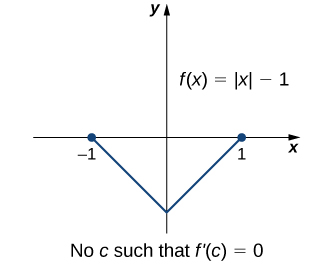
An important point about Rolle’s theorem is that the differentiability of the function is critical. If is not differentiable, even at a single point, the result may not hold. For example, the function is continuous over and but for any as shown in the following figure.
ロルの定理では、関数が微分可能であることが欠かせない。が一点でも微分不可能なら、結論が成り立たない場合がある。例えばは上で連続で、を満たす。しかし、のうち導関数が存在する点ではであり、x=0では導関数が存在しない。そのため、導関数の値が0となる点はない。次の図を参照。
OpenStax, Rice University; Calculus Volume 1. · CC BY-NC-SA 4.0
Figure 4.22図 4.22
Since is not differentiable at the conditions of Rolle’s theorem are not satisfied. In fact, the conclusion does not hold here; there is no such that
はで微分不可能なので、ロルの定理の仮定を満たさない。実際、結論も成り立たず、を満たすは存在しない。
Let’s now consider functions that satisfy the conditions of Rolle’s theorem and calculate explicitly the points where
次に、ロルの定理の仮定を満たす関数について、となる点を具体的に計算しよう。
Example 4.14例題 4.14
Using Rolle’s Theoremロルの定理を使う
For each of the following functions, verify that the function satisfies the criteria stated in Rolle’s theorem and find all values in the given interval where
次の各関数がロルの定理の仮定を満たすことを確認し、与えられた区間内でとなるをすべて求めよ。
- over区間における
- over区間における
Solution解き方
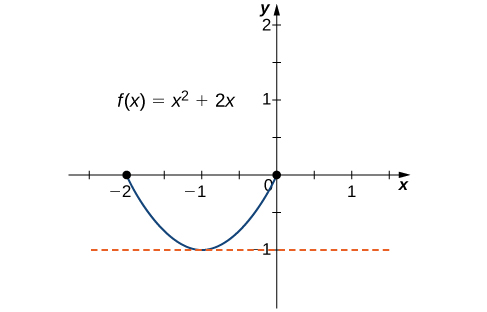
- Since is a polynomial, it is continuous and differentiable everywhere. In addition, Therefore, satisfies the criteria of Rolle’s theorem. We conclude that there exists at least one value such that Since we see that implies as shown in the following graph.は多項式なので、すべての点で連続かつ微分可能である。また、である。したがって、はロルの定理の仮定を満たし、となるが少なくとも一つ存在する。なので、よりを得る。次のグラフに示す。
OpenStax, Rice University; Calculus Volume 1. · CC BY-NC-SA 4.0
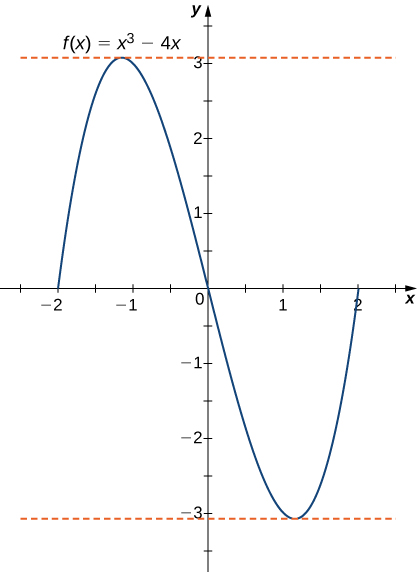
Figure 4.23図 4.23This function is continuous and differentiable over whenこの関数は上で連続かつ微分可能であり、でとなる。 - As in part a. is a polynomial and therefore is continuous and differentiable everywhere. Also, That said, satisfies the criteria of Rolle’s theorem. Differentiating, we find that Therefore, when Both points are in the interval and, therefore, both points satisfy the conclusion of Rolle’s theorem as shown in the following graph.(a)と同様、は多項式なので、すべての点で連続かつ微分可能である。また、である。よって、はロルの定理の仮定を満たす。微分するとなので、でとなる。二つの点はともにの内部にあり、どちらもロルの定理の結論を満たす。次のグラフを参照。
OpenStax, Rice University; Calculus Volume 1. · CC BY-NC-SA 4.0
Figure 4.24図 4.24For this polynomial over atこの多項式は、区間内のにおいてとなる。
The Mean Value Theorem and Its Meaning平均値の定理とその意味
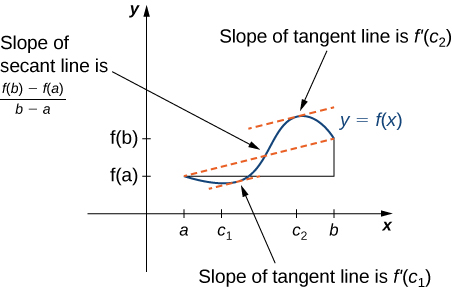
Rolle’s theorem is a special case of the Mean Value Theorem. In Rolle’s theorem, we consider differentiable functions defined on a closed interval with . The Mean Value Theorem generalizes Rolle’s theorem by considering functions that do not necessarily have equal value at the endpoints. Consequently, we can view the Mean Value Theorem as a slanted version of Rolle’s theorem (Figure 4.25). The Mean Value Theorem states that if is continuous over the closed interval and differentiable over the open interval then there exists a point such that the tangent line to the graph of at is parallel to the secant line connecting and
英語のヒント
ロルの定理は、平均値の定理の特別な場合である。ロルの定理では、閉区間に定義され、を満たす微分可能な関数を考えた。平均値の定理は、両端での値が等しいとは限らない関数へと、ロルの定理を一般化したものである。そのため、ロルの定理を「傾けたもの」と捉えられる(図4.25)。平均値の定理によれば、が閉区間上で連続、開区間上で微分可能なら、が存在し、のグラフのにおける接線が、とを結ぶ割線と平行になる。
OpenStax, Rice University; Calculus Volume 1. · CC BY-NC-SA 4.0
Figure 4.25図 4.25
The Mean Value Theorem says that for a function that meets its conditions, at some point the tangent line has the same slope as the secant line between the ends. For this function, there are two values and such that the tangent line to at and has the same slope as the secant line.
平均値の定理は、仮定を満たす関数には、接線の傾きが両端を結ぶ割線の傾きと一致する点があると述べる。この関数には、そのような値、が二つある。のとにおける接線は、どちらも割線と同じ傾きをもつ。
Proof証明
Proof証明
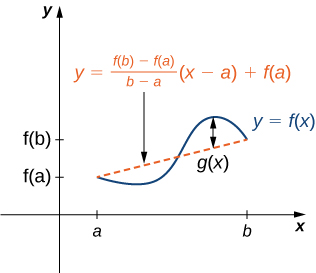
The proof follows from Rolle’s theorem by introducing an appropriate function that satisfies the criteria of Rolle’s theorem. Consider the line connecting and Since the slope of that line is
ロルの定理の仮定を満たす適切な関数を導入すれば、平均値の定理を証明できる。点とを結ぶ直線を考える。この直線の傾きは、
and the line passes through the point the equation of that line can be written as
また、この直線は点を通るので、その方程式は次のように書ける。
Let denote the vertical difference between the point and the point on that line. Therefore,
点と、この直線上の点の高さの差をとする。したがって、
OpenStax, Rice University; Calculus Volume 1. · CC BY-NC-SA 4.0
Figure 4.26図 4.26
The value is the vertical difference between the point and the point on the secant line connecting and
は、曲線上の点と、・を結ぶ割線上の点との高さの差である。
Since the graph of intersects the secant line when and we see that Since is a differentiable function over is also a differentiable function over Furthermore, since is continuous over is also continuous over Therefore, satisfies the criteria of Rolle’s theorem. Consequently, there exists a point such that Since
のグラフと割線はとで交わるので、である。は上で微分可能だから、も上で微分可能である。さらに、は上で連続だから、も上で連続である。よって、はロルの定理の仮定を満たし、となる点が存在する。また、gの定義から、
we see that
したがって、
Since we conclude that
を代入すると、求める等式が得られる。
□
□
In the next example, we show how the Mean Value Theorem can be applied to the function over the interval The method is the same for other functions, although sometimes with more interesting consequences.
次の例では、区間上の関数に平均値の定理を適用する。他の関数でも方法は同じだが、結果がさらに興味深い意味をもつこともある。
Example 4.15例題 4.15
Verifying that the Mean Value Theorem Applies平均値の定理を適用できることを確認する
For over the interval show that satisfies the hypothesis of the Mean Value Theorem, and therefore there exists at least one value such that is equal to the slope of the line connecting and Find these values guaranteed by the Mean Value Theorem.
区間上のについて、が平均値の定理の仮定を満たすことを示せ。これにより、がとを結ぶ直線の傾きに等しくなるが少なくとも一つ存在すると分かる。定理によって存在が保証されるを求めよ。
Solution解き方
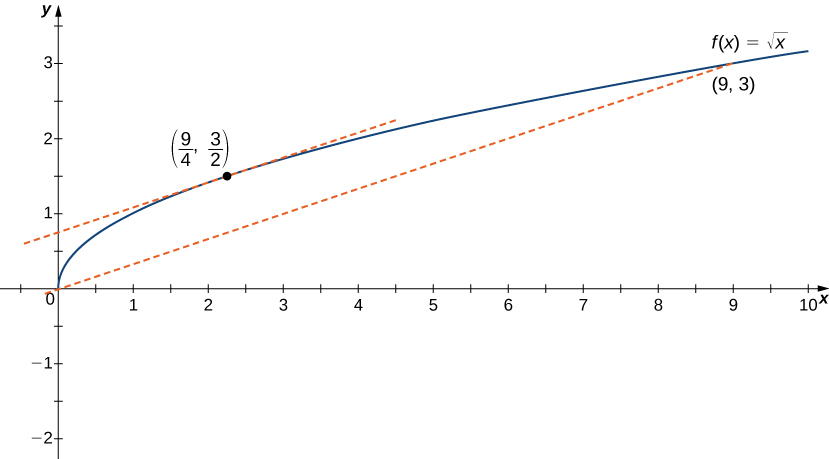
We know that is continuous over and differentiable over Therefore, satisfies the hypotheses of the Mean Value Theorem, and there must exist at least one value such that is equal to the slope of the line connecting and (Figure 4.27). To determine which value(s) of are guaranteed, first calculate the derivative of The derivative The slope of the line connecting and is given by
英語のヒント
は上で連続、上で微分可能である。したがって、は平均値の定理の仮定を満たす。よって、がとを結ぶ直線の傾きに等しくなるが少なくとも一つ存在する(図4.27)。そのを求めるために、まずを微分する。導関数はである。一方、とを結ぶ直線の傾きは、
We want to find such that That is, we want to find such that
求めるのは、を満たすである。すなわち、次式を満たすを求めればよい。
Solving this equation for we obtain At this point, the slope of the tangent line equals the slope of the line joining the endpoints.
この方程式をについて解くと、を得る。この点で、接線の傾きが両端を結ぶ直線の傾きに等しくなる。
OpenStax, Rice University; Calculus Volume 1. · CC BY-NC-SA 4.0
Figure 4.27図 4.27
The slope of the tangent line at is the same as the slope of the line segment connecting and
における接線の傾きは、とを結ぶ線分の傾きに等しい。
One application that helps illustrate the Mean Value Theorem involves velocity. For example, suppose we drive a car for 1 h down a straight road with an average velocity of 45 mph. Let and denote the position and velocity of the car, respectively, for h. Assuming that the position function is differentiable, we can apply the Mean Value Theorem to conclude that, at some time the speed of the car was exactly
英語のヒント
平均値の定理の意味がよく分かる応用例に、速度がある。直線道路を1時間走り、平均速度が時速45マイルだったとしよう。時刻(時間)における車の位置と速度を、それぞれ、で表す。位置関数が微分可能なら、平均値の定理により、ある時刻で、車の速さがちょうど次の値だったと分かる。
Example 4.16例題 4.16
Mean Value Theorem and Velocity平均値の定理と速度
If a rock is dropped from a height of 100 ft, its position seconds after it is dropped until it hits the ground is given by the function
高さ100 ftから石を落とす。落としてから地面に達するまでの、秒後の高さはで与えられる。
- Determine how long it takes before the rock hits the ground.石が地面に達するまでの時間を求めよ。
- Find the average velocity of the rock for when the rock is released and the rock hits the ground.石を放してから地面に達するまでの平均速度を求めよ。
- Find the time guaranteed by the Mean Value Theorem when the instantaneous velocity of the rock is石の瞬間速度がに等しくなる時刻を求めよ。そのような時刻の存在は、平均値の定理によって保証される。
Solution解き方
- When the rock hits the ground, its position is Solving the equation for we find that Since we are only considering the ball will hit the ground sec after it is dropped.石が地面に達したとき、となる。方程式をについて解くと、を得る。考えているのはだけなので、石は落としてから秒後に地面に達する。
- The average velocity is given by平均速度は、
- The instantaneous velocity is given by the derivative of the position function. Therefore, we need to find a time such that Since is continuous over the interval and differentiable over the interval by the Mean Value Theorem, there is guaranteed to be a point such that瞬間速度は位置関数の導関数で与えられる。したがって、となる時刻を求めればよい。は区間上で連続、区間上で微分可能なので、平均値の定理より、次式を満たすが存在する。
Taking the derivative of the position function we find that Therefore, the equation reduces to Solving this equation for we have Therefore, sec after the rock is dropped, the instantaneous velocity equals the average velocity of the rock during its free fall: ft/sec.位置関数を微分するとを得る。よって、方程式はとなる。これをについて解くとである。つまり、落下開始から秒後に、瞬間速度が自由落下中の平均速度 ft/sと等しくなる。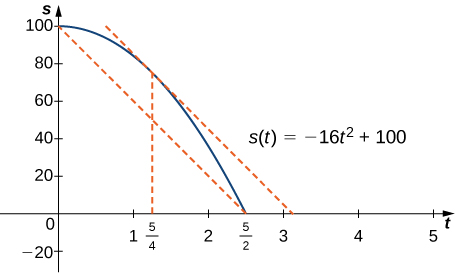
OpenStax, Rice University; Calculus Volume 1. · CC BY-NC-SA 4.0
Figure 4.28図 4.28At time sec, the velocity of the rock is equal to its average velocity from the time it is dropped until it hits the ground.時刻秒で、石の速度は、落下開始から地面に達するまでの平均速度と等しくなる。