第4章微分の応用
Growth Rates of Functions関数の増大の速さ
Suppose the functions and both approach infinity as Although the values of both functions become arbitrarily large as the values of become sufficiently large, sometimes one function is growing more quickly than the other. For example, and both approach infinity as However, as shown in the following table, the values of are growing much faster than the values of
英語のヒント
関数とは、どちらものとき無限大に近づくとする。を十分大きくすると両方の関数値がいくらでも大きくなるが、その増え方は一方のほうが速いことがある。たとえば、もも、のとき無限大に近づく。しかし、次の表のとおり、の値はの値よりはるかに速く増える。
In fact,
実際、
As a result, we say is growing more rapidly than as On the other hand, for and although the values of are always greater than the values of for each value of is roughly three times the corresponding value of as as shown in the following table. In fact,
このため、のとき、はより速く増大するという。一方、とを考える。では常にのほうがより大きい。しかし、次の表のとおり、となるにつれ、の値は対応するの値のおよそ3倍になる。実際、
In this case, we say that and are growing at the same rate as
この場合、とは、のとき同じ程度の速さで増大するという。
More generally, suppose and are two functions that approach infinity as We say grows more rapidly than as if
英語のヒント
より一般に、とは、のとき無限大に近づく2つの関数とする。次の条件が成り立つとき、のときはより速く増大するという。
On the other hand, if there exists a constant such that
一方、次を満たす定数が存在するなら、
we say and grow at the same rate as
とは、のとき同じ程度の速さで増大するという。
Next we see how to use L’Hôpital’s rule to compare the growth rates of power, exponential, and logarithmic functions.
次に、ロピタルの定理を使って、べき関数・指数関数・対数関数の増大の速さを比較しよう。
Example 4.45例題 4.45
Comparing the Growth Rates of and 、、の増大の速さを比較する
For each of the following pairs of functions, use L’Hôpital’s rule to evaluate
次の各関数の組について、ロピタルの定理を使ってを求めよ。
Solution解き方
- Since and we can use L’Hôpital’s rule to evaluate We obtainかつなので、を求めるのにロピタルの定理を使える。次のようになる。
Since and we can apply L’Hôpital’s rule again. Sinceかつなので、もう一度ロピタルの定理を使える。次が成り立つので、
we conclude that次の結論を得る。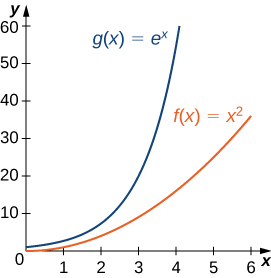
OpenStax, Rice University; Calculus Volume 1. · CC BY-NC-SA 4.0
Figure 4.73図 4.73An exponential function grows at a faster rate than a power function.指数関数は、べき関数より速く増大する。Growth rates of a power function and an exponential function.べき関数と指数関数の増大の速さ
Table 4.9表 4.9 - Since and we can use L’Hôpital’s rule to evaluate We obtainかつなので、を求めるのにロピタルの定理を使える。次のようになる。
OpenStax, Rice University; Calculus Volume 1. · CC BY-NC-SA 4.0
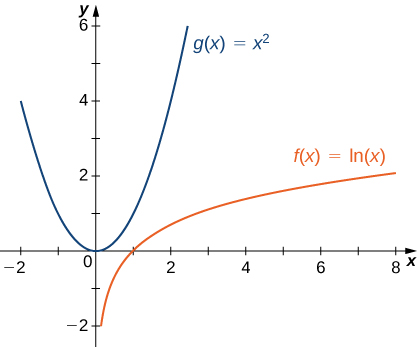
Figure 4.74図 4.74A power function grows at a faster rate than a logarithmic function.べき関数は、対数関数より速く増大する。Growth rates of a power function and a logarithmic functionべき関数と対数関数の増大の速さ
Table 4.10表 4.10
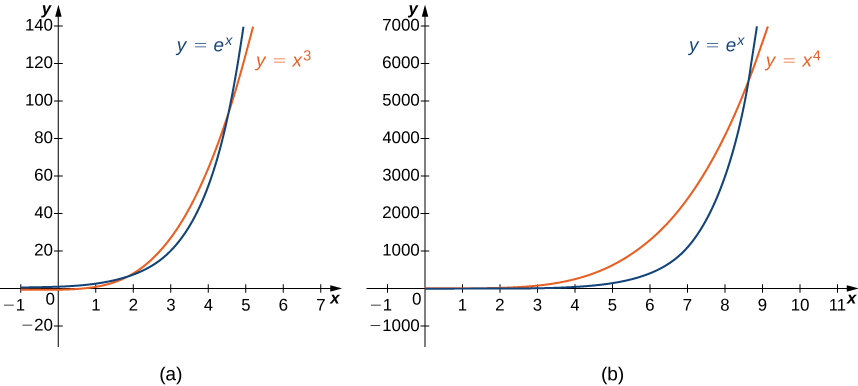
Using the same ideas as in Example 4.45a. it is not difficult to show that grows more rapidly than for any In Figure 4.75 and Table 4.11, we compare with and as
OpenStax, Rice University; Calculus Volume 1. · CC BY-NC-SA 4.0
Figure 4.75図 4.75
The exponential function grows faster than for any (a) A comparison of with (b) A comparison of with
任意のについて、指数関数はより速く増大する。(a) との比較。(b) との比較。
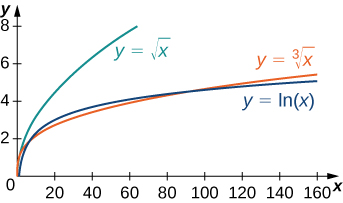
Similarly, it is not difficult to show that grows more rapidly than for any In Figure 4.76 and Table 4.12, we compare with and
OpenStax, Rice University; Calculus Volume 1. · CC BY-NC-SA 4.0
Figure 4.76図 4.76
The function grows more slowly than for any as
任意のについて、のとき、関数はより遅く増大する。
Key Concepts重要な概念
- L’Hôpital’s rule can be used to evaluate the limit of a quotient when the indeterminate form or arises.商の極限が型または型の不定形になるとき、ロピタルの定理を使って極限を求められる。
- L’Hôpital’s rule can also be applied to other indeterminate forms if they can be rewritten in terms of a limit involving a quotient that has the indeterminate form orほかの不定形でも、型または型の商の極限に書き換えられれば、ロピタルの定理を使える。
- The exponential function grows faster than any power function指数関数は、任意のべき関数()より速く増大する。
- The logarithmic function grows more slowly than any power function対数関数は、任意のべき関数()より遅く増大する。
Exercises 356–361練習問題 356–361
For the following exercises, evaluate the limit.
次の各極限を求めよ。
Exercise 356問題 356
Evaluate the limit
極限を求めよ。
Exercise 357問題 357
Evaluate the limit
極限を求めよ。
Solution解き方
Exercise 358問題 358
Evaluate the limit
極限を求めよ。
Exercise 359問題 359
Evaluate the limit .
極限を求めよ。
Solution解き方
Exercise 360問題 360
Evaluate the limit .
極限を求めよ。
Exercise 361問題 361
Evaluate the limit .
極限を求めよ。
Solution解き方
Exercises 362–366練習問題 362–366
For the following exercises, determine whether you can apply L’Hôpital’s rule directly. Explain why or why not. Then, indicate if there is some way you can alter the limit so you can apply L’Hôpital’s rule.
次の各問について、ロピタルの定理をそのまま適用できるかどうかを、理由とともに答えよ。適用できない場合は、極限の式を書き換えることで適用できるようになるかを述べよ。
Exercise 362問題 362
Exercise 363問題 363
Solution解き方
Cannot apply directly; use logarithms
そのままでは使えない。対数をとる。
Exercise 364問題 364
Exercise 365問題 365
Solution解き方
Cannot apply directly; rewrite as
そのままでは使えない。と書き換える。
Exercise 366問題 366
Exercises 367–395練習問題 367–395
For the following exercises, evaluate the limits with either L’Hôpital’s rule or previously learned methods.
次の各極限を、ロピタルの定理またはすでに学んだ方法で求めよ。
Exercise 367問題 367
Solution解き方
Exercise 368問題 368
Exercise 369問題 369
Solution解き方
Exercise 370問題 370
Exercise 371問題 371
Solution解き方
Exercise 372問題 372
Exercise 373問題 373
Solution解き方
Exercise 374問題 374
Exercise 375問題 375
Solution解き方
Exercise 376問題 376
Exercise 377問題 377
Solution解き方
Exercise 378問題 378
Exercise 379問題 379
Solution解き方
Exercise 380問題 380
Exercise 381問題 381
Solution解き方
Exercise 382問題 382
Exercise 383問題 383
Solution解き方
Exercise 384問題 384
Exercise 385問題 385
Solution解き方
Exercise 386問題 386
Exercise 387問題 387
Solution解き方
Exercise 388問題 388
Exercise 389問題 389
Solution解き方
Exercise 390問題 390
Exercise 391問題 391
Solution解き方
Exercise 392問題 392
Exercise 393問題 393
Solution解き方
Exercise 394問題 394
Exercise 395問題 395
Solution解き方
Exercises 396–405練習問題 396–405
For the following exercises, use a calculator to graph the function and estimate the value of the limit, then use L’Hôpital’s rule to find the limit directly.
次の各問では、計算機で関数のグラフを描いて極限値を推定し、その後ロピタルの定理を使って極限を計算せよ。
Exercise 396問題 396
[T]
[T]
Exercise 397問題 397
[T]
[T]
Solution解き方
Exercise 398問題 398
[T]
[T]
Exercise 399問題 399
[T]
[T]
Solution解き方
Exercise 400問題 400
[T]
[T]
Exercise 401問題 401
[T]
[T]
Solution解き方
Exercise 402問題 402
[T]
[T]
Exercise 403問題 403
[T]
[T]
Solution解き方
Exercise 404問題 404
[T]
[T]
Exercise 405問題 405
[T]
[T]
Solution解き方
indeterminate forms
不定形
when evaluating a limit, the forms and are considered indeterminate because further analysis is required to determine whether the limit exists and, if so, what its value is
極限を求めるときに現れる、、、、、、のような形。極限が存在するか、存在するならいくつかを決めるには、さらに調べる必要がある。
L’Hôpital’s rule
ロピタルの定理
if and are differentiable functions over an interval except possibly at and or and are infinite, then assuming the limit on the right exists or is or
とが、を含む開区間で、点を除いて微分可能であるとする。であるか、とがともに無限大となるなら、が成り立つ。ただし、右辺の極限が存在するかまたはであり、分母の導関数はその近傍で0でないものとする。