第4章微分の応用
End Behavior for Polynomial Functions多項式関数の無限遠での振る舞い
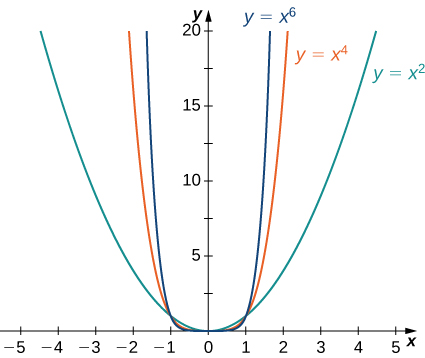
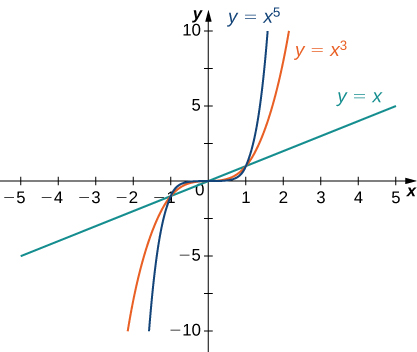
Consider the power function where is a positive integer. From Figure 4.50 and Figure 4.51, we see that
and
また、
OpenStax, Rice University; Calculus Volume 1. · CC BY-NC-SA 4.0
Figure 4.50図 4.50
For power functions with an even exponent of
指数が偶数である累乗関数では、となる。
OpenStax, Rice University; Calculus Volume 1. · CC BY-NC-SA 4.0
Figure 4.51図 4.51
For power functions with an odd exponent of and
指数が奇数である累乗関数では、かつとなる。
Using these facts, it is not difficult to evaluate and where is any constant and is a positive integer. If the graph of is a vertical stretch or compression of and therefore
以上を使えば、を任意の定数、を正の整数とするときのとを求められる。の場合、のグラフはのグラフを縦方向に拡大または縮小したものなので、次の結果が得られる。
If the graph of is a vertical stretch or compression combined with a reflection about the -axis, and therefore
の場合、のグラフは、縦方向の拡大・縮小と軸に関する対称移動を組み合わせたものになる。したがって、次の結果が得られる。
If in which case
なので、となる。
Example 4.24例題 4.24
Limits at Infinity for Power Functions累乗関数の無限遠での極限
For each function evaluate and
各関数について、とを求めよ。
Solution解き方
- Since the coefficient of is the graph of involves a vertical stretch and reflection of the graph of about the -axis. Therefore, andの係数はなので、のグラフは、のグラフを縦方向に拡大し、軸に関して対称移動したものになる。したがって、かつである。
- Since the coefficient of is the graph of is a vertical stretch of the graph of Therefore, andの係数はなので、のグラフはのグラフを縦方向に拡大したものになる。したがって、かつである。
We now look at how the limits at infinity for power functions can be used to determine for any polynomial function Consider a polynomial function
次に、累乗関数の無限遠での極限を利用して、任意の多項式関数のを求める方法を考える。次の多項式関数をとる。
of degree so that Factoring, we see that
次数をとするので、である。共通因子をくくり出すと、
As all the terms inside the parentheses approach zero except the first term. We conclude that
のとき、括弧内の第1項以外はすべて0へ近づく。したがって、次のことが分かる。
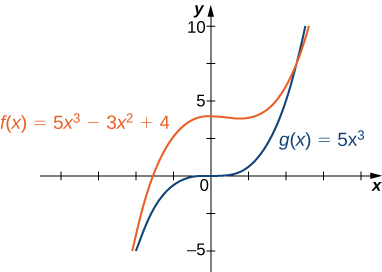
For example, the function behaves like as as shown in Figure 4.52 and Table 4.4.
OpenStax, Rice University; Calculus Volume 1. · CC BY-NC-SA 4.0
Figure 4.52図 4.52
The end behavior of a polynomial is determined by the behavior of the term with the largest exponent.
英語のヒント
多項式の無限遠での振る舞いは、最高次の項によって決まる。
End Behavior for Algebraic Functions代数関数の無限遠での振る舞い
The end behavior for rational functions and functions involving radicals is a little more complicated than for polynomials. In Example 4.25, we show that the limits at infinity of a rational function depend on the relationship between the degree of the numerator and the degree of the denominator. To evaluate the limits at infinity for a rational function, we divide the numerator and denominator by the highest power of appearing in the denominator. This determines which term in the overall expression dominates the behavior of the function at large values of
英語のヒント
有理関数や根号を含む関数の無限遠での振る舞いは、多項式の場合より少し複雑になる。例4.25では、有理関数の無限遠での極限が、分子と分母の次数の関係によって決まることを示す。有理関数の無限遠での極限を求めるには、分子と分母を、分母に現れるの最高の累乗で割る。すると、が大きいとき、式のどの項が関数の振る舞いを支配するかが分かる。
Example 4.25例題 4.25
Determining End Behavior for Rational Functions有理関数の無限遠での振る舞いを調べる
For each of the following functions, determine the limits as and Then, use this information to describe the end behavior of the function.
次の各関数について、とのときの極限を求めよ。その結果を使って、無限遠での振る舞いを説明せよ。
- (Note: The degree of the numerator and the denominator are the same.)(分子と分母の次数は等しい。)
- (Note: The degree of numerator is less than the degree of the denominator.)(分子の次数は分母の次数より小さい。)
- (Note: The degree of numerator is greater than the degree of the denominator.)(分子の次数は分母の次数より大きい。)
Solution解き方
- The highest power of in the denominator is Therefore, dividing the numerator and denominator by and applying the algebraic limit laws, we see that分母に現れるの最高の累乗はである。そこで分子と分母をで割り、極限の四則演算の法則を使うと、
Since we know that is a horizontal asymptote for this function as shown in the following graph.なので、がこの関数の水平漸近線である。次のグラフに示す。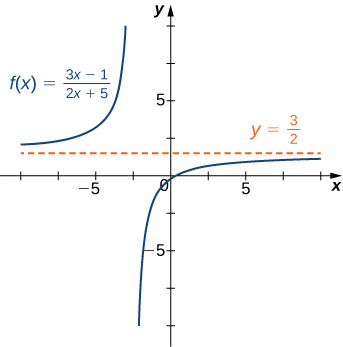
OpenStax, Rice University; Calculus Volume 1. · CC BY-NC-SA 4.0
Figure 4.53図 4.53The graph of this rational function approaches a horizontal asymptote asこの有理関数のグラフは、のとき水平漸近線へ近づく。 - Since the largest power of appearing in the denominator is divide the numerator and denominator by After doing so and applying algebraic limit laws, we obtain分母に現れるの最高の累乗はなので、分子と分母をで割る。そのうえで極限の四則演算の法則を使うと、
Therefore has a horizontal asymptote of as shown in the following graph.したがって、には水平漸近線がある。次のグラフに示す。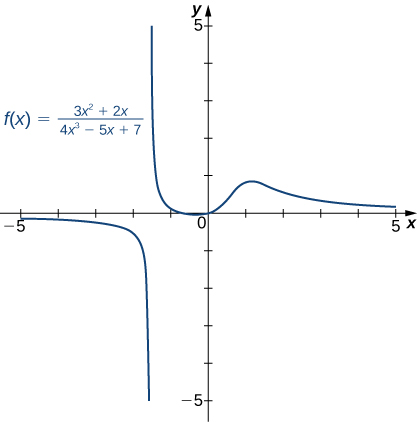
OpenStax, Rice University; Calculus Volume 1. · CC BY-NC-SA 4.0
Figure 4.54図 4.54The graph of this rational function approaches the horizontal asymptote asこの有理関数のグラフは、のとき水平漸近線へ近づく。 - Dividing the numerator and denominator by we have分子と分母をで割ると、
As the denominator approaches As the numerator approaches As the numerator approaches Therefore whereas as shown in the following figure.のとき、分母はへ近づく。のとき分子はへ向かい、のとき分子はへ向かう。したがって、であり、である。次の図に示す。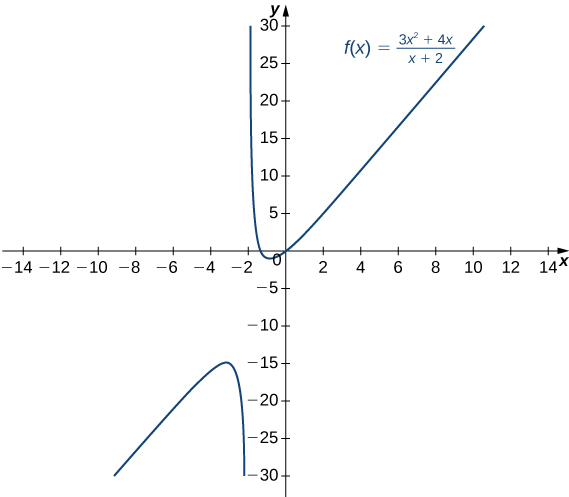
OpenStax, Rice University; Calculus Volume 1. · CC BY-NC-SA 4.0
Figure 4.55図 4.55As the values As the valuesのときとなり、のときとなる。
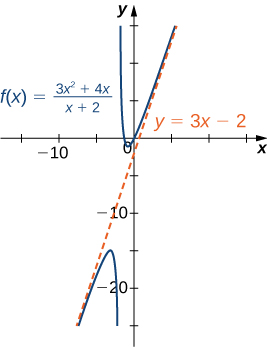
Before proceeding, consider the graph of shown in Figure 4.56. As and the graph of appears almost linear. Although is certainly not a linear function, we now investigate why the graph of seems to be approaching a linear function. First, using long division of polynomials, we can write
英語のヒント
先へ進む前に、図4.56ののグラフを考えよう。およびのとき、のグラフはほぼ直線に見える。自体は1次関数ではない。それでものグラフが直線へ近づいて見えるのはなぜか。まず、多項式の割り算を行うと、次のように書ける。
Since as we conclude that
のときなので、
Therefore, the graph of approaches the line as This line is known as an oblique asymptote for (Figure 4.56).
英語のヒント
したがって、のとき、のグラフは直線へ近づく。この直線をの「斜漸近線」という(図4.56)。
OpenStax, Rice University; Calculus Volume 1. · CC BY-NC-SA 4.0
Figure 4.56図 4.56
The graph of the rational function approaches the oblique asymptote
有理関数のグラフは、。
We can summarize the results of Example 4.25 to make the following conclusion regarding end behavior for rational functions. Consider a rational function
例4.25の結果を整理すると、有理関数の無限遠での振る舞いについて、次のようにまとめられる。有理関数
where
を考える。ただし、とする。
- If the degree of the numerator is the same as the degree of the denominator then has a horizontal asymptote of as分子と分母の次数が等しいとき、はにおいて、水平漸近線をもつ。
- If the degree of the numerator is less than the degree of the denominator then has a horizontal asymptote of as分子の次数が分母の次数より小さいとき、はにおいて、水平漸近線をもつ。
- If the degree of the numerator is greater than the degree of the denominator then does not have a horizontal asymptote. The limits at infinity are either positive or negative infinity, depending on the signs of the leading terms. In addition, using long division, the function can be rewritten as分子の次数が分母の次数より大きいとき、は水平漸近線をもたない。無限遠での極限は、最高次の項の符号に応じて、正または負の無限大になる。さらに、多項式の割り算を使えば、この関数を次のように書き直せる。
where the degree of is less than the degree of As a result, Therefore, the values of approach zero as If the degree of is exactly one more than the degree of the function is a linear function. In this case, we call an oblique asymptote.
Now let’s consider the end behavior for functions involving a radical.ここで、の次数はの次数より小さい。そのため、となる。したがって、のときの値は0へ近づく。の次数がの次数よりちょうど1大きい場合、は1次関数になる。このとき、直線y=を斜漸近線と呼ぶ。次に、根号を含む関数の無限遠での振る舞いを考えよう。
Example 4.26例題 4.26
Determining End Behavior for a Function Involving a Radical根号を含む関数の無限遠での振る舞い
Find the limits as and for and describe the end behavior of
について、とのときの極限を求め、の無限遠での振る舞いを説明せよ。
Solution解き方
Let’s use the same strategy as we did for rational functions: divide the numerator and denominator by a power of To determine the appropriate power of consider the expression in the denominator. Since
有理関数で用いたのと同じ方針で、分子と分母をの累乗で割ろう。どのの累乗で割ればよいかを判断するため、分母のに注目する。
for large values of in effect appears just to the first power in the denominator. Therefore, we divide the numerator and denominator by Then, using the fact that for for and for all we calculate the limits as follows:
この関係から、の絶対値が大きいとき、分母は実質的にの1次の大きさになる。そこで、分子と分母をで割る。では、ではであり、すべてのについてであることを利用すると、極限は次のように計算できる。
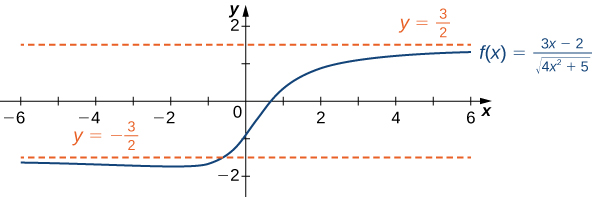
Therefore, approaches the horizontal asymptote as and the horizontal asymptote as as shown in the following graph.
したがって、は、のとき水平漸近線へ、のとき水平漸近線へ近づく。次のグラフに示す。
OpenStax, Rice University; Calculus Volume 1. · CC BY-NC-SA 4.0
Figure 4.57図 4.57
This function has two horizontal asymptotes and it crosses one of the asymptotes.
この関数には二つの水平漸近線があり、その一方と交わる。