第4章微分の応用
Corollaries of the Mean Value Theorem平均値の定理から得られる系
Let’s now look at three corollaries of the Mean Value Theorem. These results have important consequences, which we use in upcoming sections.
英語のヒント
平均値の定理から得られる三つの系を見よう。これらは、以後の節で使う重要な結果である。
At this point, we know the derivative of any constant function is zero. The Mean Value Theorem allows us to conclude that the converse is also true. In particular, if for all in some interval then is constant over that interval. This result may seem intuitively obvious, but it has important implications that are not obvious, and we discuss them shortly.
英語のヒント
定数関数の導関数が0になることは、すでに知っている。平均値の定理を使うと、その逆も正しいと示せる。すなわち、ある区間内のすべてのについてなら、はその区間で一定である。直感的には当たり前に見えるかもしれないが、この結果からは、すぐには明らかでない重要な結論も得られる。まもなく、その点を説明する。
Proof証明
Since is differentiable over must be continuous over Suppose is not constant for all in Then there exist where and Choose the notation so that Therefore,
は上で微分可能なので、は上で連続である。ここで、内のすべてのについてが一定ではないと仮定する。すると、かつとなるが存在する。となるようにa,bの名前を選べば、
Since is a differentiable function, by the Mean Value Theorem, there exists such that
は微分可能なので、平均値の定理により、次式を満たすが存在する。
Therefore, there exists such that which contradicts the assumption that for all
したがって、となるが存在する。これは、すべてのでであるという仮定に矛盾する。
□
□
From Theorem 4.6, it follows that if two functions have the same derivative, they differ by, at most, a constant.
定理4.6から、同じ区間で二つの関数の導関数が等しければ、その差は定数であると分かる。
Proof証明
Let Then, for all By Corollary 1, there is a constant such that for all Therefore, for all
とおく。すると、すべてのでとなる。系1により、定数が存在して、すべてのでが成り立つ。したがって、すべてのでである。
□
□
This fact is important because it means that for a given function if there exists a function such that then, the only other functions that have a derivative equal to are for some constant We discuss this result in more detail later in the chapter.
この事実は重要である。関数が与えられ、を満たす関数が存在するとしよう。このとき、導関数がに等しくなる他の関数は、定数を用いてと表されるものに限られる。この結果は、同じ区間上で考えていることを前提としている。この章の後半で、さらに詳しく扱う。
The third corollary of the Mean Value Theorem discusses when a function is increasing and when it is decreasing. Recall that a function is increasing over if whenever whereas is decreasing over if whenever Using the Mean Value Theorem, we can show that if the derivative of a function is positive, then the function is increasing; if the derivative is negative, then the function is decreasing (Figure 4.29). We make use of this fact in the next section, where we show how to use the derivative of a function to locate local maximum and minimum values of the function, and how to determine the shape of the graph.
英語のヒント
三つ目の系は、関数がいつ増加し、いつ減少するかに関わる。関数が区間上で増加するとは、なら必ずとなることだった。一方、が上で減少するとは、なら必ずとなることである。平均値の定理を使うと、導関数が正なら関数は増加し、導関数が負なら関数は減少すると示せる(図4.29)。次の節では、この事実を用いて極大・極小の位置を調べ、グラフの形を決める方法を学ぶ。
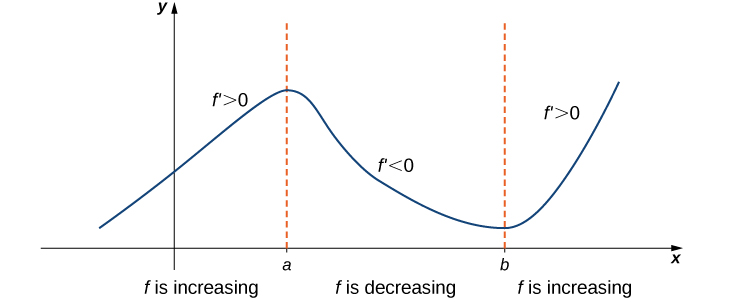
OpenStax, Rice University; Calculus Volume 1. · CC BY-NC-SA 4.0
Figure 4.29図 4.29
If a function has a positive derivative over some interval then the function increases over that interval if the derivative is negative over some interval then the function decreases over that interval
区間で導関数が正なら、その区間で関数は増加する。区間で導関数が負なら、その区間で関数は減少する。
Proof証明
We will prove i.; the proof of ii. is similar. Suppose is continuous and differentiable over an interval and for all . By way of contradiction, suppose that is not an increasing function on . Then there exist and in such that , but . Since is a differentiable function over , the Mean Value Theorem guarantees that there is some value such that
英語のヒント
(i)を証明する。(ii)も同様に示せる。は区間上で連続かつ微分可能であり、すべてのでとする。背理法を用い、が上で増加しないと仮定する。すると、内にとが存在し、であるのにとなる。は上で微分可能なので、平均値の定理より、次式を満たすが存在する。
Now , so . Because , it follows that . It follows that the quotient of and is negative. So, for c,
より、である。また、からとなる。したがって、をで割った値は0以下になる。このcについて、
However, for all including . This is a contradiction. The assumption that is not an increasing function on is false. Therefore, must be increasing throughout .
しかし、を含むすべてのでであり、これは矛盾である。よって、が上で増加しないという仮定は誤りで、は全体で増加する。
□
□