第4章微分の応用
4.9 Newton’s Method4.9 ニュートン法
Learning Objectives学習目標
- Describe the steps of Newton’s method.ニュートン法の手順を説明する。
- Explain what an iterative process means.反復過程の意味を説明する。
- Recognize when Newton’s method does not work.ニュートン法がうまくいかない場合を見分ける。
- Apply iterative processes to various situations.さまざまな状況に反復過程を応用する。
In many areas of pure and applied mathematics, we are interested in finding solutions to an equation of the form For most functions, however, it is difficult—if not impossible—to calculate their zeroes explicitly. In this section, we take a look at a technique that provides a very efficient way of approximating the zeroes of functions. This technique makes use of tangent line approximations and is behind the method used often by calculators and computers to find zeroes.
英語のヒント
純粋数学や応用数学の多くの分野で、という形の方程式の解を求めたいことがある。しかし、ほとんどの関数では、零点を明示的な式で計算することは、できるとしても難しい。この節では、関数の零点を非常に効率よく近似する方法を学ぶ。接線による近似を使うこの方法は、計算機やコンピューターが零点を求めるときによく使う方法の基礎となっている。
Describing Newton’s Methodニュートン法の仕組み
Consider the task of finding the solutions of If is the first-degree polynomial then the solution of is given by the formula If is the second-degree polynomial the solutions of can be found by using the quadratic formula. However, for polynomials of degree or more, finding roots of becomes more complicated. Although formulas exist for third- and fourth-degree polynomials, they are quite complicated. Also, if is a polynomial of degree or greater, it is known that no such formulas exist. For example, consider the function
英語のヒント
の解を求める問題を考えよう。が1次多項式なら、の解は公式で与えられる。が2次多項式なら、の解は2次方程式の解の公式で求められる。しかし、次以上の多項式では、の根を求めることはより複雑になる。3次・4次の多項式にも公式はあるが、かなり複雑である。が次以上になると、四則演算とべき根だけを使ってすべての場合に通用する一般的な解の公式は存在しないことが知られている。たとえば、次の関数を考えよう。
No formula exists that allows us to find the solutions of Similar difficulties exist for nonpolynomial functions. For example, consider the task of finding solutions of No simple formula exists for the solutions of this equation. In cases such as these, we can use Newton’s method to approximate the roots.
の解を、先ほどのような代数的な公式から求めることはできない。多項式でない関数でも、同じような難しさがある。たとえば、の解を求めたい場合も、解全体を与える簡単な公式はない。このようなとき、ニュートン法で根を近似できる。
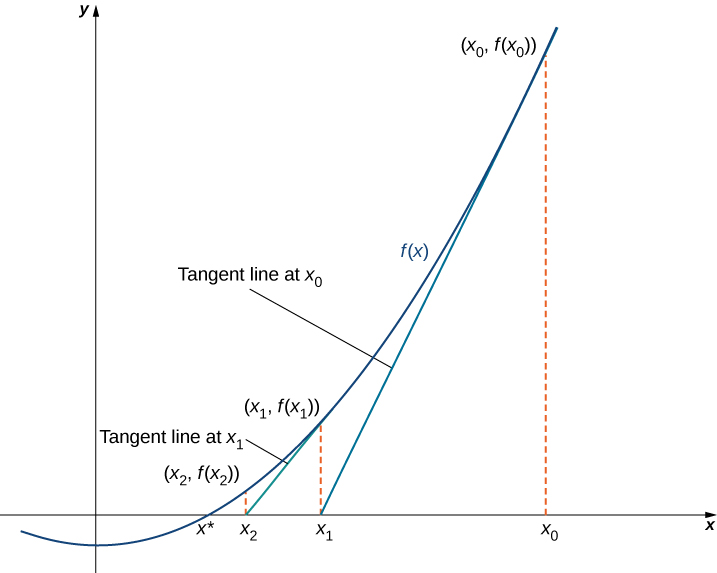
Newton’s method makes use of the following idea to approximate the solutions of By sketching a graph of we can estimate a root of Let’s call this estimate We then draw the tangent line to at If this tangent line intersects the -axis at some point Now let be the next approximation to the actual root. Typically, is closer than to an actual root. Next we draw the tangent line to at If this tangent line also intersects the -axis, producing another approximation, We continue in this way, deriving a list of approximations: Typically, the numbers quickly approach an actual root as shown in the following figure.
英語のヒント
ニュートン法は、次の考え方での解を近似する。まず、のグラフの概形から、の根のおおよその位置を見積もり、その値をとする。でのの接線を引く。なら、この接線は軸とある点で交わる。そこで、を根の次の近似値とする。通常、はより実際の根に近い。次に、でのの接線を引く。なら、この接線も軸と交わり、新しい近似値を得る。これを繰り返して、近似値の列を作る。通常、は、次の図のように実際の根へ速く近づく。
OpenStax, Rice University; Calculus Volume 1. · CC BY-NC-SA 4.0
Figure 4.77図 4.77
The approximations approach the actual root The approximations are derived by looking at tangent lines to the graph of
のグラフの接線から得る近似値が、実際の根へ近づいていく。
Now let’s look at how to calculate the approximations If is our first approximation, the approximation is defined by letting be the -intercept of the tangent line to at The equation of this tangent line is given by
近似値の計算方法を見よう。最初の近似値をとすると、でのの接線と軸との交点をとして、次の近似値を定める。この接線の方程式は、
Therefore, must satisfy
したがって、は次を満たす。
Solving this equation for we conclude that
これをについて解くと、次を得る。
Similarly, the point is the -intercept of the tangent line to at Therefore, satisfies the equation
同様に、点は、でのの接線と軸との交点である。したがって、は次の式を満たす。
In general, for satisfies
一般に、は次を満たす。
Next we see how to make use of this technique to approximate the root of the polynomial
次に、この方法を使って多項式の根を近似してみよう。
Example 4.46例題 4.46
Finding a Root of a Polynomial多項式の根を求める
Use Newton’s method to approximate a root of in the interval Let and find and
ニュートン法を使い、区間にあるの根を近似せよ。として、、を求めよ。
Solution解き方
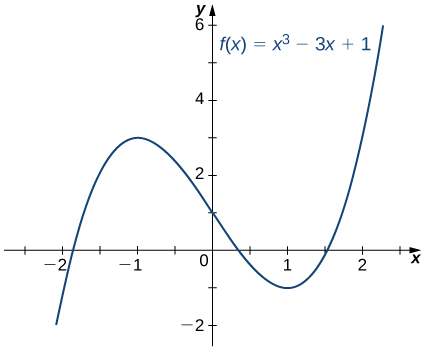
From Figure 4.78, we see that has one root over the interval Therefore seems like a reasonable first approximation. To find the next approximation, we use Equation 4.8. Since the derivative is Using Equation 4.8 with (and a calculator that displays digits), we obtain
To find the next approximation, we use Equation 4.8 with and the value of stored on the calculator. We find that
次の近似値を求めるには、式4.8でとし、計算機に保存されたの値を使う。すると、
Continuing in this way, we obtain the following results:
同じように続けると、次の値を得る。
We note that we obtained the same value for and Therefore, any subsequent application of Newton’s method will most likely give the same value for
との表示値が一致した。したがって、さらにニュートン法を繰り返しても、表示されるの値はおそらく変わらない。
OpenStax, Rice University; Calculus Volume 1. · CC BY-NC-SA 4.0
Figure 4.78図 4.78
The function has one root over the interval
関数は、区間に根を1つ持つ。
Newton’s method can also be used to approximate square roots. Here we show how to approximate This method can be modified to approximate the square root of any positive number.
ニュートン法は平方根の近似にも使える。ここではの近似値を求める。この方法を少し変えれば、任意の正の数の平方根を近似できる。
Example 4.47例題 4.47
Finding a Square Root平方根を求める
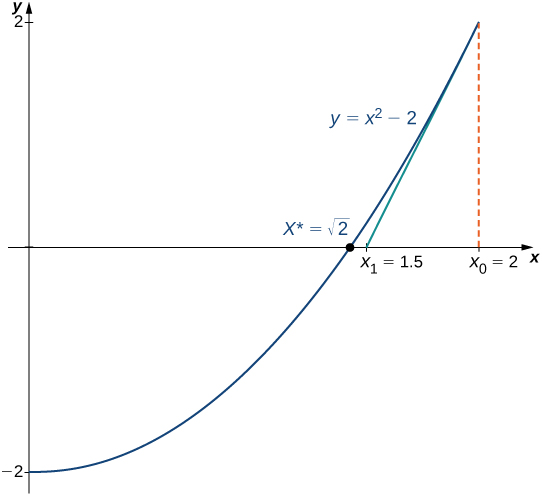
Use Newton’s method to approximate (Figure 4.79). Let let and calculate (We note that since has a zero at the initial value is a reasonable choice to approximate
ニュートン法でを近似せよ(図4.79)。、として、を計算する。の零点はなので、初期値はを近似するための妥当な選択である。
Solution解き方
For From Equation 4.8, we know that
である。式4.8から、次がわかる。
Therefore,
したがって、
Continuing in this way, we find that
同じように続けると、次を得る。
Since we obtained the same value for and it is unlikely that the value will change on any subsequent application of Newton’s method. We conclude that
との表示値が一致したので、さらに繰り返してもの表示値は変わりそうにない。したがって、とわかる。
OpenStax, Rice University; Calculus Volume 1. · CC BY-NC-SA 4.0
Figure 4.79図 4.79
We can use Newton’s method to find
ニュートン法でを求められる。
When using Newton’s method, each approximation after the initial guess is defined in terms of the previous approximation by using the same formula. In particular, by defining the function we can rewrite Equation 4.8 as This type of process, where each is defined in terms of by repeating the same function, is an example of an iterative process. Shortly, we examine other iterative processes. First, let’s look at the reasons why Newton’s method could fail to find a root.
英語のヒント
ニュートン法では、初期値の後に続く近似値を、毎回同じ公式で1つ前の近似値から定める。具体的には、関数を定義すれば、式4.8をと書き直せる。このように、同じ関数を繰り返し使い、からを定めていく操作を反復過程という。後で別の反復過程も考える。その前に、ニュートン法が根を見つけられない場合を調べよう。