第4章微分の応用
Indefinite Integrals不定積分
We now look at the formal notation used to represent antiderivatives and examine some of their properties. These properties allow us to find antiderivatives of more complicated functions. Given a function we use the notation or to denote the derivative of Here we introduce notation for antiderivatives. If is an antiderivative of we say that is the most general antiderivative of and write
原始関数を表す正式な記法と、その性質を考えよう。これらの性質によって、より複雑な関数の原始関数を求められる。関数に対して、の導関数はまたはと表した。ここでは原始関数の記法を導入する。がの原始関数なら、をの最も一般的な原始関数といい、次のように書く。
The symbol is called an integral sign, and is called the indefinite integral of
英語のヒント
記号を積分記号といい、をの不定積分という。
Given the terminology introduced in this definition, the act of finding the antiderivatives of a function is usually referred to as integrating
この定義に基づき、関数の原始関数を求めることを、通常「を積分する」という。
For a function and an antiderivative the functions where is any real number, is often referred to as the family of antiderivatives of For example, since is an antiderivative of and any antiderivative of is of the form we write
英語のヒント
関数とその原始関数に対し、を任意の実数として得られる関数の集まりを、の原始関数族という。たとえば、はの原始関数であり、の原始関数はすべてという形なので、次のように書く。
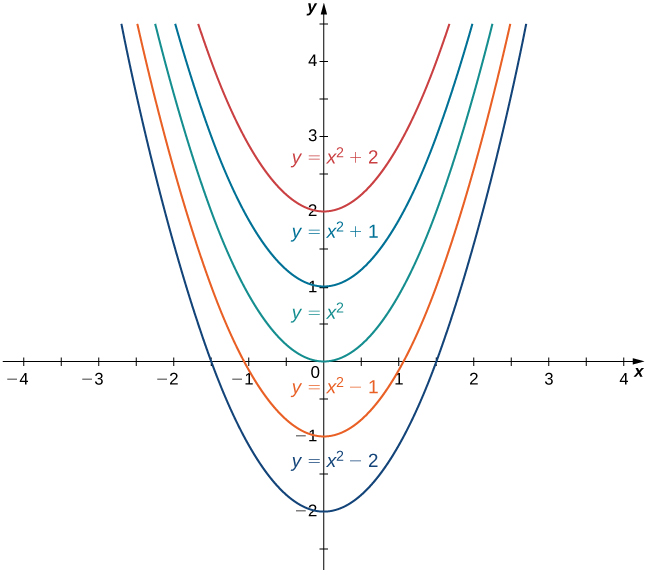
The collection of all functions of the form where is any real number, is known as the family of antiderivatives of Figure 4.85 shows a graph of this family of antiderivatives.
英語のヒント
を任意の実数としたときの、という形の関数すべての集まりが、の原始関数族である。図4.85に、そのグラフを示す。
OpenStax, Rice University; Calculus Volume 1. · CC BY-NC-SA 4.0
Figure 4.85図 4.85
The family of antiderivatives of consists of all functions of the form where is any real number.
の原始関数族は、を任意の実数としたという形の関数すべてからなる。
For some functions, evaluating indefinite integrals follows directly from properties of derivatives. For example, for
いくつかの関数では、微分の性質から直接、不定積分を求められる。たとえば、なら、
which comes directly from
これは、次の微分公式から直接わかる。
This fact is known as the power rule for integrals.
この公式を、べき関数の積分公式という。
Evaluating indefinite integrals for some other functions is also a straightforward calculation. The following table lists the indefinite integrals for several common functions. A more complete list appears in Appendix A.
ほかにも、不定積分をそのまま計算できる関数がある。次の表は、よく使う関数の不定積分をまとめたものである。さらに詳しい一覧は付録Aにある。
Differentiation Formula 微分公式 |
Indefinite Integral 不定積分 |
|---|---|
for () |
|
From the definition of indefinite integral of we know
の不定積分の定義から、次の等式が成り立つのは、
if and only if is an antiderivative of Therefore, when claiming that
がの原始関数である場合、かつその場合に限る。したがって、次のように主張するなら、
it is important to check whether this statement is correct by verifying that
英語のヒント
を確かめることによって、主張が正しいかどうかを確認することが重要である。
Example 4.51例題 4.51
Verifying an Indefinite Integral不定積分を検算する
Each of the following statements is of the form Verify that each statement is correct by showing that
次の各等式は、という形をしている。を示して、それぞれが正しいことを確かめよ。
Solution解き方
- Since次が成り立つので、
the statement等式
is correct.
Note that we are verifying an indefinite integral for a sum. Furthermore, and are antiderivatives of and respectively, and the sum of the antiderivatives is an antiderivative of the sum. We discuss this fact again later in this section.は正しい。ここでは、和の不定積分を確かめている。とは、それぞれとの原始関数であり、原始関数の和が、和の原始関数になる。この性質は、後でもう一度取り上げる。 - Using the product rule, we see that積の微分公式を使うと、次がわかる。
Therefore, the statementしたがって、等式
is correct.
Note that we are verifying an indefinite integral for a product. The antiderivative is not a product of the antiderivatives. Furthermore, the product of antiderivatives, is not an antiderivative of sinceは正しい。ここでは、積の不定積分を確かめている。ただし、原始関数は、各因子の原始関数を掛けたものではない。また、原始関数どうしの積は、の原始関数ではない。実際、
In general, the product of antiderivatives is not an antiderivative of a product.英語のヒント
一般に、原始関数どうしの積は、積の原始関数にはならない。
In Table 4.13, we listed the indefinite integrals for many elementary functions. Let’s now turn our attention to evaluating indefinite integrals for more complicated functions. For example, consider finding an antiderivative of a sum In Example 4.51a. we showed that an antiderivative of the sum is given by the sum —that is, an antiderivative of a sum is given by a sum of antiderivatives. This result was not specific to this example. In general, if and are antiderivatives of any functions and respectively, then
Therefore, is an antiderivative of and we have
したがって、はの原始関数であり、次が成り立つ。
Similarly,
同様に、
In addition, consider the task of finding an antiderivative of where is any real number. Since
さらに、を任意の実数として、の原始関数を考える。次が成り立つので、
for any real number we conclude that
任意の実数に対し、次を得る。
These properties are summarized next.
これらの性質をまとめよう。
From this theorem, we can evaluate any integral involving a sum, difference, or constant multiple of functions with antiderivatives that are known. Evaluating integrals involving products, quotients, or compositions is more complicated (see Example 4.51b. for an example involving an antiderivative of a product.) We look at and address integrals involving these more complicated functions in Introduction to Integration. In the next example, we examine how to use this theorem to calculate the indefinite integrals of several functions.
Example 4.52例題 4.52
Evaluating Indefinite Integrals不定積分を計算する
Evaluate each of the following indefinite integrals:
次の各不定積分を求めよ。
Solution解き方
- Using Theorem 4.16, we can integrate each of the four terms in the integrand separately. We obtain定理4.16により、被積分関数の4つの項を、それぞれ別々に積分できる。すると、
From the second part of Theorem 4.16, each coefficient can be written in front of the integral sign, which gives定理4.16の第2の性質により、各係数を積分記号の前へ出すと、Using the power rule for integrals, we conclude thatべき関数の積分公式を使うと、次を得る。 - Rewrite the integrand as被積分関数を次のように書き換える。
Then, to evaluate the integral, integrate each of these terms separately. Using the power rule, we have各項を別々に積分し、べき関数の積分公式を使うと、 - Using Theorem 4.16, write the integral as定理4.16により、積分を次のように書く。
Then, use the fact that is an antiderivative of to conclude thatがの原始関数であることを使うと、 - Rewrite the integrand as被積分関数を次のように書き換える。
Therefore,したがって、