第4章微分の応用
Other Indeterminate Formsほかの不定形
L’Hôpital’s rule is very useful for evaluating limits involving the indeterminate forms and However, we can also use L’Hôpital’s rule to help evaluate limits involving other indeterminate forms that arise when evaluating limits. The expressions and are all considered indeterminate forms. These expressions are not real numbers. Rather, they represent forms that arise when trying to evaluate certain limits. Next we realize why these are indeterminate forms and then understand how to use L’Hôpital’s rule in these cases. The key idea is that we must rewrite the indeterminate forms in such a way that we arrive at the indeterminate form or
ロピタルの定理は、型や型の不定形を含む極限に特に役立つが、ほかの不定形を含む極限にも利用できる。、、、、も、すべて不定形である。これらは実数を表す式ではない。極限を求めようとするときに現れる「形」を表している。なぜ不定形なのかを確認し、それぞれにロピタルの定理を使う方法を学ぼう。鍵となるのは、型または型になるように式を書き換えることである。
Indeterminate Form of Type 型の不定形
Suppose we want to evaluate where and (or as Since one term in the product is approaching zero but the other term is becoming arbitrarily large (in magnitude), anything can happen to the product. We use the notation to denote the form that arises in this situation. The expression is considered indeterminate because we cannot determine without further analysis the exact behavior of the product as For example, let be a positive integer and consider
英語のヒント
のとき、かつ(またはとなる場合に、を求めたいとする。一方の因子は0に近づくが、もう一方の因子は絶対値が限りなく大きくなるので、積がどうなるかはこれだけではわからない。この状況で生じる形をと表す。が不定形なのは、さらに調べなければ、のときの積の正確な振る舞いを決められないためである。たとえば、を正の整数として、次の関数を考えよう。
As and However, the limit as of varies, depending on If then If then If then Here we consider another limit involving the indeterminate form and show how to rewrite the function as a quotient to use L’Hôpital’s rule.
のとき、かつである。しかし、のときのの極限は、によって変わる。なら、なら、ならとなる。次に、型の不定形を含む別の極限を取り上げ、関数を商に書き換えてロピタルの定理を使う方法を示す。
Example 4.41例題 4.41
Indeterminate Form of Type 型の不定形
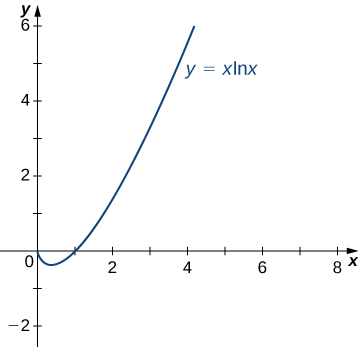
Evaluate
の値を求めよ。
Solution解き方
First, rewrite the function as a quotient to apply L’Hôpital’s rule. If we write
まず、ロピタルの定理を使えるように、関数を商の形に書き換える。次のように書くと、
we see that as and as Therefore, we can apply L’Hôpital’s rule and obtain
のとき、のときとなる。したがって、ロピタルの定理を使うと、次を得る。
We conclude that
したがって、次の結論を得る。
OpenStax, Rice University; Calculus Volume 1. · CC BY-NC-SA 4.0
Figure 4.72図 4.72
Finding the limit at of the function
関数の、における極限を求める。
Indeterminate Form of Type 型の不定形
Another type of indeterminate form is Consider the following example. Let be a positive integer and let and As and We are interested in Depending on whether grows faster, grows faster, or they grow at the same rate, as we see next, anything can happen in this limit. Since and we write to denote the form of this limit. As with our other indeterminate forms, has no meaning on its own and we must do more analysis to determine the value of the limit. For example, suppose the exponent in the function is then
もう1つの不定形はである。を正の整数とし、、としよう。のとき、かつとなる。求めたいのはである。のほうが速く増えるのか、のほうが速く増えるのか、それとも同程度に増えるのかによって、極限はさまざまになる。かつなので、この極限の形をと表す。ほかの不定形と同様、だけでは値は決まらず、さらに調べる必要がある。たとえば、関数の指数がなら、次のようになる。
On the other hand, if then
一方、なら、次のようになる。
However, if then
しかし、なら、次のようになる。
Therefore, the limit cannot be determined by considering only Next we see how to rewrite an expression involving the indeterminate form as a fraction to apply L’Hôpital’s rule.
したがって、という形だけから極限を決定することはできない。次に、型の式を分数に書き換えて、ロピタルの定理を使う方法を見よう。
Example 4.42例題 4.42
Indeterminate Form of Type 型の不定形
Evaluate
の値を求めよ。
Solution解き方
By combining the fractions, we can write the function as a quotient. Since the least common denominator is we have
英語のヒント
分数を通分すれば、関数を1つの商に書ける。最小公分母はなので、次のようになる。
As the numerator and the denominator Therefore, we can apply L’Hôpital’s rule. Taking the derivatives of the numerator and the denominator, we have
のとき、分子は、分母はとなる。したがって、ロピタルの定理を使える。分子と分母をそれぞれ微分すると、次を得る。
As and Since the denominator is positive as approaches zero from the right, we conclude that
のとき、かつとなる。が右から0に近づくとき分母は正なので、次の結論を得る。
Therefore,
したがって、
Another type of indeterminate form that arises when evaluating limits involves exponents. The expressions and are all indeterminate forms. On their own, these expressions are meaningless because we cannot actually evaluate these expressions as we would evaluate an expression involving real numbers. Rather, these expressions represent forms that arise when finding limits. Now we examine how L’Hôpital’s rule can be used to evaluate limits involving these indeterminate forms.
極限を求めるときには、指数を含む不定形も現れる。、、はすべて不定形である。これらを、実数の式と同じようにそのまま計算することはできない。極限を求める過程で現れる形を表す記号である。これらの不定形にも、ロピタルの定理を使う方法を考えよう。
Since L’Hôpital’s rule applies to quotients, we use the natural logarithm function and its properties to reduce a problem evaluating a limit involving exponents to a related problem involving a limit of a quotient. For example, suppose we want to evaluate and we arrive at the indeterminate form (The indeterminate forms and can be handled similarly.) We proceed as follows. Let
英語のヒント
ロピタルの定理が適用できるのは商なので、自然対数とその性質を使い、指数を含む極限の問題を、商の極限の問題へ変える。たとえば、を求めようとして型になったとする。型や型も同様に扱える。次のように進める。
Then,
すると、次のようになる。
Therefore,
したがって、
Since we know that Therefore, is of the indeterminate form and we can use the techniques discussed earlier to rewrite the expression in a form so that we can apply L’Hôpital’s rule. Suppose where may be or Then
なので、がわかる。したがって、は型の不定形である。先ほどの方法でを書き換えれば、ロピタルの定理を使える。としよう。ここではやでもよい。すると、
Since the natural logarithm function is continuous, we conclude that
自然対数の連続性により、次の関係が得られる。有限の極限については、まず y=exp(ln y) と指数関数の連続性を使うと、y自身の極限の存在も確かめられる。
which gives us
したがって、次を得る。
Example 4.43例題 4.43
Indeterminate Form of Type 型の不定形
Evaluate
の値を求めよ。
Solution解き方
Let Then,
とおく。すると、
We need to evaluate Applying L’Hôpital’s rule, we obtain
を求めればよい。ロピタルの定理を使うと、次を得る。
Therefore, Since the natural logarithm function is continuous, we conclude that
したがって、である。自然対数とその逆関数である指数関数の連続性から、次の関係を得る。
which leads to
これより、
Hence,
よって、
Example 4.44例題 4.44
Indeterminate Form of Type 型の不定形
Evaluate
の値を求めよ。
Solution解き方
Let
次のようにおく。
Therefore,
したがって、
We now evaluate Since and we have the indeterminate form To apply L’Hôpital’s rule, we need to rewrite as a fraction. We could write
を求めよう。かつなので、型の不定形となる。ロピタルの定理を使うには、を分数に書き換える必要がある。たとえば、次の2通りが考えられる。
or
または、
Let’s consider the first option. In this case, applying L’Hôpital’s rule, we would obtain
まず第1の書き方を試そう。ロピタルの定理を使うと、次のようになる。
Unfortunately, we not only have another expression involving the indeterminate form but the new limit is even more complicated to evaluate than the one with which we started. Instead, we try the second option. By writing
英語のヒント
ところが、再び型の不定形になるうえ、極限の計算は出発点よりもかえって複雑になる。そこで、第2の書き方を試す。次のように書いて、
and applying L’Hôpital’s rule, we obtain
ロピタルの定理を使うと、次を得る。
Using the fact that and we can rewrite the expression on the right-hand side as
およびを使うと、右辺の式を次のように書き換えられる。
We conclude that Therefore, and we have
したがって、となる。これよりであり、次を得る。
Hence,
よって、