第4章微分の応用
4.7 Applied Optimization Problems4.7 最適化の応用問題
Learning Objectives学習目標
- Set up and solve optimization problems in several applied fields.さまざまな分野の最適化問題を立式し、解く。
One common application of calculus is calculating the minimum or maximum value of a function. For example, companies often want to minimize production costs or maximize revenue. In manufacturing, it is often desirable to minimize the amount of material used to package a product with a certain volume. In this section, we show how to set up these types of minimization and maximization problems and solve them by using the tools developed in this chapter.
英語のヒント
関数の最小値や最大値を求めることは、微積分の代表的な応用である。例えば、企業は生産費用を最小にしたり、売上高を最大にしたりしようとする。製造業では、決まった体積の商品を包むための材料をできるだけ少なくしたいことがある。この節では、このような最小化・最大化の問題をどう立式し、この章で学んだ方法でどう解くかを扱う。
Solving Optimization Problems over a Closed, Bounded Interval有界閉区間での最適化問題
The basic idea of the optimization problems that follow is the same. We have a particular quantity that we are interested in maximizing or minimizing. However, we also have some auxiliary condition that needs to be satisfied. For example, in Example 4.32, we are interested in maximizing the area of a rectangular garden. Certainly, if we keep making the side lengths of the garden larger, the area will continue to become larger. However, what if we have some restriction on how much fencing we can use for the perimeter? In this case, we cannot make the garden as large as we like. Let’s look at how we can maximize the area of a rectangle subject to some constraint on the perimeter.
英語のヒント
以下の最適化問題では、基本的な考え方は共通している。最大または最小にしたい量があり、それと同時に満たさなければならない条件もある。例えば例4.32では、長方形の庭の面積を最大にしたい。辺をどこまでも長くできるなら、面積もいくらでも大きくなる。しかし、周囲に使える柵の長さに制限があったらどうだろう。その場合、庭を好きなだけ大きくすることはできない。周囲の長さに制約があるとき、長方形の面積をどう最大にできるかを見てみよう。
Example 4.32例題 4.32
Maximizing the Area of a Garden庭の面積を最大にする
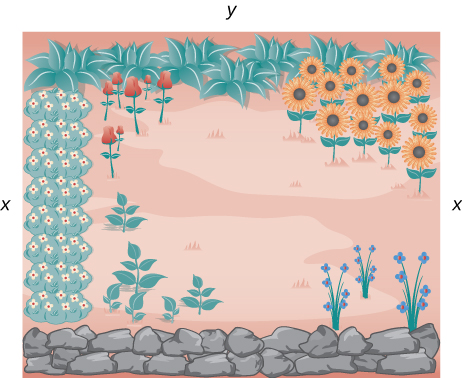
A rectangular garden is to be constructed using a rock wall as one side of the garden and wire fencing for the other three sides (Figure 4.62). Given ft of wire fencing, determine the dimensions that would create a garden of maximum area. What is the maximum area?
石垣を一辺として使い、残りの三辺を金網の柵で囲んで、長方形の庭を作る(図4.62)。使える柵の長さが ftのとき、庭の面積を最大にする縦・横の長さを求めよ。また、最大面積はいくらか。
OpenStax, Rice University; Calculus Volume 1. · CC BY-NC-SA 4.0
Figure 4.62図 4.62
We want to determine the measurements and that will create a garden with a maximum area using ft of fencing.
ftの柵を使って面積が最大の庭を作るため、辺の長さとを求めたい。
Solution解き方
Let denote the length of the side of the garden perpendicular to the rock wall and denote the length of the side parallel to the rock wall. Then the area of the garden is
石垣に垂直な辺の長さを、石垣に平行な辺の長さをとする。すると、庭の面積は、
We want to find the maximum possible area subject to the constraint that the total fencing is From Figure 4.62, the total amount of fencing used will be Therefore, the constraint equation is
柵の長さの合計がという制約のもとで、面積を最大にしたい。図4.62から、使う柵の長さはなので、制約条件は次の式で表される。
Solving this equation for we have Thus, we can write the area as
この式をについて解くと、となる。したがって、面積は次のように表せる。
Before trying to maximize the area function we need to determine the domain under consideration. To construct a rectangular garden, we certainly need the lengths of both sides to be positive. Therefore, we need and Since if then Therefore, we are trying to determine the maximum value of for over the open interval We do not know that a function necessarily has a maximum value over an open interval. However, we do know that a continuous function has an absolute maximum (and absolute minimum) over a closed interval. Therefore, let’s consider the function over the closed interval If the maximum value occurs at an interior point, then we have found the value in the open interval that maximizes the area of the garden. Therefore, we consider the following problem:
面積の関数を最大にする前に、どの範囲を考えるかを決める。長方形の庭を作るには、両方の辺の長さが正、つまりかつでなければならない。なので、ならとなる。求めたいのは、が開区間にあるときのの最大値である。ただし、開区間上の関数には最大値があるとは限らない。連続関数なら、有界閉区間上では最大値と最小値をもつことが分かっている。そこで、を閉区間で考える。最大値をとる点が区間の内部にあれば、そのは開区間に含まれ、庭の面積を最大にする。したがって、次の問題を考えればよい。
Maximize over the interval
区間でを最大にせよ。
As mentioned earlier, since is a continuous function on a closed, bounded interval, by the extreme value theorem, it has a maximum and a minimum. These extreme values occur either at endpoints or critical points. At the endpoints, Since the area is positive for all in the open interval the maximum must occur at a critical point. Differentiating the function we obtain
は有界閉区間上の連続関数なので、最大値・最小値の定理により、最大値と最小値をもつ。その候補は端点または臨界点である。端点ではであり、開区間内のすべてのでは面積が正なので、最大値は臨界点でとられる。を微分すると、
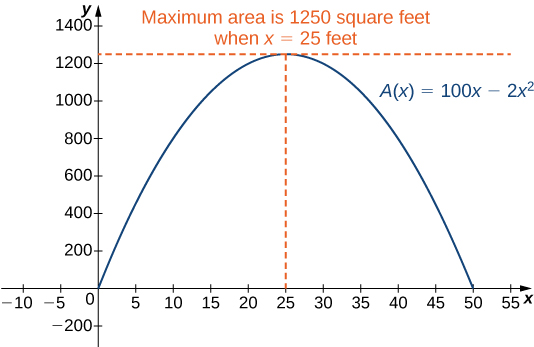
Therefore, the only critical point is (Figure 4.63). We conclude that the maximum area must occur when Then we have To maximize the area of the garden, let ft and The area of this garden is
したがって、唯一の臨界点はである(図4.63)。面積はのとき最大になる。このとき、である。つまり、 ft、とすればよく、庭の最大面積はとなる。
OpenStax, Rice University; Calculus Volume 1. · CC BY-NC-SA 4.0
Figure 4.63図 4.63
To maximize the area of the garden, we need to find the maximum value of the function
庭の面積を最大にするには、関数の最大値を求めればよい。
Now let’s look at a general strategy for solving optimization problems similar to Example 4.32.
例4.32のような最適化問題を解くための、一般的な手順を整理しよう。
Now let’s apply this strategy to maximize the volume of an open-top box given a constraint on the amount of material to be used.
次はこの手順を使い、使える材料の量が決まっているときに、ふたのない箱の体積を最大にしてみよう。
Example 4.33例題 4.33
Maximizing the Volume of a Box箱の体積を最大にする
An open-top box is to be made from a in. by in. piece of cardboard by removing a square from each corner of the box and folding up the flaps on each side. What size square should be cut out of each corner to get a box with the maximum volume?
in× inの長方形の厚紙の四隅から、同じ大きさの正方形を切り取り、各辺に残った部分を折り上げて、ふたのない箱を作る。体積を最大にするには、どの大きさの正方形を切り取ればよいか。
Solution解き方
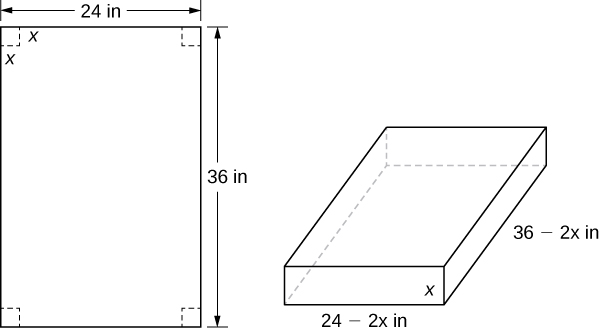
Step 1: Let be the side length of the square to be removed from each corner (Figure 4.64). Then, the remaining four flaps can be folded up to form an open-top box. Let be the volume of the resulting box.
手順1.各隅から切り取る正方形の一辺の長さをとする(図4.64)。残った四つの側面を折り上げれば、ふたのない箱になる。その体積をとする。
OpenStax, Rice University; Calculus Volume 1. · CC BY-NC-SA 4.0
Figure 4.64図 4.64
A square with side length inches is removed from each corner of the piece of cardboard. The remaining flaps are folded to form an open-top box.
厚紙の四隅から、一辺 inの正方形を切り取る。残った側面を折り上げ、ふたのない箱を作る。
Step 2: We are trying to maximize the volume of a box. Therefore, the problem is to maximize
手順2.箱の体積を最大にしたい。つまり、最大にする量はである。
Step 3: As mentioned in step we are trying to maximize the volume of a box. The volume of a box is where are the length, width, and height, respectively.
手順3.手順で確認したとおり、求める量は箱の体積である。その式はであり、はそれぞれ長さ・幅・高さを表す。
Step 4: From Figure 4.64, we see that the height of the box is inches, the length is inches, and the width is inches. Therefore, the volume of the box is
手順4.図4.64から、箱の高さは in、長さは in、幅は inである。したがって、体積は、
Step 5: To determine the domain of consideration, let’s examine Figure 4.64. Certainly, we need Furthermore, the side length of the square cannot be greater than or equal to half the length of the shorter side, in.; otherwise, one of the flaps would be completely cut off. Therefore, we are trying to determine whether there is a maximum volume of the box for over the open interval Since is a continuous function over the closed interval we know will have an absolute maximum over the closed interval. Therefore, we consider over the closed interval and check whether the absolute maximum occurs at an interior point.
手順5.変数の範囲を決めるため、図4.64を見る。まずが必要である。また、切り取る正方形の一辺は、厚紙の短辺 inの半分より小さくなければならない。半分以上にすると、側面の一つが完全になくなる。したがって、が開区間にあるときに、箱の体積が最大になる点を探す。は閉区間で連続なので、はその閉区間で最大値をもつ。そこでを閉区間で考え、最大値をとる点が内部にあるか確認する。
Step 6: Since is a continuous function over the closed, bounded interval must have an absolute maximum (and an absolute minimum). Since at the endpoints and for the maximum must occur at a critical point. The derivative is
手順6.は有界閉区間で連続なので、は最大値と最小値をもつ。端点ではであり、ではなので、最大値は臨界点でとられる。導関数は、
To find the critical points, we need to solve the equation
臨界点を求めるには、次の方程式を解く。
Dividing both sides of this equation by the problem simplifies to solving the equation
両辺をで割ると、次の方程式になる。
Using the quadratic formula, we find that the critical points are
2次方程式の解の公式を使うと、導関数が0になる点は、
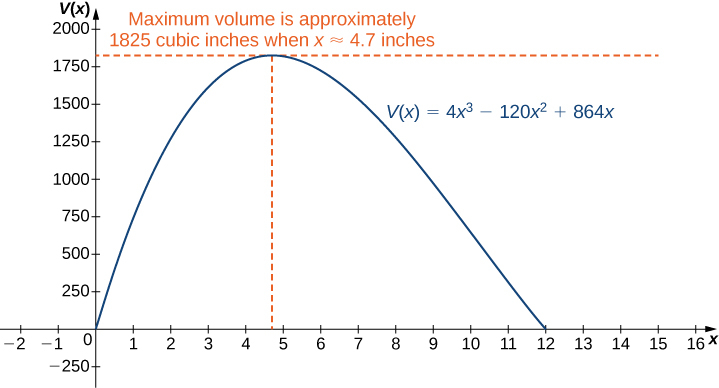
Since is not in the domain of consideration, the only critical point we need to consider is Therefore, the volume is maximized if we let The maximum volume is as shown in the following graph.
は考えている範囲の外にあるため、候補となる臨界点はだけである。したがって、とすれば体積が最大になる。最大体積はである。次のグラフに示す。
OpenStax, Rice University; Calculus Volume 1. · CC BY-NC-SA 4.0
Figure 4.65図 4.65
Maximizing the volume of the box leads to finding the maximum value of a cubic polynomial.
箱の体積の最大化は、3次多項式の最大値を求める問題になる。
Example 4.34例題 4.34
Minimizing Travel Time移動時間を最小にする
An island is due north of its closest point along a straight shoreline. A visitor is staying at a cabin on the shore that is west of that point. The visitor is planning to go from the cabin to the island. Suppose the visitor runs at a rate of and swims at a rate of How far should the visitor run before swimming to minimize the time it takes to reach the island?
英語のヒント
直線状の海岸で、島に最も近い地点をPとする。島はPの真北にある。旅行者はPから西への海岸沿いの小屋に滞在しており、小屋から島へ行こうとしている。走る速さが、泳ぐ速さがのとき、島に着くまでの時間を最小にするには、海岸をどれだけ走ってから泳ぎ始めればよいか。
Solution解き方
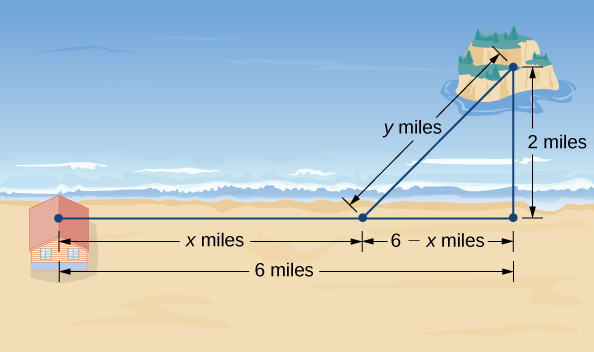
Step 1: Let be the distance running and let be the distance swimming (Figure 4.66). Let be the time it takes to get from the cabin to the island.
手順1.走る距離を、泳ぐ距離をとする(図4.66)。小屋から島に着くまでの時間をとする。
OpenStax, Rice University; Calculus Volume 1. · CC BY-NC-SA 4.0
Figure 4.66図 4.66
How can we choose and to minimize the travel time from the cabin to the island?
小屋から島までの時間を最小にするには、とをどう選べばよいか。
Step 2: The problem is to minimize
手順2.最小にする量はである。
Step 3: To find the time spent traveling from the cabin to the island, add the time spent running and the time spent swimming. Since Distance Rate Time the time spent running is
手順3.小屋から島までの時間は、走る時間と泳ぐ時間を足せばよい。「距離速さ時間」なので、走る時間は、
and the time spent swimming is
泳ぐ時間は、
Therefore, the total time spent traveling is
したがって、移動時間の合計は、
Step 4: From Figure 4.66, the line segment of miles forms the hypotenuse of a right triangle with legs of length and Therefore, by the Pythagorean theorem, and we obtain Thus, the total time spent traveling is given by the function
手順4.図4.66で、長さ miの線分は、他の2辺の長さがとである直角三角形の斜辺になる。三平方の定理からであり、が得られる。したがって、移動時間の合計は次の関数で表される。
Step 5: From Figure 4.66, we see that Therefore, is the domain of consideration.
手順5.図4.66から、考える範囲はである。したがって、定義域をとする。島の真南の地点を通り過ぎて走ると、走る距離も泳ぐ距離も増えるので、最短時間の候補にはならない。
Step 6: Since is a continuous function over a closed, bounded interval, it has a maximum and a minimum. Let’s begin by looking for any critical points of over the interval The derivative is
手順6.は有界閉区間上で連続なので、最大値と最小値をもつ。まず、区間の内部にあるの臨界点を探す。導関数は、
If then
ならば、
Therefore,
したがって、
Squaring both sides of this equation, we see that if satisfies this equation, then must satisfy
この方程式の両辺を2乗すると、これを満たすは、次の式も満たさなければならない。ここでも変数はである。
which implies
これを整理すると、
We conclude that if is a critical point, then satisfies
したがって、が臨界点なら、そのは次の条件を満たす。
Therefore, the possibilities for critical points are
臨界点の候補は、
Since is not in the domain, it is not a possibility for a critical point. On the other hand, is in the domain. Since we squared both sides of Equation 4.6 to arrive at the possible critical points, it remains to verify that satisfies Equation 4.6. Since does satisfy that equation, we conclude that is a critical point, and it is the only one. To justify that the time is minimized for this value of we just need to check the values of at the endpoints and and compare them with the value of at the critical point We find that and whereas Therefore, we conclude that has a local minimum at mi.
In business, companies are interested in maximizing revenue. In the following example, we consider a scenario in which a company has collected data on how many cars it is able to lease, depending on the price it charges its customers to rent a car. Let’s use these data to determine the price the company should charge to maximize the amount of money it brings in.
英語のヒント
企業は売上高を最大にしようとする。次の例では、レンタカー会社が、設定する料金と貸し出せる台数の関係についてデータを集めたとする。このデータから、会社が受け取る金額を最大にする料金を求めよう。
Example 4.35例題 4.35
Maximizing Revenue売上高を最大にする
Owners of a car rental company have determined that if they charge customers dollars per day to rent a car, where the number of cars they rent per day can be modeled by the linear function If they charge per day or less, they will rent all their cars. If they charge per day or more, they will not rent any cars. Assuming the owners plan to charge customers between $50 per day and per day to rent a car, how much should they charge to maximize their revenue?
あるレンタカー会社では、1台を1日貸す料金をドル、とすると、1日の貸出台数を1次関数で表せることが分かった。料金が1日以下なら全車両を貸し出せるが、1日以上なら1台も借りられない。会社は料金を1日50ドルからの間に設定する予定である。売上高を最大にするには、いくらにすればよいか。
Solution解き方
Step 1: Let be the price charged per car per day and let be the number of cars rented per day. Let be the revenue per day.
手順1.1台あたり1日の料金を、1日の貸出台数をとする。1日の売上高をとする。
Step 2: The problem is to maximize
手順2.最大にする量はである。
Step 3: The revenue (per day) is equal to the number of cars rented per day times the price charged per car per day—that is,
手順3.1日の売上高は、1日の貸出台数に、1台あたり1日の料金を掛けたものなので、である。
Step 4: Since the number of cars rented per day is modeled by the linear function the revenue can be represented by the function
手順4.1日の貸出台数は1次関数で表されるので、売上高は次の関数になる。
Step 5: Since the owners plan to charge between per car per day and per car per day, the problem is to find the maximum revenue for in the closed interval
手順5.会社は1台あたり1日の料金をからの間にする予定なので、閉区間内のについて、売上高の最大値を求めればよい。
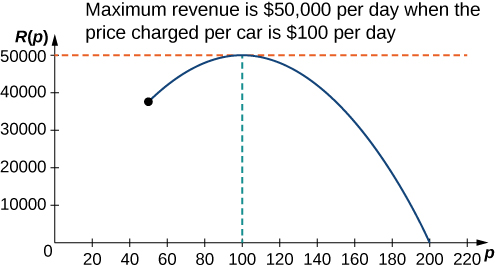
Step 6: Since is a continuous function over the closed, bounded interval it has an absolute maximum (and an absolute minimum) in that interval. To find the maximum value, look for critical points. The derivative is Therefore, the critical point is When When When Therefore, the absolute maximum occurs at The car rental company should charge per day per car to maximize revenue as shown in the following figure.
手順6.は有界閉区間で連続なので、その区間で最大値と最小値をもつ。最大値を探すため、まず臨界点を求める。導関数はであり、臨界点はである。では、では、ではとなる。したがって、で最大値をとる。売上高を最大にするには、1台あたり1日の料金をにすればよい。次の図を参照。
OpenStax, Rice University; Calculus Volume 1. · CC BY-NC-SA 4.0
Figure 4.67図 4.67
To maximize revenue, a car rental company has to balance the price of a rental against the number of cars people will rent at that price.
レンタカー会社が売上高を最大にするには、料金と、その料金で借りられる台数の釣り合いを考える必要がある。
Example 4.36例題 4.36
Maximizing the Area of an Inscribed Rectangle内接する長方形の面積を最大にする
A rectangle is to be inscribed in the ellipse
次の楕円に内接する長方形を作る。
What should the dimensions of the rectangle be to maximize its area? What is the maximum area?
面積を最大にするには、長方形の辺の長さをどう選べばよいか。最大面積はいくらか。
Solution解き方
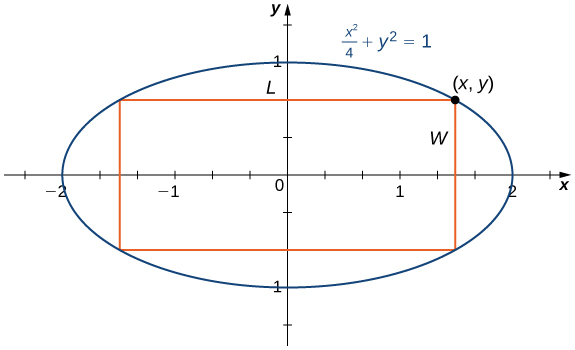
Step 1: For a rectangle to be inscribed in the ellipse, the sides of the rectangle must be parallel to the axes. Let be the length of the rectangle and be its width. Let be the area of the rectangle.
手順1.この楕円に内接する長方形の辺は、座標軸に平行になる。横の長さを、縦の長さをとし、面積をとする。
OpenStax, Rice University; Calculus Volume 1. · CC BY-NC-SA 4.0
Figure 4.68図 4.68
We want to maximize the area of a rectangle inscribed in an ellipse.
楕円に内接する長方形の面積を最大にしたい。
Step 2: The problem is to maximize
手順2.最大にする量はである。
Step 3: The area of the rectangle is
手順3.長方形の面積はである。
Step 4: Let be the corner of the rectangle that lies in the first quadrant, as shown in Figure 4.68. We can write length and width Since and we have Therefore, the area is
手順4.第1象限にある頂点をとする(図4.68)。横の長さは、縦の長さはとなる。かつなので、である。したがって、面積は、
Step 5: From Figure 4.68, we see that to inscribe a rectangle in the ellipse, the -coordinate of the corner in the first quadrant must satisfy Therefore, the problem reduces to looking for the maximum value of over the open interval Since will have an absolute maximum (and absolute minimum) over the closed interval we consider over the interval If the absolute maximum occurs at an interior point, then we have found an absolute maximum in the open interval.
手順5.図4.68から、楕円に内接する長方形を作るには、第1象限の頂点の座標がを満たす必要がある。したがって、開区間上での最大値を求める問題になる。は閉区間で連続なので、そこでは最大値と最小値をもつ。そこで、を区間で考える。最大値をとる点が内部にあれば、元の開区間での最大値も求められたことになる。
Step 6: As mentioned earlier, is a continuous function over the closed, bounded interval Therefore, it has an absolute maximum (and absolute minimum). At the endpoints and For Therefore, the maximum must occur at a critical point. Taking the derivative of we obtain
手順6.は有界閉区間で連続なので、最大値と最小値をもつ。端点とではだが、ではである。したがって、最大値は内部の臨界点でとられる。を微分すると、
To find critical points, we need to find where We can see that if is a solution of
内部の臨界点を求めるには、となる点を探す。が次の方程式の解なら、
then must satisfy
そのは次式を満たす。
Therefore, Thus, are the possible solutions of Equation 4.7. Since we are considering over the interval is a possibility for a critical point, but is not. Therefore, we check whether is a solution of Equation 4.7. Since is a solution of Equation 4.7, we conclude that is the only critical point of in the interval Therefore, must have an absolute maximum at the critical point To determine the dimensions of the rectangle, we need to find the length and the width If then
Therefore, the dimensions of the rectangle are and The area of this rectangle is
したがって、長方形の辺の長さはとであり、その面積はである。