第4章微分の応用
4.3 Maxima and Minima4.3 最大値と最小値
Learning Objectives学習目標
- Define absolute extrema.最大値・最小値を定義できる。
- Define local extrema.極大値・極小値を定義できる。
- Explain how to find the critical points of a function over a closed interval.閉区間上の関数の臨界点を求める方法を説明できる。
- Describe how to use critical points to locate absolute extrema over a closed interval.臨界点を用いて、閉区間上の最大値・最小値を求める方法を説明できる。
Given a particular function, we are often interested in determining the largest and smallest values of the function. This information is important in creating accurate graphs. Finding the maximum and minimum values of a function also has practical significance because we can use this method to solve optimization problems, such as maximizing profit, minimizing the amount of material used in manufacturing an aluminum can, or finding the maximum height a rocket can reach. In this section, we look at how to use derivatives to find the largest and smallest values for a function.
英語のヒント
関数が与えられたとき、その値がどこまで大きく、どこまで小さくなるかを知りたいことは多い。この情報は、正確なグラフを描くうえで重要である。関数の最大値・最小値を求める方法は、実際の問題にも役立つ。利益を最大にする、アルミ缶の製造に使う材料を最小限にする、ロケットが到達する最高高度を求める、といった最適化問題を解けるからである。この節では、導関数を用いて関数の最大値と最小値を求める方法を学ぶ。
Absolute Extrema最大値・最小値――区間全体で比べる
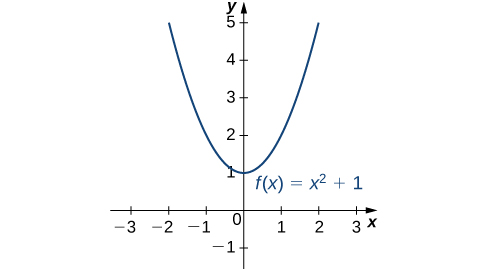
Consider the function over the interval As Therefore, the function does not have a largest value. However, since for all real numbers and when the function has a smallest value, 1, when We say that 1 is the absolute minimum of and it occurs at We say that does not have an absolute maximum (see the following figure).
区間で関数を考える。のときなので、この関数には最大値がない。一方、すべての実数に対してであり、のときとなる。したがって、のとき、関数の最小値は1である。これを、はで最小値(absolute minimum)1をとる、と表現する。には最大値(absolute maximum)がない。次の図を参照。
OpenStax, Rice University; Calculus Volume 1. · CC BY-NC-SA 4.0
Figure 4.12図 4.12
The given function has an absolute minimum of 1 at The function does not have an absolute maximum.
この関数はで最小値1をとる。最大値はない。
Before proceeding, let’s note two important issues regarding this definition. First, the term absolute here does not refer to absolute value. An absolute extremum may be positive, negative, or zero. Second, if a function has an absolute extremum over an interval at the absolute extremum is The real number is a point in the domain at which the absolute extremum occurs. For example, consider the function over the interval Since
英語のヒント
先へ進む前に、この定義について二つ注意しよう。第一に、ここでのabsoluteは「絶対値」を意味しない。最大値や最小値は、正にも負にも0にもなりうる。第二に、関数が区間上でにおいて最大値または最小値をとる場合、その値はである。実数は、その値をとる定義域内の位置を表す。例えば、区間で関数を考える。この関数には、次の不等式が成り立つ。
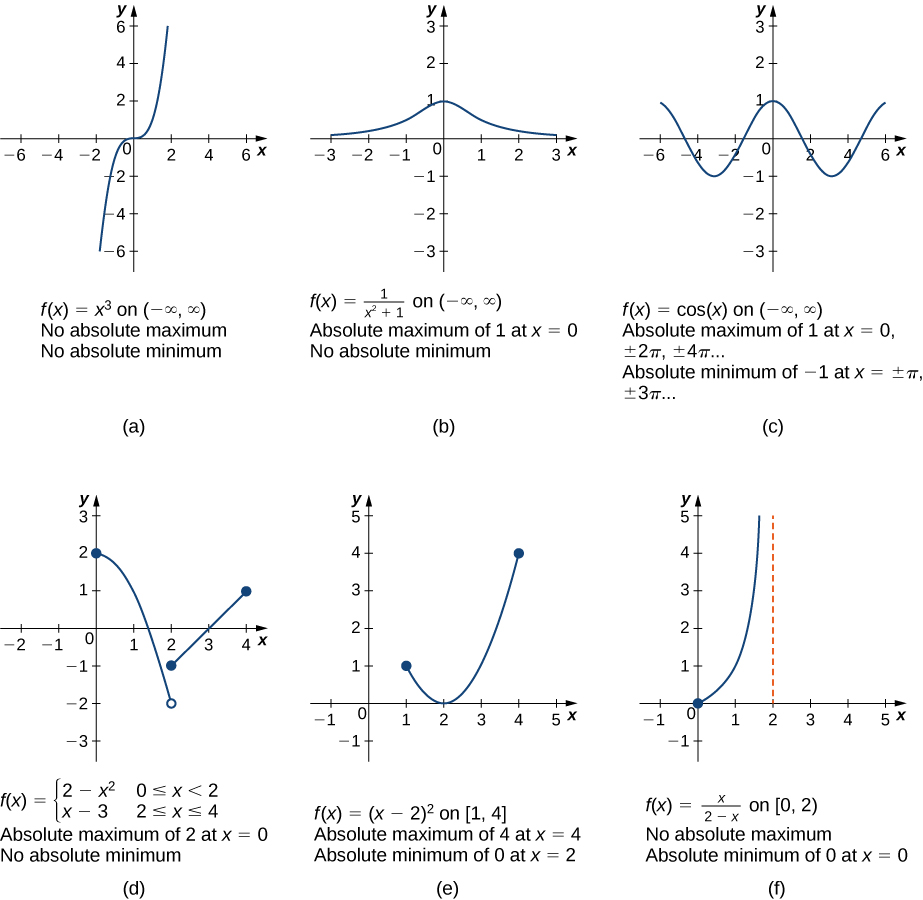
for all real numbers we say has an absolute maximum over at The absolute maximum is It occurs at as shown in Figure 4.13(b).
上の不等式がすべての実数に対して成り立つので、は区間上でにおいて最大値をとる。最大値はであり、それをとる位置はである。図4.13(b)を参照。
A function may have both an absolute maximum and an absolute minimum, just one extremum, or neither. Figure 4.13 shows several functions and some of the different possibilities regarding absolute extrema. However, the following theorem, called the Extreme Value Theorem, guarantees that a continuous function over a closed, bounded interval has both an absolute maximum and an absolute minimum.
英語のヒント
関数には、最大値と最小値の両方がある場合、片方だけがある場合、どちらもない場合がある。図4.13は、これらの可能性を示している。ただし、閉じた有界区間上の連続関数には、最大値と最小値の両方が必ず存在する。これを保証するのが、次の最大値・最小値の定理である。
OpenStax, Rice University; Calculus Volume 1. · CC BY-NC-SA 4.0
Figure 4.13図 4.13
Graphs (a), (b), and (c) show several possibilities for absolute extrema for functions with a domain of Graphs (d), (e), and (f) show several possibilities for absolute extrema for functions with a domain that is a bounded interval.
(a)、(b)、(c)は、定義域がである関数について、最大値・最小値の有無の例を示す。(d)、(e)、(f)は、定義域が有界区間である場合の例である。
The proof of the extreme value theorem is beyond the scope of this text. Typically, it is proved in a course on real analysis. There are a couple of key points to note about the statement of this theorem. For the extreme value theorem to apply, the function must be continuous over a closed, bounded interval. If the interval is open or the function has even one point of discontinuity, the function may not have an absolute maximum or absolute minimum over For example, consider the functions shown in Figure 4.13(d), (e), and (f). All three of these functions are defined over bounded intervals. However, the function in graph (e) is the only one that has both an absolute maximum and an absolute minimum over its domain. The extreme value theorem cannot be applied to the functions in graphs (d) and (f) because neither of these functions is continuous over a closed, bounded interval. Although the function in graph (d) is defined over the closed interval the function is discontinuous at The function has an absolute maximum over but does not have an absolute minimum. The function in graph (f) is continuous over the half-open interval but is not defined at and therefore is not continuous over a closed, bounded interval. The function has an absolute minimum over but does not have an absolute maximum over These two graphs illustrate why a function over a bounded interval may fail to have an absolute maximum and/or absolute minimum.
英語のヒント
最大値・最小値の定理の証明は、本書の範囲を超える。通常は実解析の科目で扱う。この定理の主張について、特に注意すべき点を確認しよう。定理を適用するには、関数が閉じた有界区間上で連続でなければならない。区間が開いていたり、不連続な点が一つでもあったりすると、上で最大値や最小値が存在しないことがある。図4.13の(d)、(e)、(f)を考える。三つとも有界区間で定義されているが、定義域上で最大値と最小値の両方をもつのは(e)だけである。(d)と(f)には、閉じた有界区間上で連続という条件が揃わず、この定理を適用できない。(d)の関数は閉区間で定義されているものの、で不連続である。上で最大値はあるが、最小値はない。(f)の関数は半開区間上で連続だが、では定義されていない。そのため、閉じた有界区間上で連続ではない。上で最小値はあるが、上で最大値はない。これらの例から、有界区間であっても、最大値・最小値の一方または両方が存在しない場合があると分かる。
Before looking at how to find absolute extrema, let’s examine the related concept of local extrema. This idea is useful in determining where absolute extrema occur.
最大値・最小値の求め方に進む前に、関連する概念である極大値・極小値を調べよう。これらは、最大値・最小値をとる位置を見つけるのに役立つ。