第4章微分の応用
Key Concepts重要な概念
- The limit of is as (or as if the values become arbitrarily close to as becomes sufficiently large.のとき、を十分大きくすることでをにいくらでも近づけられるなら、の極限はである。の場合は、xを十分小さな負の数にすることで同様に近づけられることをいう。
- The limit of is as if becomes arbitrarily large as becomes sufficiently large. The limit of is as if and becomes arbitrarily large as becomes sufficiently large. We can define the limit of as approaches similarly.を十分大きくするとがいくらでも大きくなるなら、のときのの極限はである。を十分大きくすると、を保ちながらがいくらでも大きくなるなら、のときのの極限はである。がに近づくときのの極限も、同様に定義する。
- For a polynomial function where the end behavior is determined by the leading term If approaches or at each end.多項式関数()の無限遠での振る舞いは、最高次の項で決まる。なら、は左右の遠方でそれぞれまたはへ発散する。
- For a rational function the end behavior is determined by the relationship between the degree of and the degree of If the degree of is less than the degree of the line is a horizontal asymptote for If the degree of is equal to the degree of then the line is a horizontal asymptote, where and are the leading coefficients of and respectively. If the degree of is greater than the degree of then approaches or at each end.有理関数の無限遠での振る舞いは、との次数の関係によって決まる。の次数がの次数より小さいなら、直線がの水平漸近線になる。との次数が等しいなら、直線が水平漸近線になる。ここでとは、それぞれとの最高次係数である。の次数がの次数より大きいなら、は左右の遠方でそれぞれまたはへ発散する。
Exercises 251–255練習問題 251–255
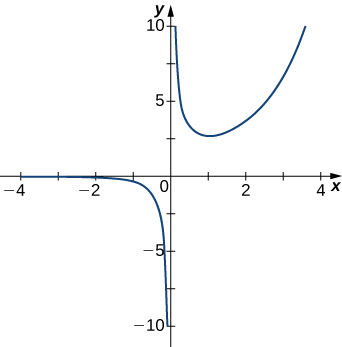
For the following exercises, examine the graphs. Identify where the vertical asymptotes are located.
次の各グラフを調べ、垂直漸近線の位置を求めよ。
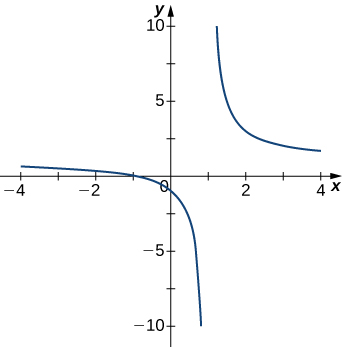
Exercise 252問題 252
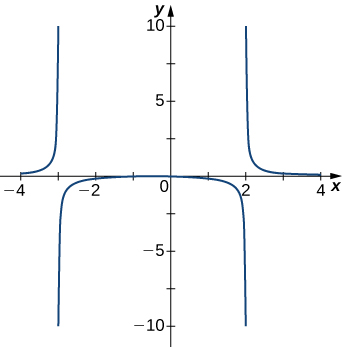
OpenStax, Rice University; Calculus Volume 1. · CC BY-NC-SA 4.0
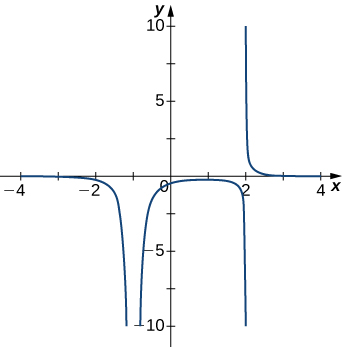
Exercise 254問題 254
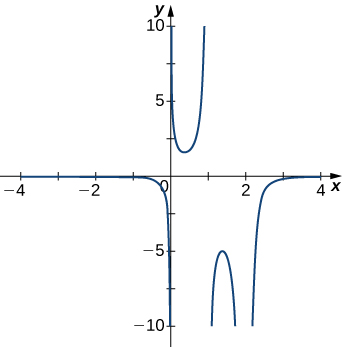
OpenStax, Rice University; Calculus Volume 1. · CC BY-NC-SA 4.0
Exercises 256–260練習問題 256–260
For the following functions determine whether there is an asymptote at Justify your answer without graphing on a calculator.
次の関数について、が垂直漸近線かどうかを調べよ。電卓でグラフを描かずに、理由を説明せよ。
Exercise 256問題 256
Exercise 257問題 257
Solution解き方
Yes, there is a vertical asymptote
はい。垂直漸近線がある。
Exercise 258問題 258
Exercise 259問題 259
Solution解き方
Yes, there is vertical asymptote
はい。垂直漸近線がある。
Exercise 260問題 260
Exercises 261–270練習問題 261–270
For the following exercises, evaluate the limit.
次の各極限を求めよ。
Exercise 261問題 261
Solution解き方
Exercise 262問題 262
Exercise 263問題 263
Solution解き方
Exercise 264問題 264
Exercise 265問題 265
Solution解き方
Exercise 266問題 266
Exercise 267問題 267
Solution解き方
Exercise 268問題 268
Exercise 269問題 269
Solution解き方
Exercise 270問題 270
Exercises 271–284練習問題 271–284
For the following exercises, find the horizontal and vertical asymptotes.
次の各関数の水平漸近線と垂直漸近線を求めよ。
Exercise 271問題 271
Solution解き方
Horizontal: none, vertical:
水平漸近線:なし。垂直漸近線:。
Exercise 272問題 272
Exercise 273問題 273
Solution解き方
Horizontal: none, vertical:
水平漸近線:なし。垂直漸近線:。
Exercise 274問題 274
Exercise 275問題 275
Solution解き方
Horizontal: none, vertical: none
水平漸近線:なし。垂直漸近線:なし。
Exercise 276問題 276
Exercise 277問題 277
Solution解き方
Horizontal: vertical:
水平漸近線:。垂直漸近線:。
Exercise 278問題 278
Exercise 279問題 279
Solution解き方
Horizontal: vertical: and
水平漸近線:。垂直漸近線:と。
Exercise 280問題 280
Exercise 281問題 281
Solution解き方
Horizontal: vertical:
水平漸近線:。垂直漸近線:。
Exercise 282問題 282
Exercise 283問題 283
Solution解き方
Horizontal: none, vertical: none
水平漸近線:なし。垂直漸近線:なし。
Exercise 284問題 284
Exercises 285–288練習問題 285–288
For the following exercises, construct a function that has the given asymptotes.
指定された漸近線をもつ関数を一つ作れ。
Exercise 285問題 285
and
および
Solution解き方
Answers will vary, for example:
答えは一通りではない。例えば、。
Exercise 286問題 286
and
および
Exercise 287問題 287
Solution解き方
Answers will vary, for example:
答えは一通りではない。例えば、。
Exercise 288問題 288
Exercises 289–293練習問題 289–293
For the following exercises, graph the function on a graphing calculator on the window and estimate the horizontal asymptote or limit. Then, calculate the actual horizontal asymptote or limit.
グラフ電卓を使い、横軸の表示範囲をとして次の各関数を描け。水平漸近線または極限を推定し、その後、計算によって正確に求めよ。
Exercise 289問題 289
[T]
[T]
Solution解き方
Exercise 290問題 290
[T]
[T]
Exercise 291問題 291
[T]
[T]
Solution解き方
Exercise 292問題 292
[T]
[T]
Exercise 293問題 293
[T]
[T]
Solution解き方
Exercises 294–310練習問題 294–310
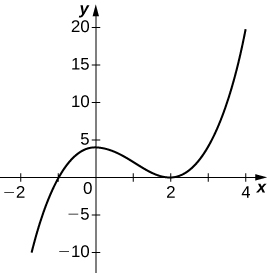
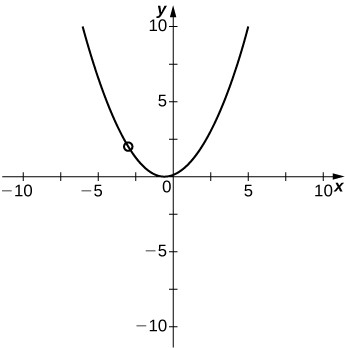
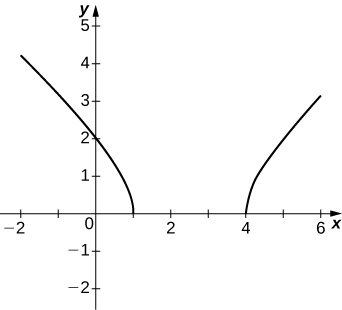
For the following exercises, draw a graph of the functions without using a calculator. Be sure to notice all important features of the graph: local maxima and minima, inflection points, and asymptotic behavior.
英語のヒント
電卓を使わずに、次の各関数のグラフを描け。極大・極小、変曲点、漸近的な振る舞いなど、グラフの重要な特徴をすべて確認すること。
Exercise 294問題 294
Exercise 296問題 296
Exercise 298問題 298
Exercise 300問題 300
Exercise 301問題 301
on
の範囲でを描く。
Solution解き方
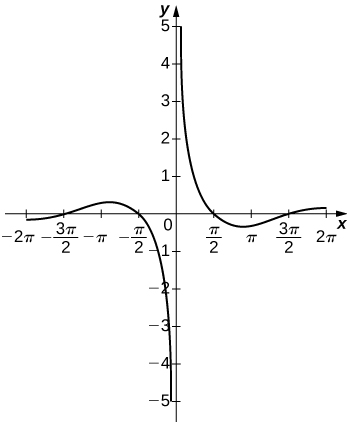
OpenStax, Rice University; Calculus Volume 1. · CC BY-NC-SA 4.0
Exercise 302問題 302
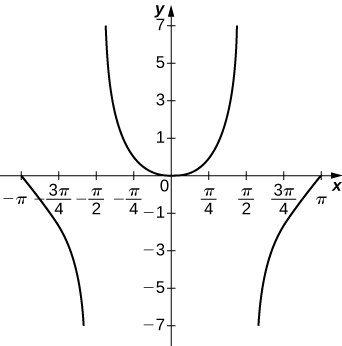
Exercise 304問題 304
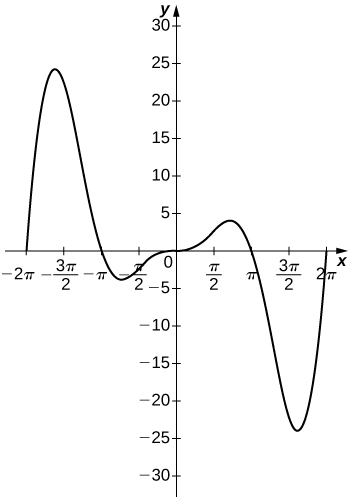
Exercise 306問題 306
For to have an asymptote at then the polynomials and must have what relation?
が水平漸近線をもつためには、多項式との間にどのような関係が必要か。
Exercise 307問題 307
For to have an asymptote at then the polynomials and must have what relation?
が垂直漸近線をもつためには、多項式との間にどのような関係が必要か。
Solution解き方
Exercise 308問題 308
If has asymptotes at and then has what asymptotes?
が漸近線とをもつとき、の漸近線について何がいえるか。この条件だけでは漸近線を確定できない点に注意する。例えば、導関数が3へ近づいても、f(x)−3xが有限値へ近づくとは限らない。また、導関数が発散する点で、元の関数は有限値にとどまることもある。
Exercise 309問題 309
Both and have asymptotes at and What is the most obvious difference between these two functions?
とは、どちらもとを漸近線にもつ。この二つの関数の最も分かりやすい違いは何か。
Solution解き方
Exercise 310問題 310
True or false: Every ratio of polynomials has vertical asymptotes.
正しいか誤りか。「多項式の比で表される関数には、必ず垂直漸近線がある。」
end behavior
無限遠での振る舞い
the behavior of a function as and
とのときの関数の様子。
horizontal asymptote
水平漸近線
if or then is a horizontal asymptote of
またはなら、直線をの水平漸近線という。
infinite limit at infinity
無限遠で無限大へ発散する極限
a function that becomes arbitrarily large as x becomes large
xを十分大きくすると、関数値がいくらでも大きくなること。負の方向や負の無限大への発散も、向きを変えて同様に定義する。
limit at infinity
無限遠での極限
the limiting value, if it exists, of a function as or
またはのときに関数が近づく極限値。存在しない場合もある。
oblique asymptote
斜漸近線
the line if approaches it as or
またはのとき、関数と直線の値の差が0へ近づくなら、その直線を斜漸近線という。ただしm≠0とする。