第4章微分の応用
Infinite Limits at Infinity無限遠で無限大へ発散する場合
Sometimes the values of a function become arbitrarily large as (or as In this case, we write (or On the other hand, if the values of are negative but become arbitrarily large in magnitude as (or as we write (or
のとき、関数の値がどこまでも大きくなることがある。このとき、と書く。負の方向のでも同様に、と書く。一方、のとき、の値が負のまま、その絶対値がどこまでも大きくなるなら、と書く。の場合も同様に、と書く。
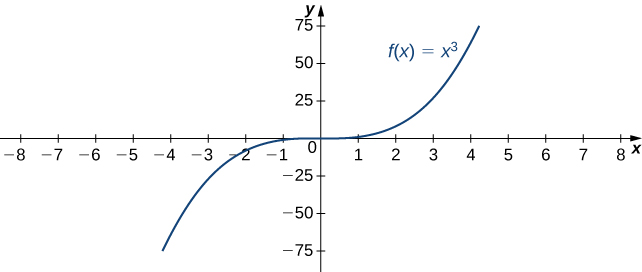
For example, consider the function As seen in Table 4.3 and Figure 4.47, as the values become arbitrarily large. Therefore, On the other hand, as the values of are negative but become arbitrarily large in magnitude. Consequently,
OpenStax, Rice University; Calculus Volume 1. · CC BY-NC-SA 4.0
Figure 4.47図 4.47
For this function, the functional values approach infinity as
この関数は、のとき、その絶対値がどこまでも大きくなる。右の遠方では正の無限大、左の遠方では負の無限大へ発散する。
Formal Definitions厳密な定義
Earlier, we used the terms arbitrarily close, arbitrarily large, and sufficiently large to define limits at infinity informally. Although these terms provide accurate descriptions of limits at infinity, they are not precise mathematically. Here are more formal definitions of limits at infinity. We then look at how to use these definitions to prove results involving limits at infinity.
英語のヒント
これまでは、「望むだけ近く」「いくらでも大きく」「十分大きく」という表現で、無限遠での極限を直感的に説明した。これらは様子を正しく伝えるものの、数学的な定義としては数値の条件を明確にする必要がある。そこで、無限遠での極限を厳密に定義する。その後、この定義を使って極限の結果を証明する方法を学ぼう。
OpenStax, Rice University; Calculus Volume 1. · CC BY-NC-SA 4.0
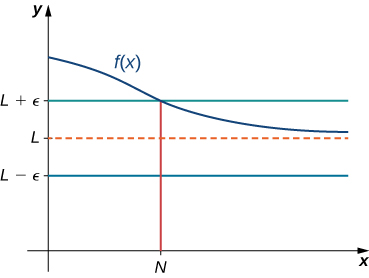
Figure 4.48図 4.48
For a function with a limit at infinity, for all
正の無限遠で極限Lをもつ関数では、Nを十分大きく選ぶと、すべてのについてが成り立つ。
Earlier in this section, we used graphical evidence in Figure 4.40 and numerical evidence in Table 4.2 to conclude that Here we use the formal definition of limit at infinity to prove this result rigorously.
Example 4.22例題 4.22
A Finite Limit at Infinity Example無限遠での有限な極限を証明する
Use the formal definition of limit at infinity to prove that
無限遠での極限の厳密な定義を用いて、を証明せよ。
Solution解き方
Let Let Therefore, for all we have
任意のをとり、とおく。すると、すべてのについて、
We now turn our attention to a more precise definition for an infinite limit at infinity.
次に、無限遠で無限大へ発散する場合を、より厳密に定義しよう。
OpenStax, Rice University; Calculus Volume 1. · CC BY-NC-SA 4.0
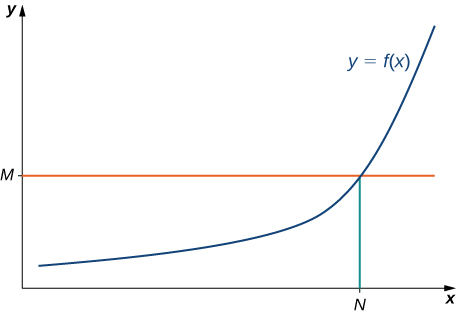
Figure 4.49図 4.49
For a function with an infinite limit at infinity, for all
正の無限遠で正の無限大へ発散する関数では、任意に指定したMに対してNを十分大きく選ぶと、すべてのについてが成り立つ。
Earlier, we used graphical evidence (Figure 4.47) and numerical evidence (Table 4.3) to conclude that Here we use the formal definition of infinite limit at infinity to prove that result.
Example 4.23例題 4.23
An Infinite Limit at Infinity無限遠で無限大へ発散することの証明
Use the formal definition of infinite limit at infinity to prove that
無限遠で無限大へ発散することの厳密な定義を用いて、を証明せよ。
Solution解き方
Let Let Then, for all we have
任意のをとり、とおく。すると、すべてのについて、
Therefore,
したがって、。
End Behavior無限遠での振る舞い
The behavior of a function as is called the function’s end behavior. At each of the function’s ends, the function could exhibit one of the following types of behavior:
英語のヒント
のときの関数の様子を、その関数の「無限遠での振る舞い」という。正と負、それぞれの方向で、次のいずれかの振る舞いが考えられる。
- The function approaches a horizontal asymptote関数が水平漸近線へ近づく。
- The function or関数がまたはとなる。
- The function does not approach a finite limit, nor does it approach or In this case, the function may have some oscillatory behavior.
英語のヒント
関数が有限の極限値へ近づくことも、やへ発散することもない。この場合、関数は振動することがある。
Let’s consider several classes of functions here and look at the different types of end behaviors for these functions.
ここでは関数をいくつかの種類に分け、それぞれの無限遠での振る舞いを調べよう。