第4章微分の応用
Concavity and Points of Inflectionグラフの凹凸と変曲点
We now know how to determine where a function is increasing or decreasing. However, there is another issue to consider regarding the shape of the graph of a function. If the graph curves, does it curve upward or curve downward? This notion is called the concavity of the function.
英語のヒント
関数がどこで増加し、どこで減少するかを調べる方法は分かった。しかし、グラフの形にはもう一つの観点がある。曲線が曲がるとき、上向きに開くように曲がるのか、それとも下向きに開くように曲がるのか。この性質を、関数の凹凸(concavity)という。
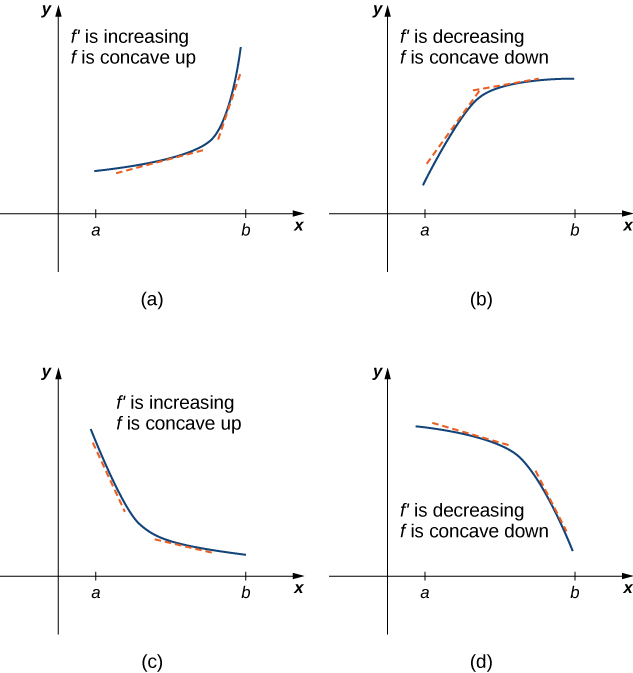
Figure 4.34(a) shows a function with a graph that curves upward. As increases, the slope of the tangent line increases. Thus, since the derivative increases as increases, is an increasing function. We say this function is concave up. Figure 4.34(b) shows a function that curves downward. As increases, the slope of the tangent line decreases. Since the derivative decreases as increases, is a decreasing function. We say this function is concave down.
OpenStax, Rice University; Calculus Volume 1. · CC BY-NC-SA 4.0
Figure 4.34図 4.34
(a), (c) Since is increasing over the interval we say is concave up over (b), (d) Since is decreasing over the interval we say is concave down over
(a)、(c):が区間で増加するので、は上で下に凸である。(b)、(d):が区間で減少するので、は上で上に凸である。
In general, without having the graph of a function how can we determine its concavity? By definition, a function is concave up if is increasing. From Corollary we know that if is a differentiable function, then is increasing if its derivative Therefore, a function that is twice differentiable is concave up when Similarly, a function is concave down if is decreasing. We know that a differentiable function is decreasing if its derivative Therefore, a twice-differentiable function is concave down when Applying this logic is known as the concavity test.
英語のヒント
関数のグラフがない場合、その凹凸をどう判定すればよいだろうか。定義より、が増加するとき、関数は下に凸である。系によれば、微分可能な関数は、その導関数がなら、が増加する。したがって、2回微分可能な関数は、のとき下に凸となる。同様に、が減少するとき、関数は上に凸である。微分可能な関数は、その導関数がなら減少する。よって、2回微分可能な関数は、のとき上に凸となる。これが第2次導関数による凹凸の判定である。
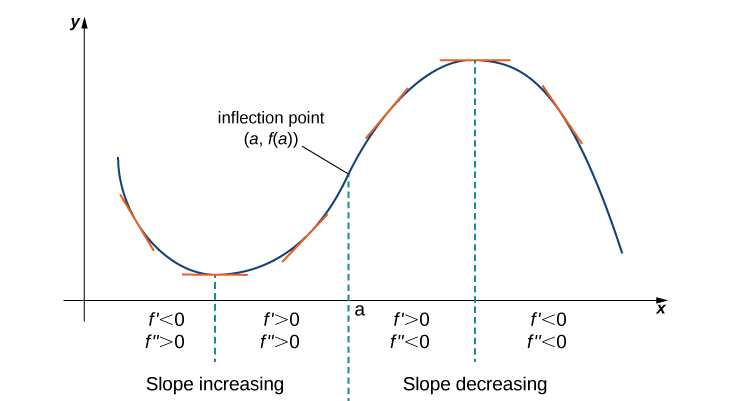
We conclude that we can determine the concavity of a function by looking at the second derivative of In addition, we observe that a function can switch concavity (Figure 4.35). However, a continuous function can switch concavity only at a point if or is undefined. Consequently, to determine the intervals where a function is concave up and concave down, we look for those values of where or is undefined. When we have determined these points, we divide the domain of into smaller intervals and determine the sign of over each of these smaller intervals. If changes sign as we pass through a point then changes concavity. It is important to remember that a function may not change concavity at a point even if or is undefined. If, however, does change concavity at a point and is continuous at we say the point is an inflection point of
英語のヒント
関数の凹凸は、の第2次導関数を調べて判定できる。また、の凹凸は途中で切り替わることがある(図4.35)。連続関数の凹凸が切り替わる点では、となるか、が定義されない。したがって、関数が下に凸、上に凸となる区間を求めるには、となるかが定義されないの値を探す。その点での定義域を小区間に分け、各区間での符号を調べる。点を通過するときにの符号が変われば、の凹凸も変わる。ただし、となるかが定義されない点でも、関数の凹凸が変わるとは限らない。が点で実際に凹凸を変え、かつがで連続なら、点をの変曲点と呼ぶ。
OpenStax, Rice University; Calculus Volume 1. · CC BY-NC-SA 4.0
Figure 4.35図 4.35
Since for the function is concave up over the interval Since for the function is concave down over the interval The point is an inflection point of
でなので、関数は区間上で下に凸である。でなので、関数は区間上で上に凸である。点はの変曲点である。
Example 4.19例題 4.19
Testing for Concavity凹凸を調べる
For the function determine all intervals where is concave up and all intervals where is concave down. List all inflection points for Use a graphing utility to confirm your results.
関数について、が下に凸となる区間と、が上に凸となる区間をすべて求めよ。の変曲点もすべて挙げ、グラフ作成ツールで結果を確認せよ。
Solution解き方
To determine concavity, we need to find the second derivative The first derivative is so the second derivative is If the function changes concavity, it occurs either when or is undefined. Since is defined for all real numbers we need only find where Solving the equation we see that is the only place where could change concavity. We now test points over the intervals and to determine the concavity of The points and are test points for these intervals.
凹凸を調べるため、第2次導関数を求める。第1次導関数はなので、第2次導関数はである。凹凸が変わる可能性があるのは、となるかが定義されない位置である。はすべての実数で定義されるので、となる位置だけを調べればよい。を解くと、の凹凸が変わりうる位置はだけである。区間とから試験点を選び、の凹凸を判定する。試験点にはとを使う。
Interval 区間 |
Test Point 調べる点 |
Sign of at Test Point 調べる点でのの符号 |
Conclusion 結論 |
|---|---|---|---|
is concave down は上に凸 |
|||
is concave up. は下に凸である。 |
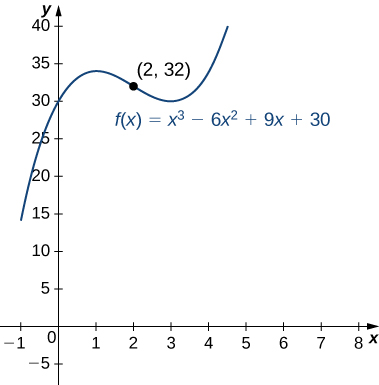
We conclude that is concave down over the interval and concave up over the interval Since changes concavity at the point is an inflection point. Figure 4.36 confirms the analytical results.
は区間で上に凸、区間で下に凸と分かる。の凹凸はで切り替わるので、点は変曲点である。図4.36も、この結果を裏づけている。
OpenStax, Rice University; Calculus Volume 1. · CC BY-NC-SA 4.0
Figure 4.36図 4.36
The given function has a point of inflection at where the graph changes concavity.
この関数はに変曲点をもち、そこでグラフの凹凸が切り替わる。
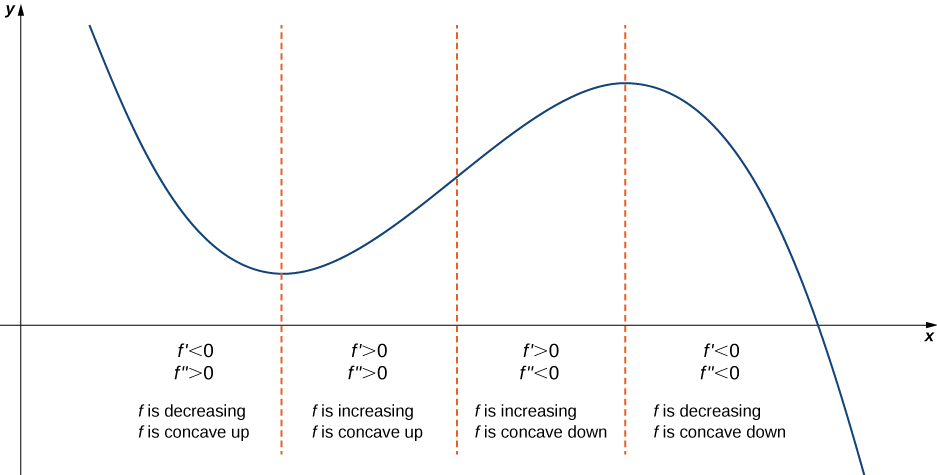
We now summarize, in Table 4.1, the information that the first and second derivatives of a function provide about the graph of and illustrate this information in Figure 4.37.
Sign of の符号 |
Sign of の符号 |
Is increasing or decreasing? の増減 |
Concavity 凹凸 |
|---|---|---|---|
Positive 正 |
Positive 正 |
Increasing 増加 |
Concave up 下に凸 |
Positive 正 |
Negative 負 |
Increasing 増加 |
Concave down 上に凸 |
Negative 負 |
Positive 正 |
Decreasing 減少 |
Concave up 下に凸 |
Negative 負 |
Negative 負 |
Decreasing 減少 |
Concave down 上に凸 |
OpenStax, Rice University; Calculus Volume 1. · CC BY-NC-SA 4.0
Figure 4.37図 4.37
Consider a twice-differentiable function over an open interval If for all the function is increasing over If for all the function is decreasing over If for all the function is concave up. If for all the function is concave down on
開区間上で2回微分可能な関数を考える。すべてのでなら、関数は上で増加する。すべてのでなら、上で減少する。すべてのでなら下に凸であり、すべてのでなら上で上に凸である。