第4章微分の応用
4.1 Related Rates4.1 関連する量の変化率
Learning Objectives学習目標
- Express changing quantities in terms of derivatives.変化する量を微分を使って表す。
- Find relationships among the derivatives in a given problem.与えられた問題で、導関数どうしの関係を見つける。
- Use the chain rule to find the rate of change of one quantity that depends on the rate of change of other quantities.ほかの量の変化率に依存する量の変化率を、合成関数の微分法で求める。
We have seen that for quantities that are changing over time, the rates at which these quantities change are given by derivatives. If two related quantities are changing over time, the rates at which the quantities change are related. For example, if a balloon is being filled with air, both the radius of the balloon and the volume of the balloon are increasing. In this section, we consider several problems in which two or more related quantities are changing and we study how to determine the relationship between the rates of change of these quantities.
英語のヒント
時間とともに変わる量について、その変化率は微分によって与えられることを学んだ。互いに関連する二つの量が時間とともに変わるなら、その変化率どうしも関連する。例えば、風船に空気を入れて膨らませると、風船の半径も体積も増加する。この節では、互いに関連する二つ以上の量が変化する問題をいくつか取り上げ、それぞれの変化率の間にどのような関係があるかを求める方法を学ぶ。
Setting up Related-Rates Problems関連する変化率の問題を式にする
In many real-world applications, related quantities are changing with respect to time. For example, if we consider the balloon example again, we can say that the rate of change in the volume, is related to the rate of change in the radius, In this case, we say that and are related rates because V is related to r. Here we study several examples of related quantities that are changing with respect to time and we look at how to calculate one rate of change given another rate of change.
英語のヒント
現実の応用では、関連する量が時間に応じて変わることが多い。先ほどの風船をもう一度考えると、体積の変化率は、半径の変化率と関連している。Vとrが関連しているため、とを、互いに関連する変化率という。ここでは、時間に応じて変わる関連した量の例をいくつか調べ、一方の変化率が与えられたときに、もう一方の変化率をどう計算するかを考える。
Example 4.1例題 4.1
Inflating a Balloon風船を膨らませる
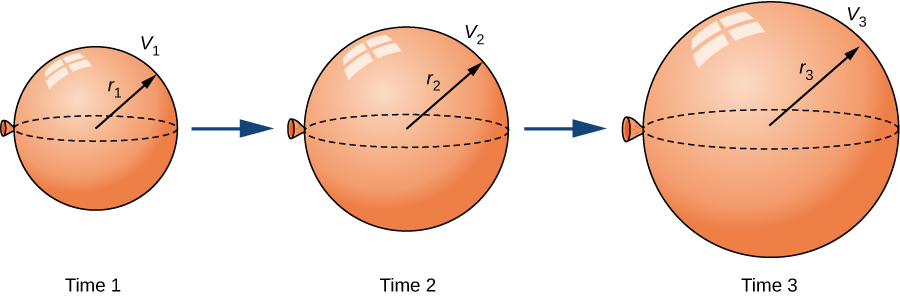
A spherical balloon is being filled with air at the constant rate of (Figure 4.2). How fast is the radius increasing when the radius is
英語のヒント
球形の風船に、一定の割合で空気を入れている(図4.2)。半径がのとき、半径はどのくらいの速さで増加しているか。
OpenStax, Rice University; Calculus Volume 1. · CC BY-NC-SA 4.0
Figure 4.2図 4.2
As the balloon is being filled with air, both the radius and the volume are increasing with respect to time.
風船に空気を入れると、半径と体積がともに時間とともに増加する。
Solution解き方
The volume of a sphere of radius centimeters is
半径センチメートルの球の体積は、次の式で与えられる。
Since the balloon is being filled with air, both the volume and the radius are functions of time. Therefore, seconds after beginning to fill the balloon with air, the volume of air in the balloon is
風船に空気を入れているので、体積も半径も時間の関数になる。したがって、空気を入れ始めてから秒後の、風船内の空気の体積は次のようになる。
Differentiating both sides of this equation with respect to time and applying the chain rule, we see that the rate of change in the volume is related to the rate of change in the radius by the equation
英語のヒント
この式の両辺を時間について微分し、合成関数の微分法を使うと、体積の変化率と半径の変化率が次の式で結ばれることが分かる。
The balloon is being filled with air at the constant rate of 2 cm3/sec, so Therefore,
風船には一定の割合2 cm3/secで空気を入れているので、である。したがって、
which implies
この式から、次を得る。
When the radius
半径がのとき、
Before looking at other examples, let’s outline the problem-solving strategy we will be using to solve related-rates problems.
英語のヒント
ほかの例を見る前に、関連する変化率の問題を解くための手順をまとめておこう。
Note that when solving a related-rates problem, it is crucial not to substitute known values too soon. For example, if the value for a changing quantity is substituted into an equation before both sides of the equation are differentiated, then that quantity will behave as a constant and its derivative will not appear in the new equation found in step 4. We examine this potential error in the following example.
英語のヒント
関連する変化率の問題では、分かっている値を早い段階で代入しすぎないことが非常に重要である。例えば、変化する量の値を、式の両辺を微分する前に代入すると、その量を定数として扱うことになり、手順4で得られる新しい式に、その量の導関数が現れなくなる。次の例で、この起こりやすい誤りを確かめる。
Examples of the Process手順を用いる例
Let’s now implement the strategy just described to solve several related-rates problems. The first example involves a plane flying overhead. The relationship we are studying is between the speed of the plane and the rate at which the distance between the plane and a person on the ground is changing.
英語のヒント
今述べた手順を使い、関連する変化率の問題をいくつか解いてみよう。最初の例では、上空を飛ぶ飛行機を考える。調べたいのは、飛行機の速さと、飛行機から地上の人までの距離の変化率との関係である。
Example 4.2例題 4.2
An Airplane Flying at a Constant Elevation一定の高度を飛ぶ飛行機
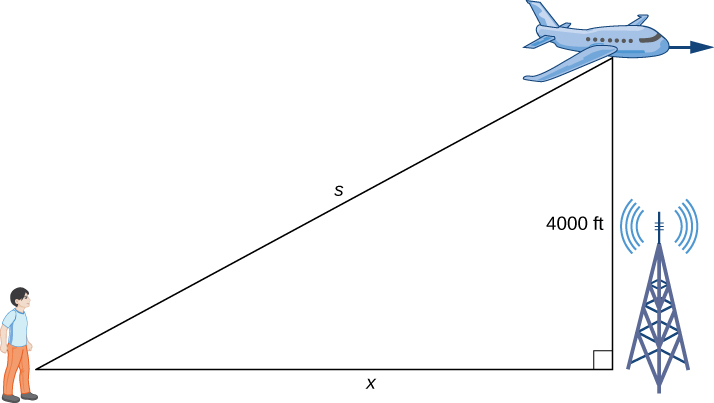
An airplane is flying overhead at a constant elevation of A man is viewing the plane from a position from the base of a radio tower. The airplane is flying horizontally away from the man. If the plane is flying at the rate of at what rate is the distance between the man and the plane increasing when the plane passes over the radio tower?
英語のヒント
飛行機が、一定の高度で上空を飛んでいる。ある男性が、電波塔の根元から離れた場所で飛行機を見ている。飛行機は男性から遠ざかる向きに水平に飛んでいる。飛行機の速さがのとき、電波塔の真上を通過する瞬間に、男性と飛行機の間の距離はどのくらいの速さで増加しているか。
Solution解き方
Step 1. Draw a picture, introducing variables to represent the different quantities involved.
手順1.関係する各量を表す変数を導入し、図を描く。
OpenStax, Rice University; Calculus Volume 1. · CC BY-NC-SA 4.0
Figure 4.3図 4.3
An airplane is flying at a constant height of 4000 ft. The distance between the person and the airplane and the person and the place on the ground directly below the airplane are changing. We denote those quantities with the variables and respectively.
英語のヒント
飛行機は一定の高度4000 ftを飛んでいる。人から飛行機までの距離と、人から飛行機の真下の地上の点までの距離が変化する。これらを、それぞれ変数、で表す。
As shown, denotes the distance between the man and the position on the ground directly below the airplane. The variable denotes the distance between the man and the plane. Note that both and are functions of time. We do not introduce a variable for the height of the plane because it remains at a constant elevation of Since an object’s height above the ground is measured as the shortest distance between the object and the ground, the line segment of length 4000 ft is perpendicular to the line segment of length feet, creating a right triangle.
英語のヒント
図のは、男性から飛行機の真下の地上の点までの距離を表す。変数は、男性から飛行機までの距離を表す。もも時間の関数であることに注意しよう。飛行機の高度はで一定なので、高度を表す変数は導入しない。地上から物体までの高さは、物体と地面との最短距離として測る。そのため、長さ4000 ftの線分と長さフィートの線分は垂直になり、直角三角形を作る。
Step 2. Since denotes the horizontal distance between the man and the point on the ground below the plane, represents the speed of the plane. We are told the speed of the plane is 600 ft/sec. Therefore, ft/sec. Since we are asked to find the rate of change in the distance between the man and the plane when the plane is directly above the radio tower, we need to find when
手順2.は男性から飛行機の真下の地上の点までの水平距離なので、は飛行機の速さを表す。問題文より、その速さは600 ft/secである。したがって、 ft/secとなる。求めるのは、飛行機が電波塔の真上にいるときの、男性と飛行機の間の距離の変化率である。つまり、のときのを求めればよい。
Step 3. From the figure, we can use the Pythagorean theorem to write an equation relating and
英語のヒント
手順3.図に三平方の定理を使うと、との関係を次の式で表せる。
Step 4. Differentiating this equation with respect to time and using the fact that the derivative of a constant is zero, we arrive at the equation
手順4.この式を時間について微分する。定数の導関数は0なので、次の式が得られる。
Step 5. Find the rate at which the distance between the man and the plane is increasing when the plane is directly over the radio tower. That is, find when Since the speed of the plane is we know that We are not given an explicit value for however, since we are trying to find when we can use the Pythagorean theorem to determine the distance when and the height is Solving the equation
手順5.飛行機が電波塔の真上にいるときに、男性と飛行機の間の距離がどのくらいの速さで増加しているかを求める。すなわち、のときのを求める。飛行機の速さはなので、と分かる。の値は直接には与えられていない。しかし、求めたいのはのときのである。そこで、、高度という条件で三平方の定理を用い、距離を求められる。次の方程式を、
for we have at the time of interest. Using these values, we conclude that is a solution of the equation
英語のヒント
について解くと、調べている瞬間にはと分かる。これらの値を使えば、は次の方程式を満たす。
Therefore,
したがって、
Note: When solving related-rates problems, it is important not to substitute values for the variables too soon. For example, in step 3, we related the variable quantities and by the equation
注意:関連する変化率の問題では、変数に値を早く代入しすぎないことが重要である。例えば手順3では、変化する量との関係を、次の式で表した。
Since the plane remains at a constant height, it is not necessary to introduce a variable for the height, and we are allowed to use the constant 4000 to denote that quantity. However, the other two quantities are changing. If we mistakenly substituted into the equation before differentiating, our equation would have been
英語のヒント
飛行機の高度は一定なので、高度の変数を導入する必要はなく、その量を定数4000で表してよい。しかし、残りの二つの量は変化している。もし微分する前に、誤ってを代入してしまったとすると、式は次のようになっていただろう。
After differentiating, our equation would become
これを微分すると、式は次のようになってしまう。
As a result, we would incorrectly conclude that
その結果、と誤って結論してしまう。
We now return to the problem involving the rocket launch from the beginning of the chapter.
ここで、章の冒頭で取り上げたロケットの打ち上げの問題に戻ろう。
Example 4.3例題 4.3
Chapter Opener: A Rocket Launch章の導入問題:ロケットの打ち上げ
Image omitted because its reuse rights could not be verified.権利の確認ができないため画像を割愛。
Figure 4.4図 4.4
(credit: modification of work by Steve Jurvetson, Wikimedia Commons)
(出典:Steve Jurvetsonによる作品を改変、Wikimedia Commons)
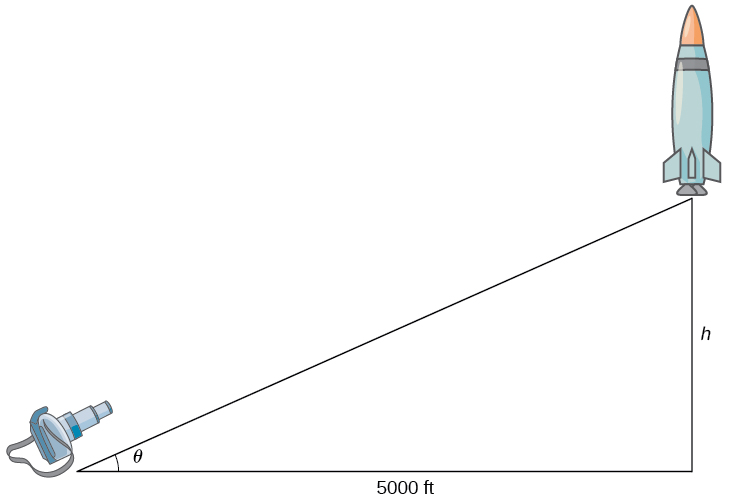
A rocket is launched so that it rises vertically. A camera is positioned from the launch pad. When the rocket is above the launch pad, its velocity is Find the necessary rate of change of the camera’s angle as a function of time so that it stays focused on the rocket.
英語のヒント
ロケットを鉛直上向きに打ち上げる。カメラは発射台から離れた位置に置いてある。ロケットが発射台の上方にいるとき、その速度はである。カメラがロケットを捉え続けるために必要な、カメラの角度の時間に対する変化率を求めよ。
Solution解き方
Step 1. Draw a picture introducing the variables.
手順1.変数を導入し、図を描く。
OpenStax, Rice University; Calculus Volume 1. · CC BY-NC-SA 4.0
Figure 4.5図 4.5
A camera is positioned 5000 ft from the launch pad of the rocket. The height of the rocket and the angle of the camera are changing with respect to time. We denote those quantities with the variables and respectively.
ロケットの発射台から5000 ft離れた場所にカメラを置く。ロケットの高さとカメラの角度が時間とともに変わる。それぞれを変数、で表す。
Let denote the height of the rocket above the launch pad and be the angle between the camera lens and the ground.
発射台から測ったロケットの高さを、カメラのレンズの向きと地面とのなす角をとする。
Step 2. We are trying to find the rate of change in the angle of the camera with respect to time when the rocket is 1000 ft off the ground. That is, we need to find when At that time, we know the velocity of the rocket is
手順2.求めたいのは、ロケットが地上1000 ftにあるときの、カメラの角度の時間に対する変化率である。つまり、のときのを求める。この瞬間のロケットの速度は、と分かっている。
Step 3. Now we need to find an equation relating the two quantities that are changing with respect to time: and How can we create such an equation? Using the fact that we have drawn a right triangle, it is natural to think about trigonometric functions. Recall that is the ratio of the length of the opposite side of the triangle to the length of the adjacent side. Thus, we have
英語のヒント
手順3.時間とともに変化する二つの量、との関係を表す式を見つける。この式は、どのように作ればよいだろうか。描いた図が直角三角形であることから、三角関数を考えるのが自然である。は対辺の長さと隣辺の長さの比であることを思い出そう。したがって、
This gives us the equation
これより、次の式が得られる。
Step 4. Differentiating this equation with respect to time we obtain
手順4.この式を時間について微分すると、次を得る。
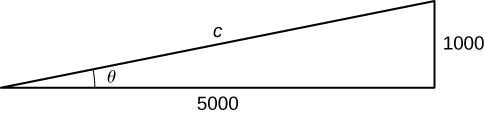
Step 5. We want to find when At this time, we know that We need to determine Recall that is the ratio of the length of the hypotenuse to the length of the adjacent side. We know the length of the adjacent side is To determine the length of the hypotenuse, we use the Pythagorean theorem, where the length of one leg is the length of the other leg is and the length of the hypotenuse is feet as shown in the following figure.
英語のヒント
手順5.のときのを求めたい。この瞬間にはと分かっているので、を求める必要がある。は斜辺の長さと隣辺の長さの比であり、隣辺の長さはと分かっている。斜辺の長さには三平方の定理を使う。次の図のように、直角を挟む二辺の長さをそれぞれ、とし、斜辺の長さをフィートとする。
OpenStax, Rice University; Calculus Volume 1. · CC BY-NC-SA 4.0
We see that
次の関係が成り立つ。
and we conclude that the hypotenuse is
したがって、斜辺の長さは次のようになる。
Therefore, when we have
よって、のとき、
Recall from step 4 that the equation relating to our known values is
手順4で得た、と既知の値を結ぶ式を思い出そう。
When we know that and Substituting these values into the previous equation, we arrive at the equation
のとき、、と分かっている。これらを前の式に代入すると、次の式が得られる。
Therefore,
したがって、。
In the next example, we consider water draining from a cone-shaped funnel. We compare the rate at which the level of water in the cone is decreasing with the rate at which the volume of water is decreasing.
英語のヒント
次の例では、円錐形の漏斗から水が流れ出す場合を考える。円錐内の水位が低下する割合と、水の体積が減少する割合とを比較する。
Example 4.4例題 4.4
Water Draining from a Funnel漏斗から流れ出す水
Water is draining from the bottom of a cone-shaped funnel at the rate of The height of the funnel is 2 ft and the radius at the top of the funnel is At what rate is the height of the water in the funnel changing when the height of the water is
円錐形の漏斗の底から、水がの割合で流れ出している。漏斗の高さは2 ft、上端の半径はである。水の深さがのとき、水面の高さはどのくらいの割合で変化しているか。
Solution解き方
Step 1: Draw a picture introducing the variables.
手順1.変数を導入し、図を描く。
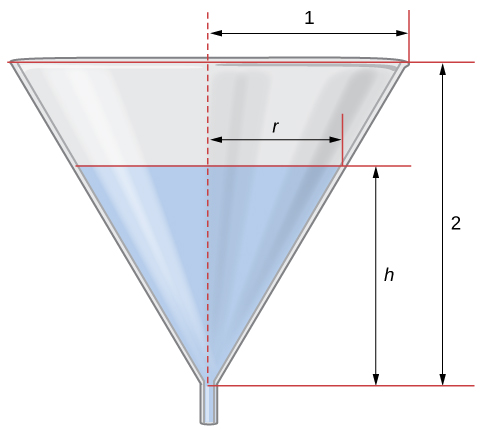
OpenStax, Rice University; Calculus Volume 1. · CC BY-NC-SA 4.0
Figure 4.6図 4.6
Water is draining from a funnel of height 2 ft and radius 1 ft. The height of the water and the radius of water are changing over time. We denote these quantities with the variables and respectively.
高さ2 ft、半径1 ftの漏斗から水が流れ出している。水の高さと水面の半径が時間とともに変わる。それぞれを変数、で表す。
Let denote the height of the water in the funnel, denote the radius of the water at its surface, and denote the volume of the water.
漏斗内の水の高さを、水面の半径を、水の体積をとする。
Step 2: We need to determine when We know that
手順2.のときのを求める。と分かっている。
Step 3: The volume of water in the cone is
手順3.円錐内の水の体積は、
From the figure, we see that we have similar triangles. Therefore, the ratio of the sides in the two triangles is the same. Therefore, or Using this fact, the equation for volume can be simplified to
英語のヒント
図には相似な三角形がある。したがって、二つの三角形で対応する辺の比は等しく、、すなわちとなる。これを使えば、体積の式は次のように簡単になる。
Step 4: Applying the chain rule while differentiating both sides of this equation with respect to time we obtain
手順4.合成関数の微分法を使い、この式の両辺を時間について微分すると、
Step 5: We want to find when Since water is leaving at the rate of we know that Therefore,
手順5.のときのを求めたい。水はの割合で流れ出しているので、である。したがって、
which implies
この式から、
It follows that
よって、次を得る。