第4章微分の応用
Locating Absolute Extrema最大値・最小値を求める
The extreme value theorem states that a continuous function over a closed, bounded interval has an absolute maximum and an absolute minimum. As shown in Figure 4.13, one or both of these absolute extrema could occur at an endpoint. If an absolute extremum does not occur at an endpoint, however, it must occur at an interior point, in which case the absolute extremum is a local extremum. Therefore, by Theorem 4.2, the point at which the local extremum occurs must be a critical point. We summarize this result in the following theorem.
英語のヒント
With this idea in mind, let’s examine a procedure for locating absolute extrema.
この考え方を踏まえて、最大値・最小値を求める手順を確認しよう。
Now let’s look at how to use this strategy to find the absolute maximum and absolute minimum values for continuous functions.
この手順を使って、連続関数の最大値と最小値を求める例を見よう。
Example 4.13例題 4.13
Locating Absolute Extrema最大値・最小値を求める
For each of the following functions, find the absolute maximum and absolute minimum over the specified interval and state where those values occur.
次の各関数について、指定された区間上の最大値・最小値を求め、それぞれどの位置で生じるかも答えよ。
- over区間における
- over区間における
Solution解き方
- Step 1. Evaluate at the endpoints and手順1:端点とでの値を計算する。
Step 2. Since is defined for all real numbers Therefore, there are no critical points where the derivative is undefined. It remains to check where Since at and is in the interval is a candidate for an absolute extremum of over We evaluate and find手順2:なので、はすべての実数で定義される。したがって、導関数が定義されないことによる臨界点はない。残るのはとなる位置である。でとなり、は区間に含まれるので、はの上での最大値・最小値の候補になる。を計算すると、
Step 3. We set up the following table to compare the values found in steps 1 and 2.手順3:手順1と2で求めた値を、次の表で比較する。Conclusion結論Absolute maximum最大値Absolute minimum最小値
From the table, we find that the absolute maximum of over the interval [1, 3] is and it occurs at The absolute minimum of over the interval [1, 3] is and it occurs at as shown in the following graph.表より、区間[1,3]上でのの最大値はで、において生じる。同じ区間上でのの最小値はで、において生じる。次のグラフにも示した。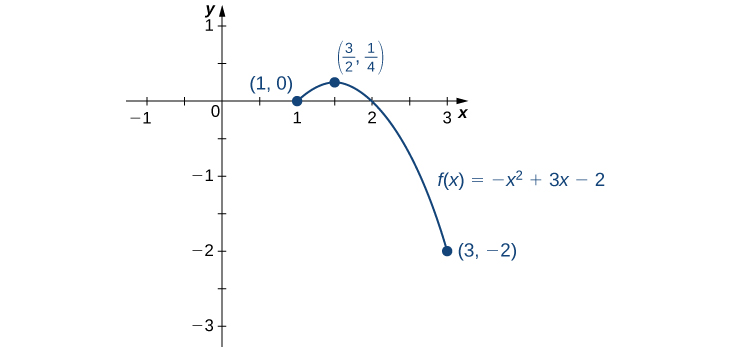
OpenStax, Rice University; Calculus Volume 1. · CC BY-NC-SA 4.0
Figure 4.19図 4.19This function has both an absolute maximum and an absolute minimum.この関数には最大値と最小値の両方がある。 - Step 1. Evaluate at the endpoints and手順1:端点とでの値を計算する。
Step 2. The derivative of is given by手順2:の導関数は、
for The derivative is zero when which implies The derivative is undefined at Therefore, the critical points of are The point is an endpoint, so we already evaluated in step 1. The point is not in the interval of interest, so we need only evaluate We find thatただし、上式はで成り立つ。導関数が0になるのはのとき、すなわちのときである。また、では導関数が定義されない。したがって、の臨界点はである。は端点でもあるため、は手順1ですでに計算した。は対象の区間に含まれないので、残りはだけを計算すればよい。その値は、
Step 3. We compare the values found in steps 1 and 2, in the following table.手順3:手順1と2で求めた値を、次の表で比較する。Conclusion結論Absolute maximum最大値Absolute minimum最小値
We conclude that the absolute maximum of over the interval [0, 2] is zero, and it occurs at The absolute minimum is −2, and it occurs at as shown in the following graph.区間[0,2]上でのの最大値は0で、において生じる。最小値は−2で、において生じる。次のグラフを参照。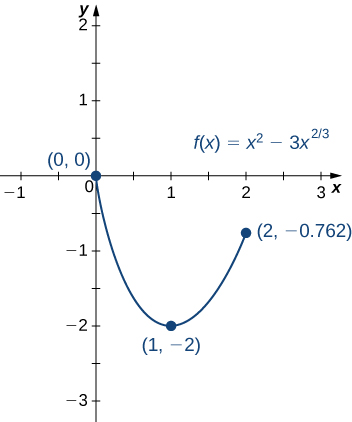
OpenStax, Rice University; Calculus Volume 1. · CC BY-NC-SA 4.0
Figure 4.20図 4.20This function has an absolute maximum at an endpoint of the interval.この関数は、区間の端点で最大値をとる。
At this point, we know how to locate absolute extrema for continuous functions over closed intervals. We have also defined local extrema and determined that if a function has a local extremum at a point then must be a critical point of However, being a critical point is not a sufficient condition for to have a local extremum at Later in this chapter, we show how to determine whether a function actually has a local extremum at a critical point. First, however, we need to introduce the Mean Value Theorem, which will help as we analyze the behavior of the graph of a function.
英語のヒント
ここまでで、閉区間上の連続関数について、最大値・最小値を求める方法を学んだ。また極大値・極小値を定義し、関数が点で極値をとるならば、はの臨界点でなければならないことを確認した。しかし、が臨界点であることだけでは、がで極値をとるための十分条件にはならない。臨界点で本当に極値をとるかどうかを判定する方法は、この章の後半で扱う。その前に、関数のグラフの振る舞いを解析する際に役立つ、平均値の定理を導入しよう。