第4章微分の応用
4.8 L’Hôpital’s Rule4.8 ロピタルの定理
Learning Objectives学習目標
- Recognize when to apply L’Hôpital’s rule.ロピタルの定理を使える場合を見分ける。
- Identify indeterminate forms produced by quotients, products, subtractions, and powers, and apply L’Hôpital’s rule in each case.商・積・差・べきから生じる不定形を見分け、それぞれにロピタルの定理を使う。
- Describe the relative growth rates of functions.関数どうしの増大の速さの違いを説明する。
In this section, we examine a powerful tool for evaluating limits. This tool, known as L’Hôpital’s rule, uses derivatives to calculate limits. With this rule, we will be able to evaluate many limits we have not yet been able to determine. Instead of relying on numerical evidence to conjecture that a limit exists, we will be able to show definitively that a limit exists and to determine its exact value.
英語のヒント
この節では、極限を求めるための強力な道具を学ぶ。ロピタルの定理と呼ばれるこの方法は、導関数を使って極限を計算する。これによって、これまで求められなかった多くの極限を求められるようになる。数値的な証拠に頼って極限の存在を推測するだけでなく、極限が存在することを確かに示し、その厳密な値を決定できる。
Applying L’Hôpital’s Ruleロピタルの定理の適用
L’Hôpital’s rule can be used to evaluate limits involving the quotient of two functions. Consider
英語のヒント
ロピタルの定理は、2つの関数の商を含む極限を求めるときに使える。次の極限を考えよう。
If then
なら、次が成り立つ。
However, what happens if and We call this one of the indeterminate forms, of type This is considered an indeterminate form because we cannot determine the exact behavior of as without further analysis. We have seen examples of this earlier in the text. For example, consider
英語のヒント
では、かつの場合はどうなるだろうか。これは型の不定形と呼ばれる。不定形というのは、さらに調べなければ、のときのの正確な振る舞いを決められないからである。すでに、このような例を見てきた。たとえば、次の極限を考えよう。
For the first of these examples, we can evaluate the limit by factoring the numerator and writing
最初の例は、分子を因数分解して次のように書けば、極限を求められる。
For we were able to show, using a geometric argument, that
については、幾何学的な議論によって次のことを示した。
Here we use a different technique for evaluating limits such as these. Not only does this technique provide an easier way to evaluate these limits, but also, and more important, it provides us with a way to evaluate many other limits that we could not calculate previously.
英語のヒント
ここでは、このような極限を求める別の方法を使う。この方法は、これらの極限をより簡単に求められるだけでなく、さらに重要なことに、これまで計算できなかった多くの極限も求められるようにする。
The idea behind L’Hôpital’s rule can be explained using local linear approximations. Consider two differentiable functions and such that and such that For near we can write
英語のヒント
ロピタルの定理の発想は、局所的な線形近似によって説明できる。を満たし、である2つの微分可能な関数とを考える。に近いについて、次のように書ける。
and
また、
Therefore,
したがって、
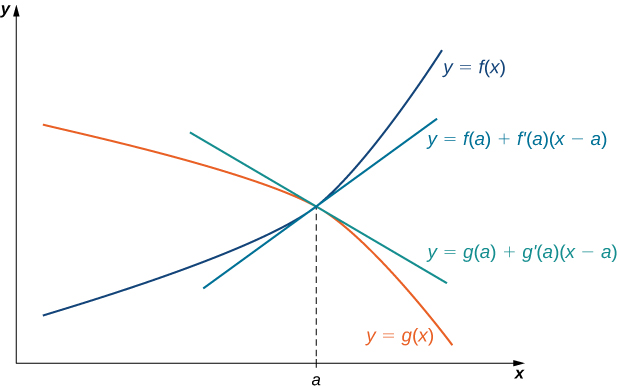
OpenStax, Rice University; Calculus Volume 1. · CC BY-NC-SA 4.0
Figure 4.71図 4.71
If then the ratio is approximately equal to the ratio of their linear approximations near
なら、の近くで、比はそれぞれの線形近似の比にほぼ等しくなる。
Since is differentiable at then is continuous at and therefore Similarly, If we also assume that and are continuous at then and Using these ideas, we conclude that
はで微分可能なので、はで連続であり、となる。同様に、である。さらに、とがで連続であると仮定すると、およびが成り立つ。これらを使うと、次が得られる。
Note that the assumption that and are continuous at and can be loosened. We state L’Hôpital’s rule formally for the indeterminate form Also note that the notation does not mean we are actually dividing zero by zero. Rather, we are using the notation to represent a quotient of limits, each of which is zero.
英語のヒント
とがで連続であること、およびという仮定は、より弱くできる。型の不定形について、ロピタルの定理を正確に述べよう。なお、という記号は、実際に0を0で割っているという意味ではない。は、分子と分母の極限がともに0になる商の形を表す記法である。
Proof証明
We provide a proof of this theorem in the special case when and are all continuous over an open interval containing In that case, since and and are continuous at it follows that Therefore,
ここでは、およびがすべてを含む開区間で連続である特別な場合を証明する。この証明では、さらに g′(a)≠0 を仮定する。この場合、であり、とがで連続なので、となる。したがって、
Note that L’Hôpital’s rule states we can calculate the limit of a quotient by considering the limit of the quotient of the derivatives It is important to realize that we are not calculating the derivative of the quotient
ロピタルの定理は、商の極限を、導関数どうしの商の極限から計算できるというものである。商そのものを微分しているのではないことに注意しよう。
□
□
Example 4.38例題 4.38
Applying L’Hôpital’s Rule (0/0 Case)ロピタルの定理を使う(0/0 型)
Evaluate each of the following limits by applying L’Hôpital’s rule.
ロピタルの定理を使って、次の各極限を求めよ。
Solution解き方
- Since the numerator and the denominator we can apply L’Hôpital’s rule to evaluate this limit. We have分子は、分母はとなるので、ロピタルの定理を使える。次のようになる。
- As the numerator and the denominator Therefore, we can apply L’Hôpital’s rule. We obtainのとき、分子は、分母はとなる。したがって、ロピタルの定理を使うと、次を得る。
- As the numerator and the denominator Therefore, we can apply L’Hôpital’s rule. We obtainのとき、分子は、分母はとなる。したがって、ロピタルの定理を使うと、次を得る。
- As both the numerator and denominator approach zero. Therefore, we can apply L’Hôpital’s rule. We obtainのとき、分子も分母も0に近づく。したがって、ロピタルの定理を使うと、次を得る。
Since the numerator and denominator of this new quotient both approach zero as we apply L’Hôpital’s rule again. In doing so, we see that新しい商も、のとき分子と分母がともに0に近づく。そこで、もう一度ロピタルの定理を使うと、次のようになる。
Therefore, we conclude thatしたがって、次の結論を得る。
We can also use L’Hôpital’s rule to evaluate limits of quotients in which and Limits of this form are classified as indeterminate forms of type Again, note that we are not actually dividing by Since is not a real number, that is impossible; rather, is used to represent a quotient of limits, each of which is or
ロピタルの定理は、かつとなる商の極限にも使える。この形の極限は、型の不定形に分類される。ここでも、をで実際に割っているわけではない。は実数ではないので、そのような割り算はできない。という記法は、分子と分母の極限がそれぞれまたはになる商の形を表している。
Example 4.39例題 4.39
Applying L’Hôpital’s Rule Case)ロピタルの定理を使う 型)
Evaluate each of the following limits by applying L’Hôpital’s rule.
ロピタルの定理を使って、次の各極限を求めよ。
Solution解き方
- Since and are first-degree polynomials with positive leading coefficients, and Therefore, we apply L’Hôpital’s rule and obtainとは、どちらも最高次係数が正の1次多項式なので、およびとなる。したがって、ロピタルの定理を使うと、次を得る。
Note that this limit can also be calculated without invoking L’Hôpital’s rule. Earlier in the chapter we showed how to evaluate such a limit by dividing the numerator and denominator by the highest power of in the denominator. In doing so, we saw that英語のヒント
この極限は、ロピタルの定理を使わずにも求められる。この章の前半では、分母に現れるの最高次のべきで分子と分母を割る方法を示した。それによって、次を得た。
L’Hôpital’s rule provides us with an alternative means of evaluating this type of limit.ロピタルの定理は、この種の極限を求める別の手段となる。 - Here, and Therefore, we can apply L’Hôpital’s rule and obtainここでは、およびである。したがって、ロピタルの定理を使うと、次を得る。
Now as Therefore, the first term in the denominator is approaching zero and the second term is getting really large. In such a case, anything can happen with the product. Therefore, we cannot make any conclusion yet. To evaluate the limit, we use the definition of to writeのとき、となる。したがって、分母を構成する最初の因子は0に近づき、もう一方の因子は際限なく大きくなる。このような積がどうなるかは、これだけでは判断できない。極限を求めるため、の定義を使って次のように書く。
Now and so we apply L’Hôpital’s rule again. We find今度はかつなので、もう一度ロピタルの定理を使える。すると、次を得る。
We conclude thatしたがって、次の結論を得る。
As mentioned, L’Hôpital’s rule is an extremely useful tool for evaluating limits. It is important to remember, however, that to apply L’Hôpital’s rule to a quotient it is essential that the limit of be of the form or Consider the following example.
英語のヒント
ここまで見たように、ロピタルの定理は極限を求める強力な道具である。ただし、商に適用するには、の極限が型または型であることが不可欠である。次の例を考えよう。
Example 4.40例題 4.40
When L’Hôpital’s Rule Does Not Applyロピタルの定理を使えない場合
Consider Show that the limit cannot be evaluated by applying L’Hôpital’s rule.
を考える。この極限を求めるのにロピタルの定理を使えないことを示せ。
Solution解き方
Because the limits of the numerator and denominator are not both zero and are not both infinite, we cannot apply L’Hôpital’s rule. If we try to do so, we get
分子と分母の極限は、ともに0になるわけでも、ともに無限大になるわけでもない。したがって、ロピタルの定理は使えない。無理に使おうとすると、次のようになる。
and
また、
At which point we would conclude erroneously that
英語のヒント
ここから次のように結論すると、それは誤りである。
However, since and we actually have
実際には、かつなので、次のようになる。
We can conclude that
したがって、次がわかる。