第3章軌道と重力Orbits and Gravity
3.6 Gravity with More Than Two Bodies3.6 3個以上の天体の間に働く重力
Learning Objectives学習の目標
By the end of this section, you will be able to:
この節を終えると、次のことができるようになる。
Explain how the gravitational interactions of many bodies can causes perturbations in their motions
多数の天体の重力相互作用が、その運動にどのように摂動を生じさせるかを説明する
Explain how the planet Neptune was discovered
惑星の海王星がどのように発見されたかを説明する
Until now, we have considered the Sun and a planet (or a planet and one of its moons) as nothing more than a pair of bodies revolving around each other. In fact, all the planets exert gravitational forces upon one another as well. These interplanetary attractions cause slight variations from the orbits than would be expected if the gravitational forces between planets were neglected. The motion of a body that is under the gravitational influence of two or more other bodies is very complicated and can be calculated properly only with large computers. Fortunately, astronomers have such computers at their disposal in universities and government research institutes.
英語のヒント
ここまでは、太陽と惑星、あるいは惑星とその衛星1個を、互いの周りを回る一対の天体としてのみ考えてきた。実際には、すべての惑星は互いにも重力を及ぼし合っている。惑星間のこうした引力によって、惑星同士の重力を無視した場合に予想される軌道から、わずかなずれが生じる。ほかの2個以上の天体から重力の影響を受ける天体の運動は、非常に複雑であり、大型コンピューターを用いなければ適切に計算できない。幸い、天文学者は大学や政府の研究機関で、そのようなコンピューターを利用できる。
The Interactions of Many Bodies多数の天体の相互作用
As an example, suppose you have a cluster of a thousand stars all orbiting a common center (such clusters are quite common, as we shall see in Star Clusters). If we know the exact position of each star at any given instant, we can calculate the combined gravitational force of the entire group on any one member of the cluster. Knowing the force on the star in question, we can therefore find how it will accelerate. If we know how it was moving to begin with, we can then calculate how it will move in the next instant of time, thus tracking its motion.
英語のヒント
例として、1,000個の恒星がすべて共通の中心を回っている星団を考えよう。このような星団は、「星団」の章で見るように、ごく普通に存在する。ある瞬間における各恒星の正確な位置がわかれば、星団のどれか1個の恒星に対して、星団全体が及ぼす重力の合力を計算できる。したがって、注目している恒星に働く力がわかれば、その恒星がどのように加速するかが求められる。もともとどのように動いていたかがわかっていれば、次の瞬間にどう動くかを計算し、こうしてその運動を追跡できる。
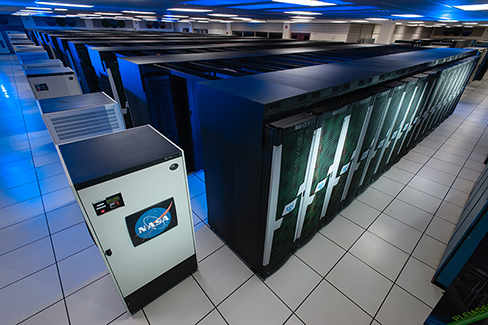
However, the problem is complicated by the fact that the other stars are also moving and thus changing the effect they will have on our star. Therefore, we must simultaneously calculate the acceleration of each star produced by the combination of the gravitational attractions of all the others in order to track the motions of all of them, and hence of any one. Such complex calculations have been carried out with modern computers to track the evolution of hypothetical clusters of stars with up to a million members (Figure 3.13).
英語のヒント
しかし、ほかの恒星も動いているために、注目する恒星に及ぼす影響も変わっていく。この事実が問題を複雑にする。すべての恒星の運動を追い、ひいてはそのうちのどれか1個の運動を追うためにも、各恒星について、ほかのすべての恒星からの引力を合わせて生じる加速度を同時に計算しなければならない。現代のコンピューターを使って、このような複雑な計算が行われており、最大100万個の恒星を含む仮想的な星団の進化を追跡している(図3.13)。
Modern Computing Power.現代の計算能力。
credit: NASA Ames Research Center/Pleiades · NASA media use guidelines
Figure 3.13 These supercomputers at NASA’s Ames Research Center are capable of tracking the motions of more than a million objects under their mutual gravitation. (credit: NASA Ames Research Center/Pleiades)
図3.13 NASAエイムズ研究センターにあるこれらのスーパーコンピューターは、互いに重力を及ぼし合う100万個以上の天体の運動を追跡できる。(提供:NASA Ames Research Center/Pleiades)
Within the solar system, the problem of computing the orbits of planets and spacecraft is somewhat simpler. We have seen that Kepler’s laws, which do not take into account the gravitational effects of the other planets on an orbit, really work quite well. This is because these additional influences are very small in comparison with the dominant gravitational attraction of the Sun. Under such circumstances, it is possible to treat the effects of other bodies as small perturbations (or disturbances). During the eighteenth and nineteenth centuries, mathematicians developed many elegant techniques for calculating perturbations, permitting them to predict very precisely the positions of the planets. Such calculations eventually led to the prediction and discovery of a new planet in 1846.
英語のヒント
太陽系の中で惑星や宇宙機の軌道を計算する問題は、これよりいくらか単純である。これまで見てきたように、ある軌道に対するほかの惑星の重力の影響を考慮していないケプラーの法則も、実際にはかなりよく成り立つ。これは、太陽の支配的な重力と比べて、こうした付加的な影響がきわめて小さいためである。そのような状況では、ほかの天体の影響を小さな摂動、つまり乱れとして扱うことができる。18世紀から19世紀にかけて、数学者たちは摂動を計算するための巧妙な方法を数多く開発し、惑星の位置をきわめて正確に予測できるようにした。こうした計算が、やがて1846年の新しい惑星の予測と発見につながった。
The Discovery of Neptune海王星の発見
The discovery of the eighth planet, Neptune, was one of the high points in the development of gravitational theory. In 1781, William Herschel, a musician and amateur astronomer, accidentally discovered the seventh planet, Uranus. It happens that Uranus had been observed a century before, but in none of those earlier sightings was it recognized as a planet; rather, it was simply recorded as a star. Herschel’s discovery showed that there could be planets in the solar system too dim to be visible to the unaided eye, but ready to be discovered with a telescope if we just knew where to look.
英語のヒント
8番目の惑星、海王星の発見は、重力理論の発展における輝かしい出来事の一つだった。1781年、音楽家でありアマチュア天文学者でもあったウィリアム・ハーシェルは、7番目の惑星、天王星を偶然発見した。実は天王星はその1世紀前にも観測されていたが、それらの早い時期の観測では、一度も惑星と認識されていなかった。単に恒星として記録されていたのである。ハーシェルの発見によって、太陽系には肉眼で見えないほど暗い惑星が存在しうること、そして探す場所さえわかれば、そのような惑星も望遠鏡で発見できることが示された。
By 1790, an orbit had been calculated for Uranus using observations of its motion in the decade following its discovery. Even after allowance was made for the perturbing effects of Jupiter and Saturn, however, it was found that Uranus did not move on an orbit that exactly fit the earlier observations of it made since 1690. By 1840, the discrepancy between the positions observed for Uranus and those predicted from its computed orbit amounted to about 0.03°—an angle barely discernable to the unaided eye but still larger than the probable errors in the orbital calculations. In other words, Uranus just did not seem to move on the orbit predicted from Newtonian theory.
英語のヒント
1790年までには、発見後10年間の運動の観測から、天王星の軌道が計算されていた。しかし、木星と土星による摂動の影響を考慮しても、天王星は1690年以降の過去の観測と正確に一致する軌道上を動いていないことがわかった。1840年までに、観測された天王星の位置と、計算した軌道から予測された位置との差は、約0.03°に達した。この角度は肉眼ではかろうじて見分けられる程度だが、それでも軌道計算で見込まれる誤差より大きかった。言い換えれば、天王星は、どうもニュートンの理論から予測される軌道を動いていないように見えたのである。
In 1843, John Couch Adams, a young Englishman who had just completed his studies at Cambridge, began a detailed mathematical analysis of the irregularities in the motion of Uranus to see whether they might be produced by the pull of an unknown planet. He hypothesized a planet more distant from the Sun than Uranus, and then determined the mass and orbit it had to have to account for the departures in Uranus’ orbit. In October 1845, Adams delivered his results to George Airy, the British Astronomer Royal, informing him where in the sky to find the new planet. We now know that Adams’ predicted position for the new body was correct to within 2°, but for a variety of reasons, Airy did not follow up right away.
英語のヒント
1843年、ケンブリッジで学業を終えたばかりの若いイギリス人、ジョン・クーチ・アダムズは、天王星の運動の不規則さについて、詳しい数学的解析を始めた。未知の惑星の引力が、その原因となっている可能性があるかを調べるためである。アダムズは、太陽から見て天王星より遠方にある惑星を仮定し、天王星の軌道のずれを説明するには、その惑星がどのような質量と軌道を持っていなければならないかを求めた。1845年10月、アダムズはイギリスの王室天文官ジョージ・エアリーに結果を届け、空のどこを探せば新しい惑星が見つかるかを知らせた。現在では、その新天体についてアダムズが予測した位置は、2°以内の誤差で正しかったとわかっている。しかし、さまざまな理由から、エアリーはすぐには追加の調査を行わなかった。
Meanwhile, French mathematician Urbain Jean Joseph Le Verrier, unaware of Adams or his work, attacked the same problem and published its solution in June 1846. Airy, noting that Le Verrier’s predicted position for the unknown planet agreed to within 1° with that of Adams, suggested to James Challis, Director of the Cambridge Observatory, that he begin a search for the new object. The Cambridge astronomer, having no up-to-date star charts of the Aquarius region of the sky where the planet was predicted to be, proceeded by recording the positions of all the faint stars he could observe with his telescope in that location. It was Challis’ plan to repeat such plots at intervals of several days, in the hope that the planet would distinguish itself from a star by its motion. Unfortunately, he was negligent in examining his observations; although he had actually seen the planet, he did not recognize it.
英語のヒント
一方、フランスの数学者ユルバン・ジャン・ジョゼフ・ルヴェリエは、アダムズやその研究を知らずに同じ問題に取り組み、1846年6月に解を公表した。エアリーは、未知の惑星についてルヴェリエが予測した位置が、アダムズの予測と1°以内で一致していることに気づき、ケンブリッジ天文台長ジェームズ・チャリスに、その新天体の捜索を始めるよう提案した。惑星があると予測されたのは、みずがめ座の領域だった。しかし、このケンブリッジの天文学者は、その領域の最新の星図を持っていなかった。そのため、その場所で望遠鏡を使って観測できる暗い恒星すべての位置を記録するという方法で捜索を進めた。チャリスの計画は、数日おきにこのような位置の記入を繰り返し、惑星が移動することで恒星と見分けられるようになるのを期待するものだった。残念なことに、彼は観測結果の検討を怠っていた。実際にはその惑星を見ていたのに、それと認識しなかったのである。
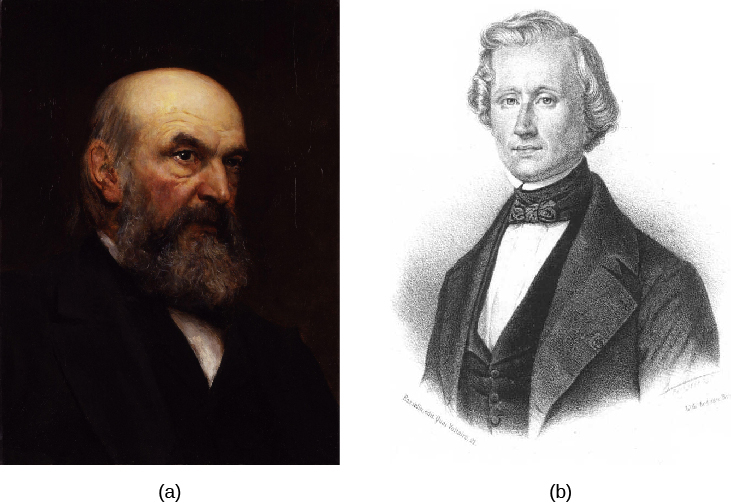
About a month later, Le Verrier suggested to Johann Galle, an astronomer at the Berlin Observatory, that he look for the planet. Galle received Le Verrier’s letter on September 23, 1846, and, possessing new charts of the Aquarius region, found and identified the planet that very night. It was less than a degree from the position Le Verrier predicted. The discovery of the eighth planet, now known as Neptune (the Latin name for the god of the sea), was a major triumph for gravitational theory for it dramatically confirmed the generality of Newton’s laws. The honor for the discovery is properly shared by the two mathematicians, Adams and Le Verrier (Figure 3.14).
英語のヒント
約1か月後、ルヴェリエはベルリン天文台の天文学者ヨハン・ガレに、その惑星を探すよう提案した。ガレがルヴェリエの手紙を受け取ったのは1846年9月23日だった。みずがめ座の領域の新しい星図を持っていたガレは、その夜のうちに惑星を発見し、それと確認した。その位置は、ルヴェリエの予測から1°も離れていなかった。この8番目の惑星は、現在では海の神を表すラテン語の名に由来するネプチューン、すなわち海王星と呼ばれている。その発見は、ニュートンの法則が広く成り立つことを劇的に確かめたため、重力理論にとって大きな勝利だった。発見の栄誉は、2人の数学者、アダムズとルヴェリエの双方に帰せられるべきである(図3.14)。
Mathematicians Who Discovered a Planet.惑星を発見した数学者たち。
OpenStax / Rice University · CC BY 4.0
Figure 3.14 (a) John Couch Adams (1819–1892) and (b) Urbain J. J. Le Verrier (1811–1877) share the credit for discovering the planet Neptune.
図3.14 (a)ジョン・クーチ・アダムズ(1819〜1892年)と、(b)ユルバン・J・J・ルヴェリエ(1811〜1877年)は、ともに海王星発見の功績を認められている。
We should note that the discovery of Neptune was not a complete surprise to astronomers, who had long suspected the existence of the planet based on the “disobedient” motion of Uranus. On September 10, 1846, two weeks before Neptune was actually found, John Herschel, son of the discoverer of Uranus, remarked in a speech before the British Association, “We see [the new planet] as Columbus saw America from the shores of Spain. Its movements have been felt trembling along the far-reaching line of our analysis with a certainty hardly inferior to ocular demonstration.”
英語のヒント
海王星の発見は、天文学者にとってまったく予想外の出来事ではなかったことに注意しよう。天王星の「言うことを聞かない」運動から、彼らは長らく、この惑星が存在するのではないかと考えていた。実際に海王星が見つかる2週間前の1846年9月10日、天王星発見者の息子ジョン・ハーシェルは、英国科学振興協会での講演で次のように語った。「われわれには[新しい惑星が]見えている。スペインの岸辺からコロンブスにアメリカが見えていたように。その運動は、遠くまで伸びるわれわれの解析の糸に沿って震えとして感じ取られている。しかも、その確かさは、目で見て確かめることにほとんど劣らない。」
This discovery was a major step forward in combining Newtonian theory with painstaking observations. Such work continues in our own times with the discovery of planets around other stars.
英語のヒント
この発見は、ニュートンの理論と丹念な観測を結びつけるうえで、大きな前進だった。こうした研究は、ほかの恒星を回る惑星の発見という形で、現代も続いている。