第3章軌道と重力Orbits and Gravity
3.2 Newton’s Great Synthesis3.2 ニュートンによる大いなる統合
Learning Objectives学習の目標
By the end of this section, you will be able to:
この節を学ぶと、次のことができるようになる。
Describe Newton’s three laws of motion
ニュートンの運動の三法則を述べる。
Explain how Newton’s three laws of motion relate to momentum
ニュートンの運動の三法則と運動量の関係を説明する。
Define mass, volume, and density and how they differ
質量、体積、密度を定義し、それぞれの違いを説明する。
Define angular momentum
角運動量を定義する。
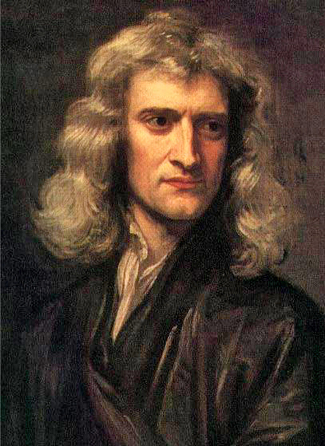
It was the genius of Isaac Newton that found a conceptual framework that completely explained the observations and rules assembled by Galileo, Brahe, Kepler, and others. Newton was born in Lincolnshire, England, in the year after Galileo’s death (Figure 3.6). Against the advice of his mother, who wanted him to stay home and help with the family farm, he entered Trinity College at Cambridge in 1661 and eight years later was appointed professor of mathematics. Among Newton’s contemporaries in England were architect Christopher Wren, authors Aphra Behn and Daniel Defoe, and composer G. F. Handel.
英語のヒント
ガリレオ、ブラーエ、ケプラーらが積み上げた観測と規則を完全に説明する、概念の枠組みを見いだしたのは、アイザック・ニュートンの天才であった。ニュートンは、ガリレオが亡くなった翌年、イングランドのリンカンシャーに生まれた(図3.6)。家に残って農場を手伝ってほしいという母親の勧めに反し、1661年にケンブリッジのトリニティ・カレッジに入り、8年後に数学教授に任命された。当時のイングランドには、建築家クリストファー・レン、作家アフラ・ベーンとダニエル・デフォー、作曲家G. F. ヘンデルといった、ニュートンと同時代の人々がいた。
Isaac Newton (1643–1727), 1689 Portrait by Sir Godfrey Kneller.アイザック・ニュートン(1643〜1727年)。ゴドフリー・ネラー卿による1689年の肖像画。
OpenStax / Rice University · CC BY 4.0
Figure 3.6 Isaac Newton’s work on the laws of motion, gravity, optics, and mathematics laid the foundations for much of physical science.
図3.6 運動法則、重力、光学、数学に関するアイザック・ニュートンの仕事は、物理科学の多くの分野の基礎を築いた。
Newton’s Laws of Motionニュートンの運動法則
As a young man in college, Newton became interested in natural philosophy, as science was then called. He worked out some of his first ideas on machines and optics during the plague years of 1665 and 1666, when students were sent home from college. Newton, a moody and often difficult man, continued to work on his ideas in private, even inventing new mathematical tools to help him deal with the complexities involved. Eventually, his friend Edmund Halley (profiled in Comets and Asteroids: Debris of the Solar System) prevailed on him to collect and publish the results of his remarkable investigations on motion and gravity. The result was a volume that set out the underlying system of the physical world, Philosophiae Naturalis Principia Mathematica. The Principia, as the book is generally known, was published at Halley’s expense in 1687.
英語のヒント
大学で学ぶ青年だったニュートンは、当時、科学がそう呼ばれていた自然哲学に関心を持った。ペストのため学生が大学から帰郷させられた1665年と1666年に、機械や光学に関する初期の考えのいくつかをまとめた。気分屋で、しばしば付き合いにくい人物でもあったニュートンは、自分の考えを人知れず研究し続け、そこに伴う複雑さに対処するため、新しい数学的な道具まで発明した。やがて友人のエドモンド・ハレーが、運動と重力についての優れた研究結果をまとめて出版するよう、彼を説き伏せた。ハレーについては「彗星と小惑星――太陽系に残されたかけら」で紹介する。その結果が、物理的な世界の根底にある体系を述べた著書『自然哲学の数学的諸原理(Philosophiae Naturalis Principia Mathematica)』である。通称『プリンキピア』は、1687年にハレーの費用負担で出版された。
At the very beginning of the Principia, Newton proposes three laws that would govern the motions of all objects:
『プリンキピア』の冒頭で、ニュートンは、あらゆる物体の運動を支配する三つの法則を提案している。
Newton’s first law: Every object will continue to be in a state of rest or move at a constant speed in a straight line unless it is compelled to change by an outside force.
英語のヒント
ニュートンの第一法則:すべての物体は、外からの力によって変化を強いられないかぎり、静止の状態、または一定の速さで直線上を動く状態を保ち続ける。
Newton’s second law: The change of motion of a body is proportional to and in the direction of the force acting on it.
ニュートンの第二法則:物体の運動の変化は、その物体に働く力に比例し、力と同じ方向に起こる。
Newton’s third law: For every action there is an equal and opposite reaction (or: the mutual actions of two bodies upon each other are always equal and act in opposite directions).
英語のヒント
ニュートンの第三法則:あらゆる作用には、大きさが等しく向きが反対の反作用がある。言い換えると、二つの物体が互いに及ぼす作用は、常に大きさが等しく、反対向きに働く。
In the original Latin, the three laws contain only 59 words, but those few words set the stage for modern science. Let us examine them more carefully.
元のラテン語では、この三法則はわずか59語である。しかし、その短い言葉が、近代科学の舞台を整えた。もう少し詳しく調べてみよう。
Interpretation of Newton’s Lawsニュートンの法則を読み解く
Newton’s first law is a restatement of one of Galileo’s discoveries, called the conservation of momentum. The law states that in the absence of any outside influence, there is a measure of a body’s motion, called its momentum, that remains unchanged. You may have heard the term momentum used in everyday expressions, such as “This bill in Congress has a lot of momentum; it’s going to be hard to stop.”
英語のヒント
ニュートンの第一法則は、ガリレオの発見の一つである、運動量の保存を言い換えたものである。この法則は、外部からの作用がなければ、物体の運動を測る量である運動量が、変化せず保たれると述べる。英語の momentum という言葉を、日常の表現で聞いたことがあるかもしれない。たとえば「議会のこの法案には大きな勢いがある。止めるのは難しいだろう」というときの「勢い」に、この語が使われる。
Newton’s first law is sometimes called the law of inertia, where inertia is the tendency of objects (and legislatures) to keep doing what they are already doing. In other words, a stationary object stays put, and a moving object keeps moving unless some force intervenes.
英語のヒント
ニュートンの第一法則は、慣性の法則と呼ばれることもある。慣性とは、物体が、そして議会も、すでにしていることを続けようとする性質である。言い換えると、何らかの力が介入しないかぎり、静止した物体はその場にとどまり、動いている物体は動き続ける。
Let’s define the precise meaning of momentum—it depends on three factors: (1) speed—how fast a body moves (zero if it is stationary), (2) the direction of its motion, and (3) its mass—a measure of the amount of matter in a body, which we will discuss later. Scientists use the term velocity to describe the speed and direction of motion. For example, 20 kilometers per hour due south is velocity, whereas 20 kilometers per hour just by itself is speed. Momentum then can be defined as an object’s mass times its velocity.
英語のヒント
運動量の正確な意味を定義しよう。運動量は三つの要素に依存する。(1)速さ、つまり物体がどれほど速く動くかで、静止していればゼロである。(2)運動の方向。(3)質量、つまり物体に含まれる物質の量を測る量で、これについては後で説明する。科学者は、運動の速さと方向をまとめて表すために、速度という語を使う。たとえば「真南へ毎時20キロメートル」は速度であるが、単に「毎時20キロメートル」だけなら速さである。すると運動量は、物体の質量にその速度を掛けたものと定義できる。
It’s not so easy to see this rule in action in the everyday world because of the many forces acting on a body at any one time. One important force is friction, which generally slows things down. If you roll a ball along the sidewalk, it eventually comes to a stop because the sidewalk exerts a rubbing force on the ball. But in the space between the stars, where there is so little matter that friction is insignificant, objects can in fact continue to move (to coast) indefinitely.
英語のヒント
日常の世界では、同時に多くの力が物体に働くため、この規則の働きを見て取るのは、それほど簡単ではない。重要な力の一つが、一般に物の動きを遅くする摩擦である。歩道の上で球を転がすと、歩道が球にこする力を及ぼすため、やがて止まる。しかし恒星の間の空間では、物質が非常に少なく、摩擦は無視できるほどなので、物体は実際に、いつまでも惰性で動き続けられる。
The momentum of a body can change only under the action of an outside influence. Newton’s second law expresses force in terms of its ability to change momentum with time. A force (a push or a pull) has both size and direction. When a force is applied to a body, the momentum changes in the direction of the applied force. This means that a force is required to change either the speed or the direction of a body, or both—that is, to start it moving, to speed it up, to slow it down, to stop it, or to change its direction.
英語のヒント
物体の運動量が変わるのは、外部から作用が加わるときだけである。ニュートンの第二法則は、運動量を時間とともに変える能力によって、力を表す。押すことや引くことである力には、大きさと向きの両方がある。物体に力を加えると、運動量は加えた力の向きに変化する。つまり、物体の速さ、方向、あるいはその両方を変えるには、力が必要である。具体的には、動かし始める、速くする、遅くする、止める、向きを変えるといったことである。
As you learned in Observing the Sky: The Birth of Astronomy, the rate of change in an object’s velocity is called acceleration. Newton showed that the acceleration of a body was proportional to the force being applied to it. Suppose that after a long period of reading, you push an astronomy book away from you on a long, smooth table. (We use a smooth table so we can ignore friction.) If you push the book steadily, it will continue to speed up as long as you are pushing it. The harder you push the book, the larger its acceleration will be. How much a force will accelerate an object is also determined by the object’s mass. If you kept pushing a pen with the same force with which you pushed the textbook, the pen—having less mass—would be accelerated to a greater speed.
英語のヒント
「空を観測する――天文学の誕生」で学んだように、物体の速度の変化率を加速度と呼ぶ。ニュートンは、物体の加速度が、その物体に加えられる力に比例することを示した。長い間読書をした後、長く滑らかな机の上で、天文学の本を向こうへ押すとしよう。滑らかな机を使うのは、摩擦を無視できるようにするためである。本を一定の力で押し続ければ、押している間、本は速くなり続ける。強く押すほど、加速度は大きくなる。ある力がどれほど物体を加速させるかは、物体の質量によっても決まる。教科書を押したのと同じ力でペンを押し続ければ、ペンのほうが質量が小さいため、より大きな速さまで加速される。
Newton’s third law is perhaps the most profound of the rules he discovered. Basically, it is a generalization of the first law, but it also gives us a way to define mass. If we consider a system of two or more objects isolated from outside influences, Newton’s first law says that the total momentum of the objects should remain constant. Therefore, any change of momentum within the system must be balanced by another change that is equal and opposite so that the momentum of the entire system is not changed.
英語のヒント
ニュートンの第三法則は、おそらく彼が発見した規則の中で最も深い意味を持つものである。基本的には第一法則を一般化したものであるが、質量を定義する方法も与えてくれる。外部からの影響を受けない、二つ以上の物体からなる系を考えると、第一法則によれば、それらの物体の運動量の総和は一定に保たれるはずである。したがって、系の内部で運動量が変化したら、系全体の運動量が変わらないように、大きさが等しく向きが反対の別の変化によって、必ず釣り合わされなければならない。
This means that forces in nature do not occur alone: we find that in each situation there is always a pair of forces that are equal to and opposite each other. If a force is exerted on an object, it must be exerted by something else, and the object will exert an equal and opposite force back on that something. We can look at a simple example to demonstrate this.
英語のヒント
これは、自然界の力が単独では生じないという意味である。どの場合にも、互いに大きさが等しく向きが反対の、一対の力があるのである。ある物体に力が及ぼされるなら、それを及ぼす別の何かが必ずあり、その物体も、相手に大きさが等しく反対向きの力を及ぼす。簡単な例で確かめよう。
Suppose that a daredevil astronomy student—and avid skateboarder—wants to jump from his second-story dorm window onto his board below (we don’t recommend trying this!). The force pulling him down after jumping (as we will see in the next section) is the force of gravity between him and Earth. Both he and Earth must experience the same total change of momentum because of the influence of these mutual forces. So, both the student and Earth are accelerated by each other’s pull. However, the student does much more of the moving. Because Earth has enormously greater mass, it can experience the same change of momentum by accelerating only a very small amount. Things fall toward Earth all the time, but the acceleration of our planet as a result is far too small to be measured.
英語のヒント
向こう見ずな天文学の学生で、熱心なスケートボーダーでもある人が、寮の2階の窓から、下に置いたボードへ飛び降りようとしているとする。これは試してはならない。飛び降りた後に彼を下へ引く力は、次の節で見るように、彼と地球の間の重力である。この相互の力の作用により、彼も地球も、運動量の変化の大きさは同じでなければならない。したがって、学生も地球も、互いの引力によって加速される。しかし、実際に大きく動くのは学生のほうである。地球の質量は桁違いに大きいため、ほんのわずかに加速されるだけで、同じ大きさの運動量の変化を得られる。物は絶えず地球へ落ちているが、その結果生じる地球の加速度は、測れないほど小さいのである。
A more obvious example of the mutual nature of forces between objects is familiar to all who have batted a baseball. The recoil you feel as you swing your bat shows that the ball exerts a force on it during the impact, just as the bat does on the ball. Similarly, when a rifle you are bracing on your shoulder is discharged, the force pushing the bullet out of the muzzle is equal to the force pushing backward upon the gun and your shoulder.
英語のヒント
物体間の力の相互性を示す、もっとわかりやすい例は、野球のボールを打ったことがある人なら誰でも知っている。バットを振ったときに感じる反動は、衝突の間、バットが球に力を及ぼすのと同じように、球もバットに力を及ぼしていることを示す。同様に、肩に当てて構えたライフルを発射すると、銃口から弾丸を押し出す力は、銃と肩を後ろへ押す力と等しくなる。
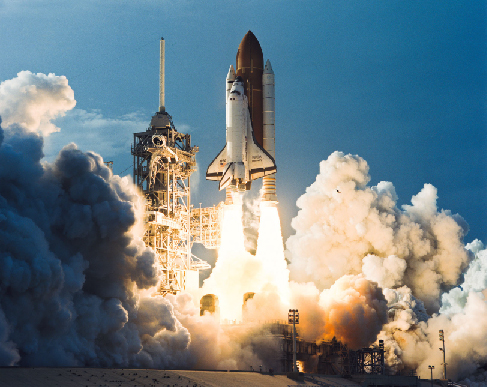
This is the principle behind jet engines and rockets: the force that discharges the exhaust gases from the rear of the rocket is accompanied by the force that pushes the rocket forward. The exhaust gases need not push against air or Earth; a rocket actually operates best in a vacuum (Figure 3.7).
英語のヒント
これが、ジェットエンジンやロケットの背後にある原理である。ロケットの後部から排気ガスを噴き出す力には、ロケットを前へ押す力が伴う。排気ガスが空気や地面を押す必要はない。実際、ロケットは真空中で最もよく働く(図3.7)。
Demonstrating Newton’s Third Law.ニュートンの第三法則の実演
credit: modification of work by NASA · NASA media use guidelines
Figure 3.7 The U.S. Space Shuttle (here launching Discovery), powered by three fuel engines burning liquid oxygen and liquid hydrogen, with two solid fuel boosters, demonstrates Newton’s third law. (credit: modification of work by NASA)
図3.7 アメリカのスペースシャトル(ここではディスカバリーの打ち上げ)は、液体酸素と液体水素を燃やす3基のエンジンと、2基の固体燃料補助ロケットによって推進され、ニュートンの第三法則を示している。(クレジット:NASAの作品を改変)